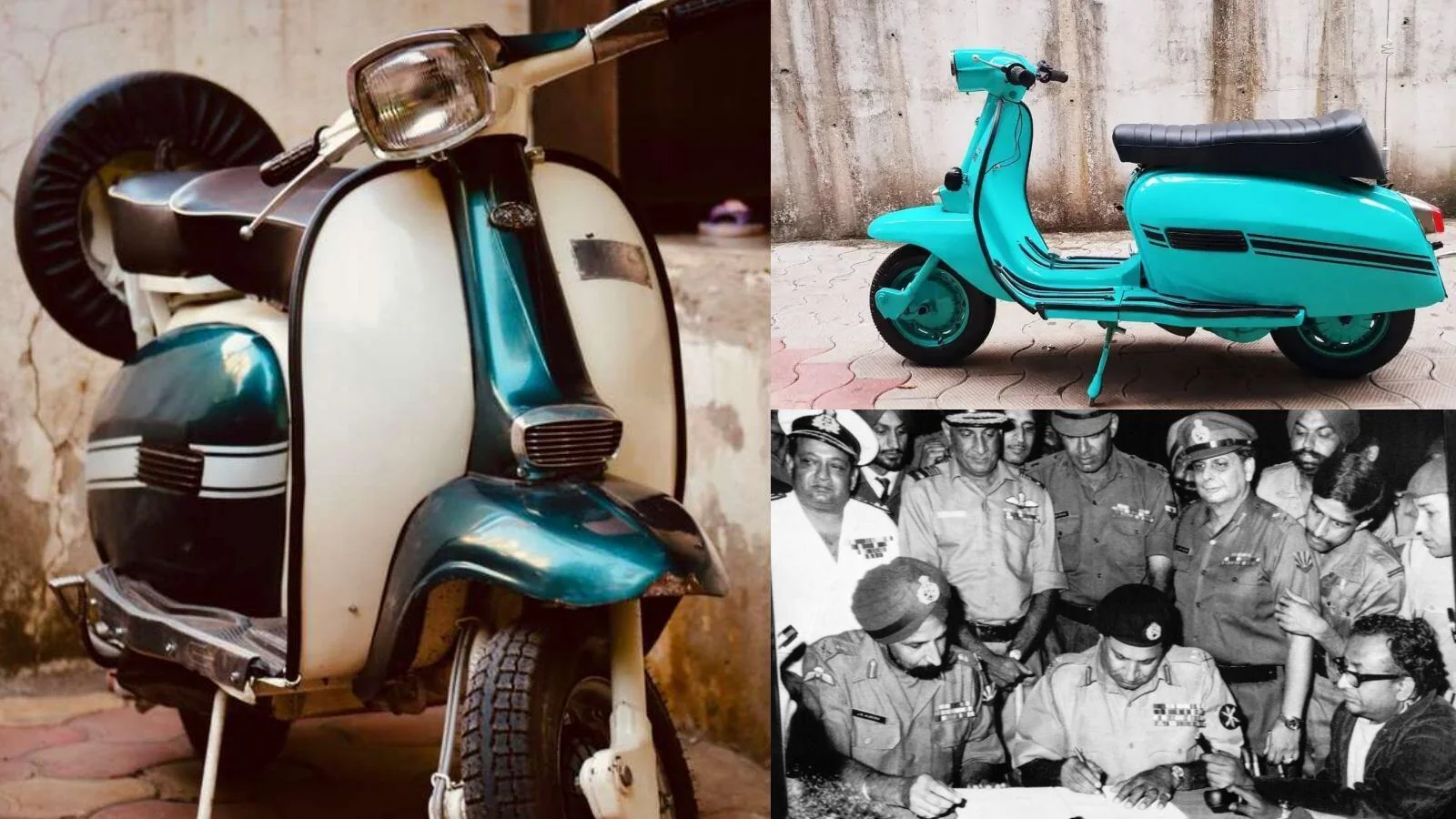
When the Indian cricket team won its first World Cup in 1983, the government gifted every player a Vijay Super scooter. In the seventies and eighties, long before Hamara Bajaj reached every home, the Vijay Super was the first choice of the Indian middle class, and its name carried the memory of a war victory.
The scooter took its name from India's victory in the 1971 war with Pakistan. It became a symbol of that win on Indian roads, and its styling and performance gave an entire era its identity.
Born in Lucknow in 1972
The foundation of the Vijay Super was laid in 1972, when the then Prime Minister Indira Gandhi laid the foundation stone of the public sector unit Scooters India Limited in Lucknow. The government bought all the equipment and production rights of the Italian company Innocenti and started manufacturing the scooter in India.
Three years later, Scooters India upgraded its Vijay and Deluxe DL models and began selling the improved scooter as the Vijay Super. The name Vijay, meaning victory, was chosen in honour of India's historic win in the 1971 war.
A runaway hit of the seventies and eighties
In the seventies and eighties, the Vijay Super became a well known name in the Indian automobile market. Its sleek design, unique headlight, easy to read speedometer and centre mounted engine made it an instant hit with buyers, and it was promoted as the best deal on the roads.
The craze for the scooter grew so strong that when India won its first cricket World Cup in 1983, the government gifted a Vijay Super to every member of the winning team. The scooter had become part of the country's popular culture, a machine the middle class aspired to own.
The company later stepped into the three-wheeler market as well, building three-wheelers under the Vikram and Lambro brand names. For a time, the Vijay Super and its three-wheeler siblings carried the Scooters India name across the country.
Competition arrives, production ends in 1997
The nineties brought harder times. New models such as Bajaj's Chetak and Priya arrived, and a shortage of spare parts and mechanics weakened the Vijay Super's hold on the market. With little product variety and no new technical innovation, Scooters India slipped into heavy losses.
In 1997, the company stopped production of the Vijay Super scooter completely and put its full focus on Vikram three-wheeler manufacturing. Even in the three-wheeler segment, it faced tough competition from rivals, and the losses continued.
Revival attempts and a hope of return
The government tried to save the company. In 2011, it proposed a revival package of Rs 202 crore. The plant cut energy costs and reduced the weight of its vehicles, and the company made a profit for a short while, but it was not enough to stop the continuing losses.
In 2016, the NITI Aayog placed Scooters India on its list of loss-making public sector units and recommended disinvestment. In 2018, tenders were invited to sell the Centre's 93.47 percent stake in the company, but no buyer showed interest.
Today, the brand that once ruled Indian roads looks for a way back through electric vehicle technology. The Vijay Super is gone from the showrooms, but for a generation that grew up with it, the scooter remains a reminder of a time when an Indian made machine, named after a war victory, carried the middle class.