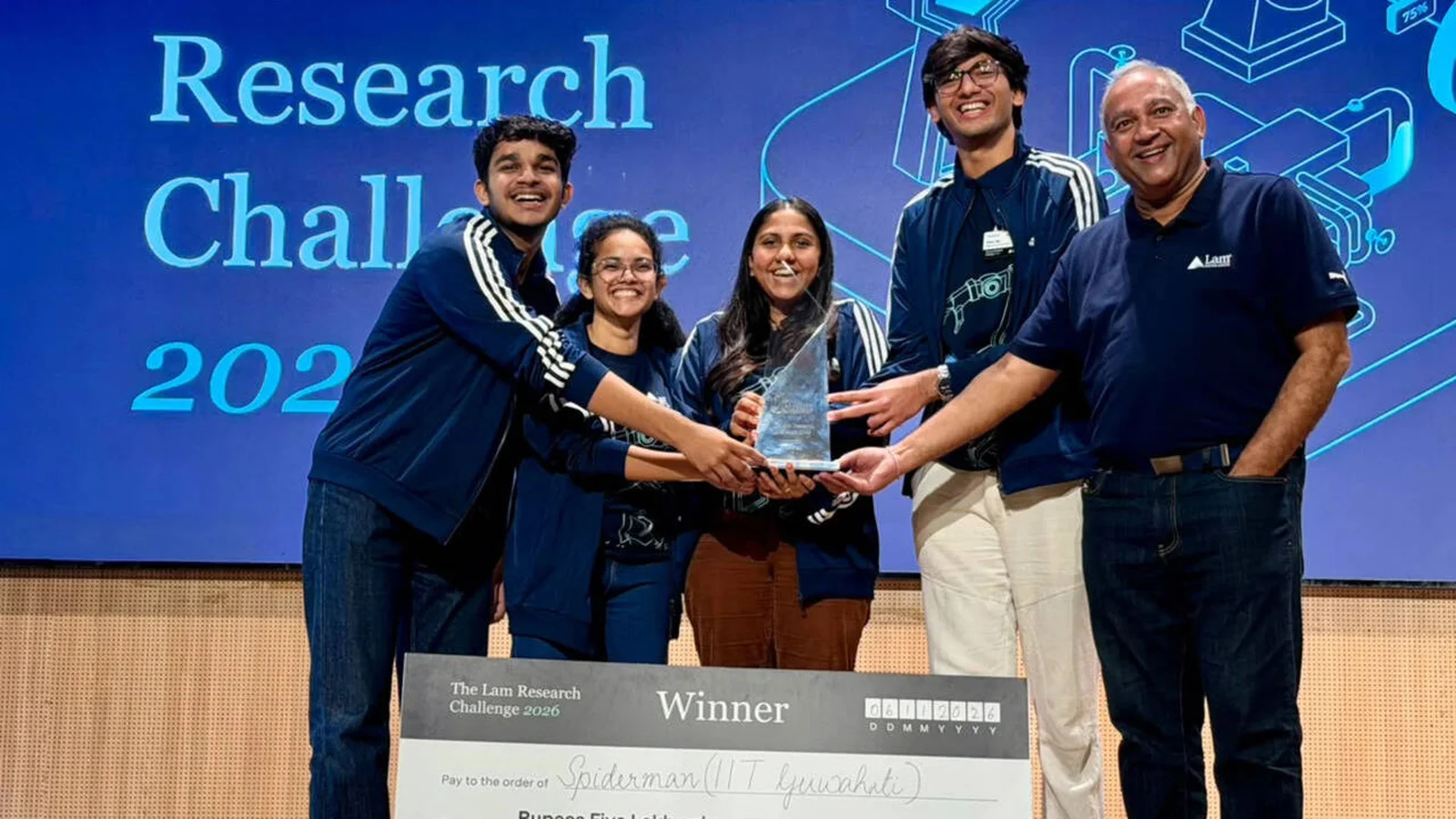
IIT Guwahati emerged as the overall winner of the third edition of the Lam Research Challenge 2026, an industry-led semiconductor systems engineering competition that brought together more than 3,000 students from engineering institutions across India.
IIT Ropar secured the runner-up position, while NIT Calicut finished third. The winners were announced at the grand finale held at PES University, Bengaluru. The top teams shared prize money worth Rs 10 lakh, while select participants will also get internship opportunities with Lam Research.
The competition attracted 803 teams from 189 colleges across India. Each team comprised four students from multidisciplinary backgrounds, and the finalists included students from 10 IITs, two NITs and two BITS campuses.
A three-month contest of hardware and systems
Following a three-month selection process involving qualification and hardware-building rounds, 25 teams representing 20 colleges advanced to the finale. The final round asked teams to work on complex technical challenges that required them to combine hardware, software, automation, data science, process engineering and advanced controls.
As part of the challenge, teams built a table-top paint factory capable of automatically mixing three base colours to produce three litres of a target colour, matching a reference sample in the first attempt. Since paint could be added but not removed, the task demanded precision in calculating and dosing the colours.
On the second day, teams automated the entire process through a single button press, integrating pipeline flushing, tank cooling and colour dosing without human intervention. The task tested exactly the kind of systems thinking used in semiconductor manufacturing operations.
A multidisciplinary winning team
The winning IIT Guwahati team comprised Suhani Maheswari from Electronics and Communication Engineering, Aakash Kumar Meena from Mechanical Engineering, Shrut Jain and Kummari Premaja from Electrical and Electronics Engineering. The mix of disciplines showed the multidisciplinary approach the challenge rewards.
The IIT Ropar team included students from Mechanical Engineering and Engineering Physics, while the NIT Calicut team comprised students from Mechanical Engineering, Electrical and Electronics Engineering and Computer Science Engineering.
Unlike conventional engineering competitions that focus on individual disciplines, the challenge emphasised systems-level thinking and the ability to develop integrated solutions for complex semiconductor manufacturing operations. Entries were evaluated on innovation, technical excellence, collaboration, problem-solving and performance under pressure.
Building the next generation of innovators
Rangesh Raghavan, corporate vice-president and managing director of Lam Research India, said the challenge was designed to help students build these capabilities while gaining exposure to the kinds of engineering problems shaping the future of the industry. He said it further demonstrated the company's continuing commitment to inspire the next generation of innovators.
For the winning students, the prize money and the internship opportunities with Lam Research are a direct route into the semiconductor industry. For the competition, the third edition showed how deep student interest in systems engineering now runs across India.