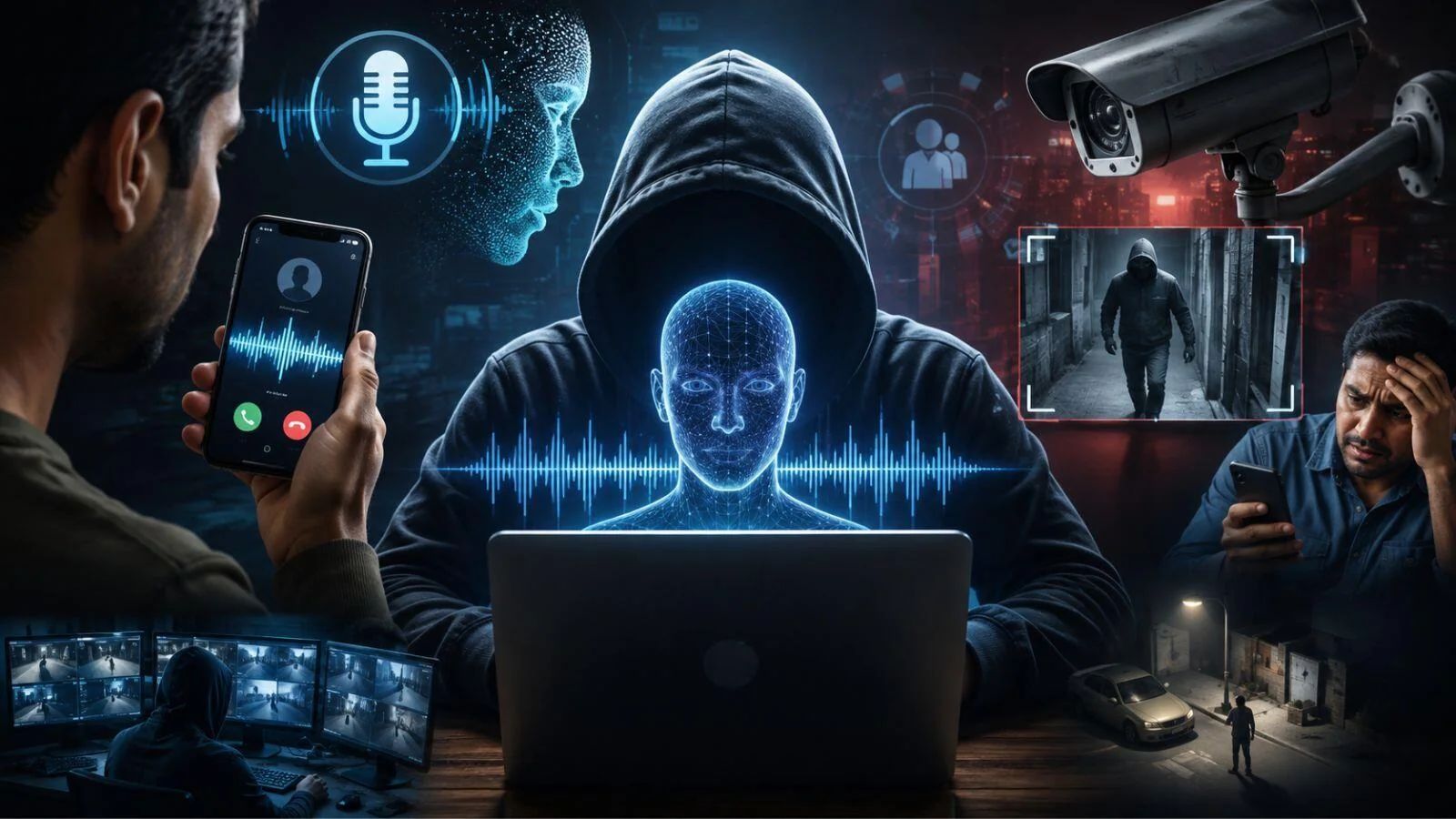
Artificial intelligence is changing the way people work, and cyber criminals are using the same technology to make fraud, blackmail and identity theft more convincing. In some cases a voice is cloned so closely that crores of rupees are transferred, and in others an AI-made video is passed off as real CCTV footage.
The Ministry of Electronics and Information Technology said in a statement in July 2026 that deepfake videos and AI-generated content are a growing problem. The statement said people are being tricked using faces, images and voices, and the government has said there are no clear rules for detecting such content yet. The ministry said India recorded 19,18,000 cyber crime cases in 2024, up from 15,56,218 cases in 2023, 9,66,790 cases in 2022 and 3,94,499 cases in 2019.
Cases from different parts of the country show that the use of AI in crime is no longer a new model, with five incidents from Delhi, Ahmedabad, Ghaziabad and Indore showing how criminals are putting the technology to use.
Cloned voice used in a fraud of over Rs 10 crore
In June, Delhi Police arrested five people in a case of alleged fraud through AI-based voice cloning. Police said the gang cloned the voice of the managing director of a Mumbai company, and then contacted the company's deputy general manager posing as a senior officer and asked for money to be transferred to different accounts.
Investigators found that the money was routed through 63 bank accounts, and the total amount was more than Rs 10 crore. The case came to light when one of the accused went to a bank to encash a cheque of Rs 9 lakh, and the bank manager grew suspicious of the transaction, after which the investigation moved forward.
The role of AI in this case matters, because the investigators said the gang used AI to create fake identity cards and other documents. These were used to open bank accounts and build the network that the fraud worked through.
Fake CCTV video and a deepfake to beat Aadhaar checks
Delhi Police recently arrested a 24-year-old man in a case involving an AI-generated video that showed ACP Vivek Bhagat allegedly misbehaving with a woman. The video was circulated on social media as CCTV footage from a protest site.
According to Delhi Police, AI tools were used to create an artificial profile of the woman and to change her voice. The accused was identified as Naseem Ahmed Amin, a resident of West Bengal, who is alleged to have created the fake video using the AI tool of a social media platform.
In Ahmedabad in April, police arrested four people who were allegedly cheating people by posing as a fake company. Police said the accused used deepfake videos to beat Aadhaar-based biometric verification.
Blackmail and a fake kidnapping video
In Ghaziabad, police arrested four people who were accused of being involved in a video-call fraud, in which the accused allegedly threatened a woman, stole digital money from her account, and then threatened to post her intimate photographs on social media.
During a video call the victim was recorded, and the footage was used to make a nude video with the help of AI, and then the victim was threatened. The gang is also accused of demanding $50,000 for the removal of certain things.
In Indore in February, a man was arrested after he allegedly lost Rs 1 lakh in a fraud that used a fake video call. Police said the victim got a call in which the caller had been shown in a video as his nephew, accusing him of being stranded somewhere and asking for money in an emergency.
The five cases together show the many ways AI is now being used in crime. From cloned voices and fake videos to deepfakes and fake chatbots, the cases show that criminals are now using tools that make old scams harder to spot.