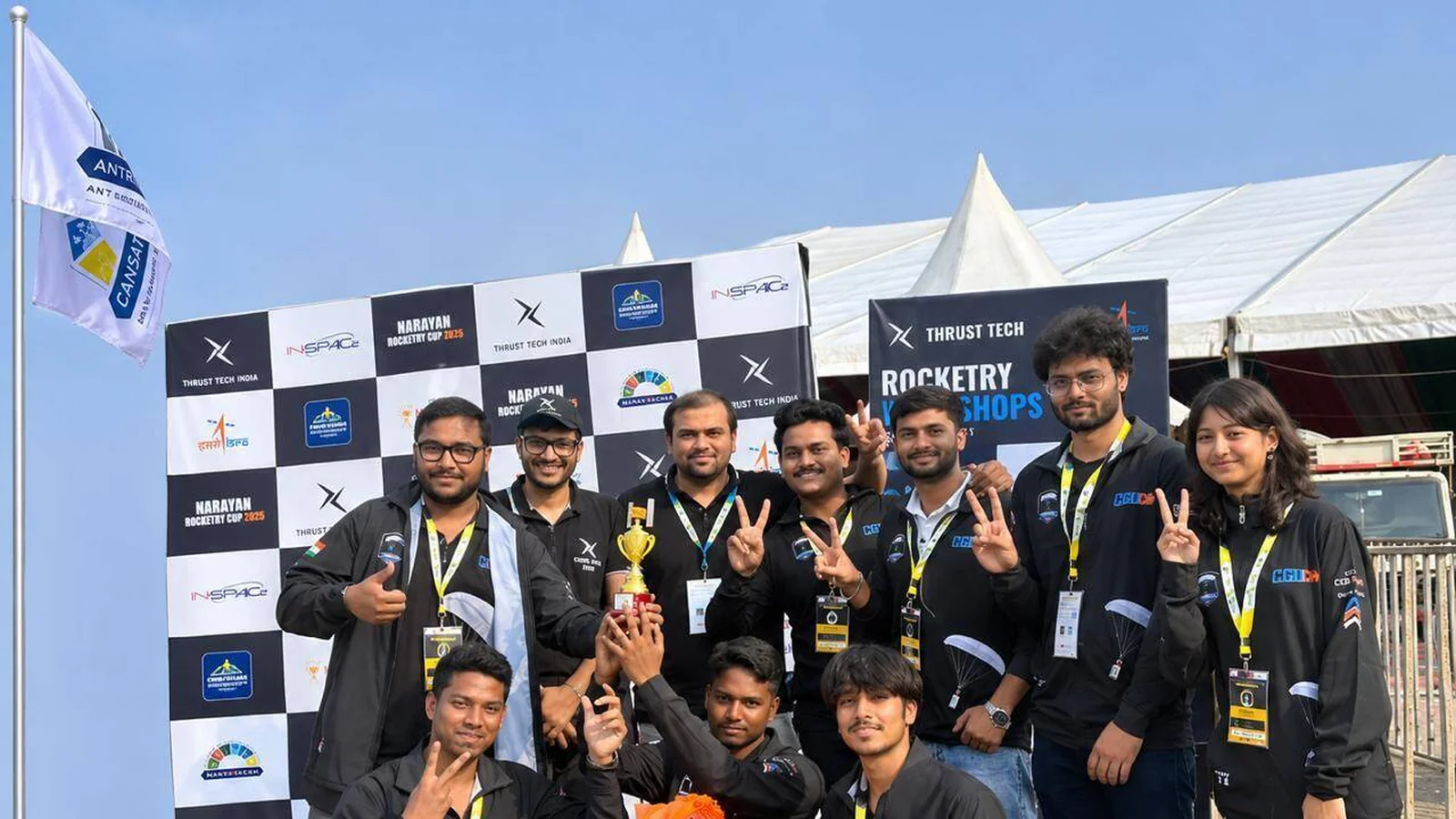
Students of C V Raman Global University (CGU), Odisha, secured the second prize in the national-level model rocketry and CanSat competition organised by IN-SPACe, in collaboration with ISRO, in Uttar Pradesh. The university team successfully demonstrated an indigenously developed CanSat through a rocket launch.
The team met the technical parameters set for the competition, which covered sensor performance, the landing mechanism and other prescribed criteria. A CanSat is a small satellite built to fit inside a soft drink can, and it must carry out its tasks after being launched and landing safely.
The competition saw 43 universities reach the final round out of 69 that qualified in the initial phase. The eight-member CGU team finished second among those 43 finalists, a result that put the Odisha university among the best student space teams in the country.
The contest is organised by IN-SPACe, the body that promotes private and student participation in India's space sector, working with ISRO. Its national competitions give students a first chance to build and fly real hardware.
Invited to present before ISRO scientists
The eight-member CGU team was among five universities invited to Bengaluru to present their detailed project reports before ISRO scientists during SPACE EXPO 2026. The invitation recognised the quality of the team's design and the results of its launch.
The students were mentored by Smita Rani Parija and Virender Singh of the electronics and communication engineering department. Their guidance helped the team build a CanSat that could survive a rocket launch and return useful data.
University president Sanjib Kumar Rout and vice-chancellor Banshidhar Majhi congratulated the team on its achievement. The result adds to a growing list of student space achievements from Odisha's universities.
What the competition tests
The national competition tests student teams on the full cycle of a small space mission, from designing and building the CanSat to launching it and recovering it. Teams must show that their sensors work, that the landing system protects the payload, and that the data collected is sound.
The CGU team's CanSat met those tests in the final round. The rocket launch was the centrepiece of the demonstration, and the team's indigenously developed hardware performed as designed through the flight and landing.
A step towards bigger space work
For the students, the second prize is a step towards bigger work in space technology. Presenting before ISRO scientists at SPACE EXPO 2026 gives the team a direct link to the country's space programme and to the scientists who run it.
The competition is part of a wider push to bring students into space research early. With 69 universities qualifying for the initial phase, the event showed how many campuses across India are now building small satellites and rockets of their own.