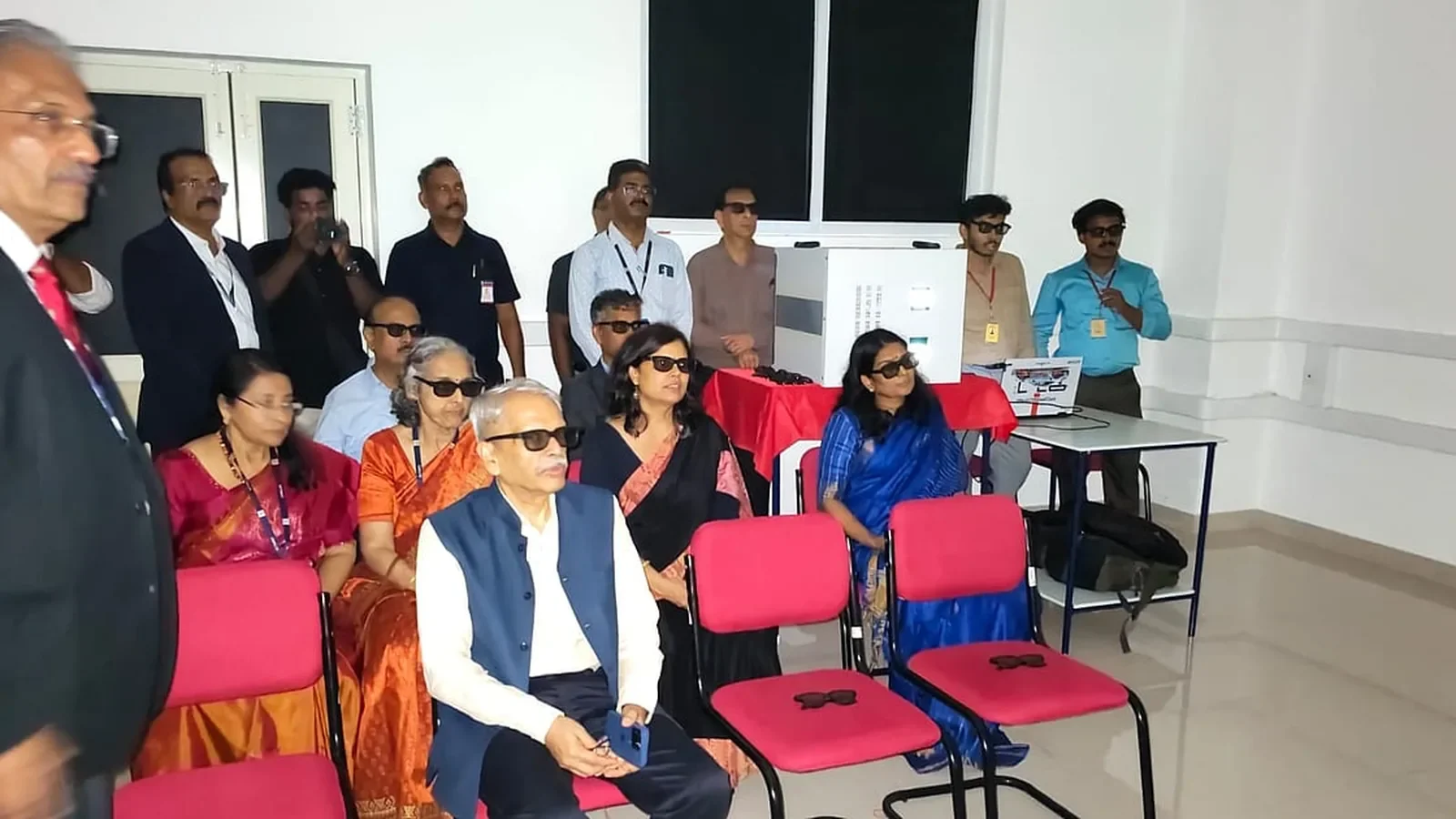
For the first time in India, the polarised-glasses technology behind 3D movies has found a medical use. A platform called StereoSurge converts routine CT and MRI scans into high-definition stereoscopic 3D models, so doctors can map a procedure in detail before surgery begins.
The technology is the same one that powered 3D cinema, including the Malayalam pioneer My Dear Kuttichathan. Where audiences once wore polarised glasses to watch a film, surgeons now wear them to study the inside of a patient's body in three dimensions.
StereoSurge was built jointly by the Sree Chitra Tirunal Institute for Medical Sciences and Technology, known as SCTIMST, and Barton Hill Government Engineering College in Thiruvananthapuram. It uses a dual-projection polarisation system with two projectors, a specialised silver screen, 3D glasses and custom software.
The system can be watched by around 200 viewers at once, which makes it useful for teaching in medical colleges as well as for planning individual operations. A whole classroom can study the same 3D model together instead of crowding around a single screen.
Built by students, taken forward by a startup
The idea was conceived by three students of the 2025 information technology batch, Anand S, Radev Krishna M R and Devadathan A. It was taken forward through incubation at SCTIMST-TIMed and their startup, Feraura Pvt Ltd.
A dedicated StereoSurge 3D Spatial Medicine Lab now runs at Thiruvananthapuram Government Medical College Hospital, and another unit works at SCTIMST Hospital. The platform has moved from a student project to a working facility inside two hospitals.
Its uses go beyond the operating theatre. StereoSurge supports pre-surgical planning, patient counselling and medical education, offering a third dimension alongside textbooks and cadaver dissection. Rare cases can also be preserved as 3D teaching models for future students.
Research and a lower cost
The platform is also being used for research, including the study of brain-volume change in Alzheimer's disease and the extent of brain tumours against nearby blood vessels. Seeing these structures in three dimensions gives researchers a clearer picture than flat scans alone.
There is a cost angle too. Imported anatomical-visualisation systems such as Anatomage can cost over Rs 1 crore, which puts them out of reach for many institutions. StereoSurge aims to make immersive 3D learning more accessible by building the capability in India at a lower cost.
The step from cinema to surgery is an unusual one, but the principle is the same: two slightly different images, one for each eye, combine into depth. In a cinema that depth entertains, and in a hospital it may help a surgeon plan a safer operation.