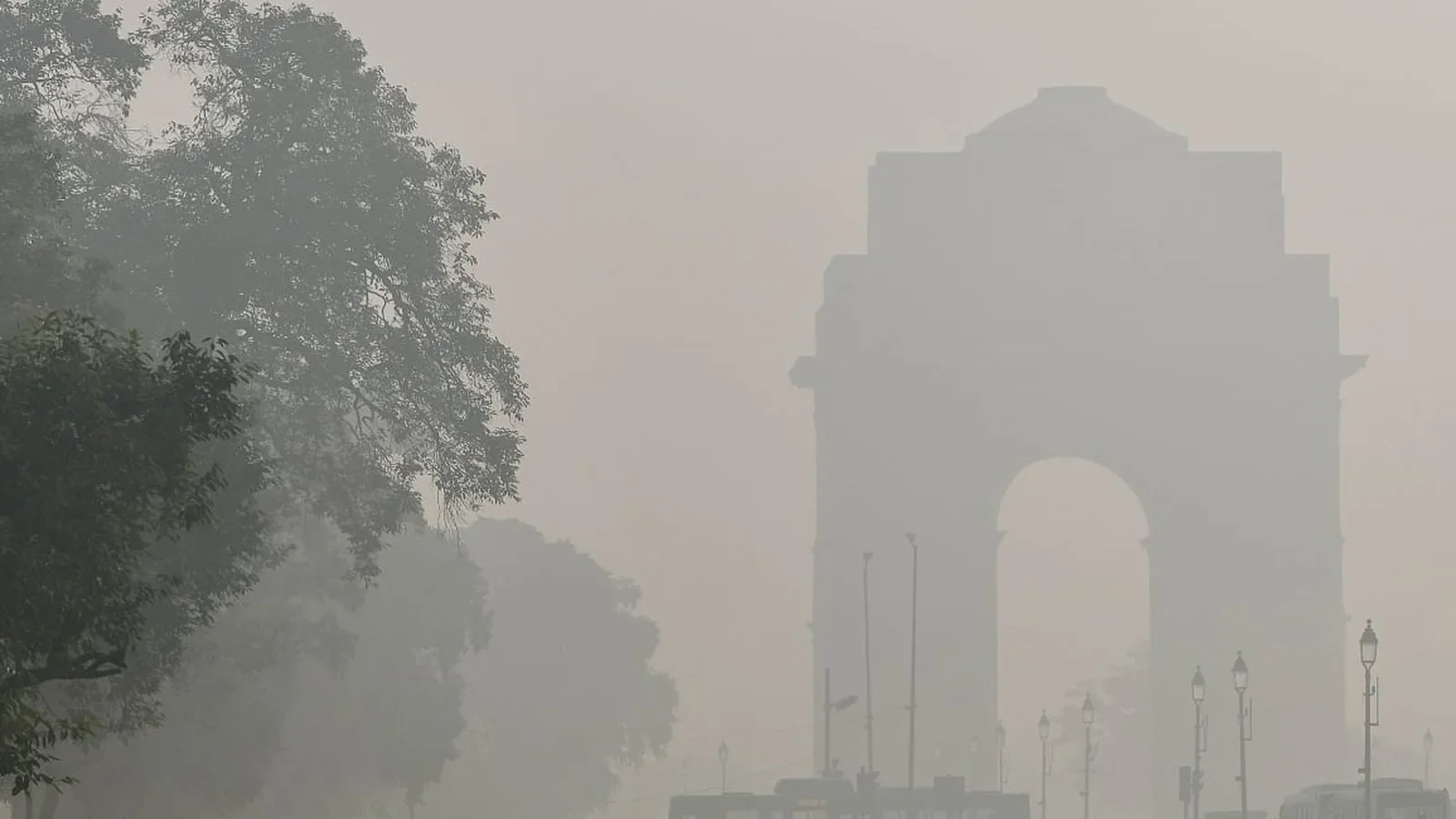
Delhi recorded its most polluted Diwali in five years, but the severity of the pollution was likely worse than official figures suggested, as several monitoring stations went offline on Sunday night during the peak period of firecracker use in the capital. The gap has raised questions over the reliability of the air quality monitoring exercise itself.
Experts tracking the figures in real time said key monitoring stations stopped reporting readings during the night, when pollution levels surged as Supreme Court-mandated restrictions on the use of fireworks were flouted. They also flagged significant discrepancies between readings reported by government and private monitoring agencies.
AQI readings published by private agencies painted a considerably worse picture than official figures, with most parts of Delhi-NCR reporting extremely hazardous pollution levels, according to the source report. The difference has prompted experts to question the government's data.
Delhi's average AQI was 376 on Diwali day, according to official data cited in the source report. The morning after was only marginally better, with an AQI of 371 recorded at 10 am on Monday, and the post-Diwali morning reading of 371 was also the worst since 2021, according to the source report.
How many stations stopped reporting
Data from Delhi's 59 air quality monitoring stations showed that the number of stations with missing readings rose sharply as Diwali night progressed, according to an analysis by the Centre for Research on Energy and Clean Air. Only one station had missing data at 7 pm on Sunday, and the number rose to seven by 10 pm and 23 by 11 pm.
By midnight, 29 stations were not reporting readings, with the number rising further to 36 at 1 am on Monday, according to the analysis. That meant only 23 of the city's 59 monitoring stations were reporting data at that time.
The number remained high at 2 am, when 35 stations had missing data, before gradually declining. At 3 am, 30 stations were not reporting readings, while the number fell to 20 by 4 am, 19 by 5 am and 16 by 6 am, according to the source report.
The situation gradually improved through the morning, with 13 stations reporting missing data at 7 am and seven at 8 am. By 9 am, only two stations were not reporting readings, while one continued to have missing data until 11 am, according to the source report.
Readings before the stations went blank
Several Delhi air quality monitoring stations, including those in RK Puram, Nehru Nagar, Mundka, Sonia Vihar and Dwarka, stopped displaying readings after 9 pm on Diwali night, according to a report on the outages. Before its data disappeared, RK Puram recorded PM2.5 levels of 924 micrograms per cubic metre.
The Jawaharlal Nehru University station continued reporting readings during the same period, according to the same report. Its PM2.5 concentration rose from 161 micrograms per cubic metre at 8 pm to 786 micrograms per cubic metre by 11 pm.
An analysis by the Centre for Research on Energy and Clean Air counted 227 missing hourly observations between midnight and 5 am across 59 stations, according to a report on the analysis. At 1 am, an analysis of 39 stations found only 13 reported PM2.5, while 38 continued reporting nitrogen dioxide, according to the same report.
What experts said
Anumita Roychowdhury, executive director of the Centre for Science and Environment, said the monitoring network's failure to provide real-time data was inexplicable despite substantial public investment in its establishment and maintenance. She said: "When substantial public funds have been invested in establishing Delhi-NCR's air quality monitoring network, the densest in the country, backed by active operation and maintenance contracts, a data eclipse precisely during peak Diwali pollution is inexplicable."
She said real-time data should have driven targeted public health advisories and calibrated emergency responses. She added: "While the severity of exposure is evident on the ground, credible official data is needed for institutional accountability, public awareness and mitigation. Losing data does not reduce the public health emergency."
Radhey Shyam Sharma, head of the Department of Environmental Studies at Delhi University, said transparency in air quality figures was essential, particularly during an emergency when people needed reliable information about their exposure to pollution. He said: "Transparency in data should be there. There is also the question of accountability. We are talking about an emergency situation, a severe emergency."
Sharma said the missing readings could create confusion and panic, and that the absence of data was not a solution to the capital's annual air pollution crisis. He said the monitoring system and its management needed to be improved rather than allowing data to go missing.
The official response and the political row
Responding to a question on the issue at a press conference, Delhi cabinet minister Kapil Mishra asked reporters to share details of AQI monitoring stations that were reportedly non-functional, adding that he would seek action on the matter, according to the source report.
The opposition criticised the authorities, with senior Aam Aadmi Party leader Saurabh Bharadwaj accusing the Delhi government of data fraud and alleging that it was manipulating air quality readings to understate pollution levels, putting people's lives at risk. That allegation has not been established, and it is reported here only as an allegation by the opposition.
Bharadwaj also alleged that the government had installed 20 new AQI monitoring stations in open and green areas with less traffic and lower population density to bring down the overall average. The Aam Aadmi Party had alleged that dozens of monitoring stations operated by the Central Pollution Control Board, the Delhi Pollution Control Committee, the India Meteorological Department and the Indian Institute of Tropical Meteorology had gone offline as pollution levels rose on Diwali night and resumed functioning the following morning.
A similar row erupted after Diwali last year, when the Aam Aadmi Party accused the BJP-led Delhi government of deliberately shutting down air quality monitoring stations to conceal rising pollution levels, according to the source report. Experts tracking the data in real time corroborated the allegations at that time, according to the source report.
Why the readings differed
While official data put Delhi's AQI at 370 at 8 am on Monday, private monitoring platforms reported considerably different figures, according to the source report. Swiss air quality monitoring platform IQAir recorded an AQI of 245 on the US scale in the very unhealthy category at 8.30 am, with PM2.5 concentrations at 170 micrograms per cubic metre, around 34 times the World Health Organisation's annual guideline value.
Meanwhile, AQI.in recorded an air quality reading of 637 in Delhi on Monday morning, classifying it as hazardous, according to the source report. The platform also reported that the city's AQI had peaked at 2,283 after Diwali, according to the source report.
Delhi's average AQI fell to 344 by 4 pm on Monday, compared with 376 at the same time on Diwali day, according to the source report. However, only 47 monitoring stations were recording data at 4 pm, of which 40 were in the very poor category and seven in the poor category. Bawana recorded the highest AQI at 396, followed by Burari at 393.
Punjab recorded the season's biggest single-day jump in farm fires on Diwali, with 1,152 fresh fires, according to the gather file. The state total rose to 4,459 from 3,307 on 7 November, according to the same file. Farm fires add to the regional pollution load, but the missing data in this story concerns the Delhi monitoring network.