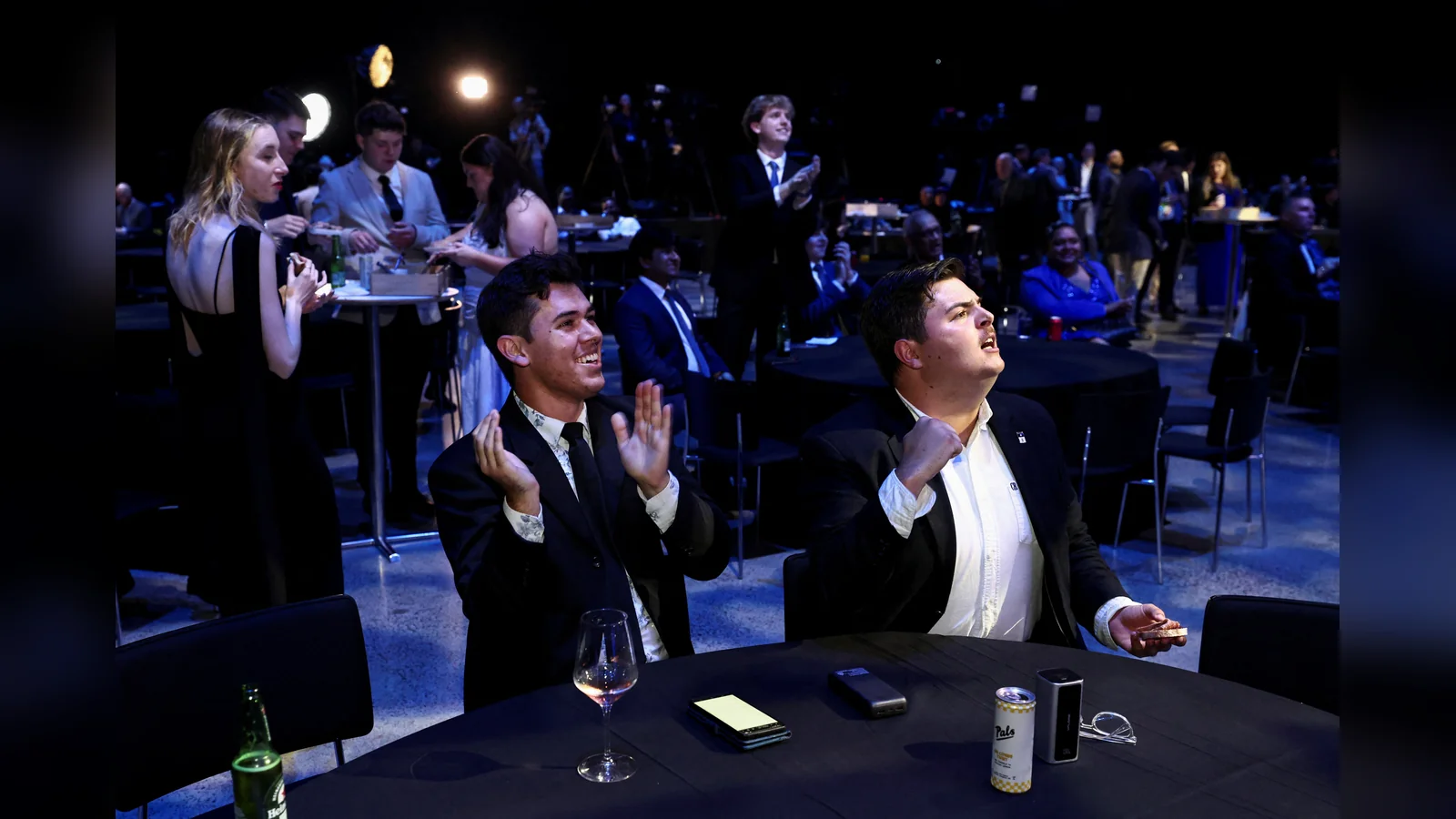
New Zealand's governing coalition hoped to hang on to power based on an initial vote count in the general election on Saturday, but the shape of the next government will not become clear until official results are announced on November 27.
Preliminary results from the Electoral Commission on Sunday showed the governing coalition of the National Party, ACT and New Zealand First with 67 of a projected 131 seats, one more than the 66 needed for a majority. National won 42 seats, ACT netted 13 and New Zealand First got 12.
The commission said special votes, around 14 percent of the total vote, still need to be counted. These votes include those from overseas New Zealanders and people voting outside their electorate, and they have historically favoured the left. They will be released with the final count on November 27. Until then, the coalition will continue as a caretaker government.
Neither side claims victory
Neither Prime Minister Christopher Luxon nor Labour Party leader Chris Hipkins claimed victory in their election-night speeches. Luxon told supporters in Auckland that National was once again the largest party in parliament and had a pathway to forming the next government, but right now it was too close to call.
Hipkins told supporters that New Zealand had spoken, though it may take a little bit longer to figure out exactly what it had said. Labour was on 36 seats, the Greens on 16 and Te Pati Maori on five, in the preliminary count.
The two main parties finished neck and neck, with each just under 30 percent of the party vote when 98 percent of voting places had been counted. The combined support for National and Labour is at its lowest level since the introduction of the mixed-member proportional system, with both parties' popular vote sitting below 30 percent.
The kingmaker party
If the National-led coalition loses its majority at the official count, either it or a left-leaning coalition would require the support of the centrist Opportunity Party, which looks likely to enter parliament for the first time. The party crossed the 5 percent threshold, which would give it seven seats in a 131-member parliament.
Opportunity is led by Qiulae Wong, a 38-year-old former sustainable-business consultant who took over the decade-old party in November 2025 after answering a job advertisement. She oversaw a rebrand and a sharp rise in the party's support, and its current vote share of about 5.96 percent would make it the first new entrant to parliament in more than a decade.
The election campaign was dominated by concerns about the cost of living, rising interest rates and a patchy economic recovery. New Zealand's central bank has lifted its cash rate twice since mid-2026 in response to resurgent inflation, and voters punished both big parties for the squeeze on household budgets.
What happens next
The special votes will be counted over the coming weeks, with final figures due on November 27. There is no fixed timeframe for when a government must be formed, and coalition talks are expected to begin only after the official results are known.
Several prominent members of National's front bench could lose their seats, including the finance minister, the speaker, the defence minister and the attorney-general, according to the count so far. The result also showed National and Te Pati Maori each winning a disproportionately high share of constituency seats relative to their popular vote, because of tactical voting.
Voting began on October 26 and ended on Saturday, with nearly 3.8 million people eligible to take part. For now, New Zealand has a caretaker government, a one-seat coalition lead, and three weeks of waiting before anyone knows who will actually govern.