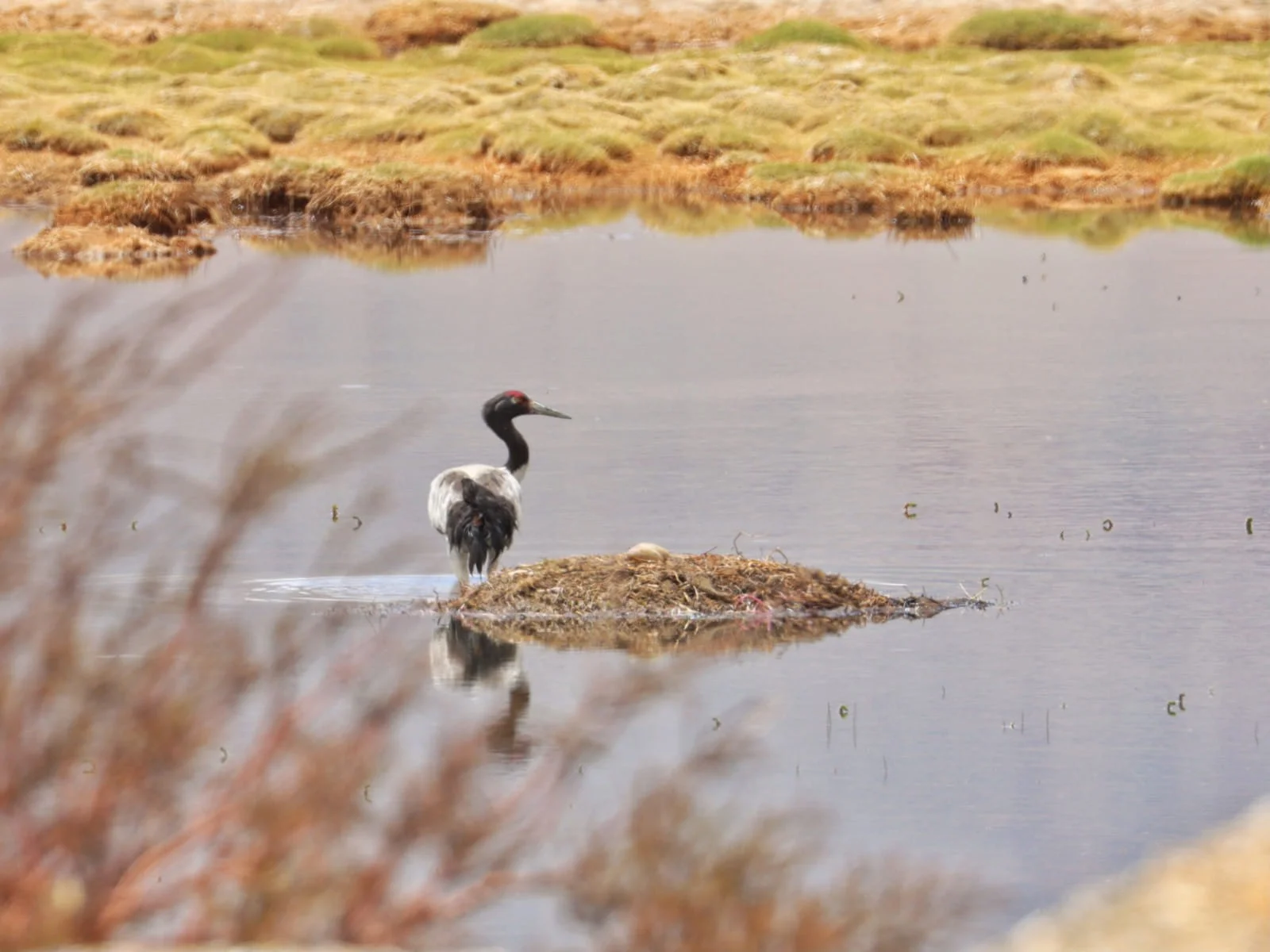
Ladakh's efforts to protect its state bird appear to be yielding results, with the recorded population of black-necked cranes increasing to 108 in 2026 from 87 a year earlier, a rise of nearly 25 per cent in a single year. The count has crossed the 100 mark for the first time.
The latest breeding-season survey recorded 86 adult cranes and 22 juveniles, compared with 70 adults and 17 juveniles in 2025, indicating an increase in both adult and young birds. The rise in juveniles points to encouraging breeding success, not just better counting.
Among the surveyed breeding sites, Chushul recorded the highest abundance with 16 birds, followed by Tso Kar and Kargyam with 15 each, and Korzok with 14. Together, these four locations accounted for nearly 56 per cent of the total population of 108 birds in 2026, all of them in the Changthang landscape.
The milestone follows a steady rise in recorded adult numbers between 2021 and 2025, with an average annual growth rate of around 12.9 per cent in the birds' count. The 2026 jump builds on that trend rather than breaking from it.
Ex-servicemen guard the nests
Lieutenant Governor Vinai Kumar Saxena announced the count on social media on Tuesday, calling it a monumental milestone for wildlife conservation in Ladakh. He credited the Environment Protection Force, particularly ex-servicemen inducted into the force, with helping protect the bird's nesting sites, eggs and hatchlings from the serious threat posed by free-ranging dogs.
Free-ranging dogs are one of the major threats to crane nests and hatchlings in Ladakh. The Environment Protection Force plays an important role in strengthening on-ground conservation efforts and protecting the fragile habitats of Ladakh's wildlife, carrying out sustained monitoring in some of the region's most remote and environmentally sensitive areas.
The Lieutenant Governor also commended local communities, particularly young people, for their active participation in conservation initiatives and for becoming partners in protecting Ladakh's ecological heritage. The Union Territory administration organised the first-ever Black-necked Crane Festival this year to raise awareness about conserving the state bird and protecting its natural habitat.
A high-altitude wetland species
The black-necked crane, Grus nigricollis, is a high-altitude wetland species found across the Tibetan Plateau and adjoining Himalayan regions. It is a tall bird, measuring about 1.35 metres in height, with a wingspan of approximately 2 to 2.5 metres and a body weight of 6 to 8 kg.
Ladakh declared the black-necked crane its state bird in September 2021, after attaining Union Territory status following the bifurcation of the erstwhile state of Jammu and Kashmir in 2019.
The species is classified as Near Threatened on the International Union for Conservation of Nature Red List. It is protected under Schedule I of India's Wild Life (Protection) Act, 1972, giving it the country's highest level of legal protection. It is also listed in Appendix I of the Convention on International Trade in Endangered Species of Wild Fauna and Flora and Appendix I of the Convention on the Conservation of Migratory Species of Wild Animals.
Important habitats of the black-necked crane have been notified as protected areas, including the Changthang Wildlife Sanctuary in Ladakh. The Tso Kar Wetland Complex, an important foraging and breeding ground for the cranes, was designated a Ramsar Site in December 2020, recognising its international importance as a wetland ecosystem.
The Union Territory administration says it remains fully committed to preserving Ladakh's ecological heritage and ensuring that the cranes continue to thrive. For a bird that numbered 87 a year ago, the count of 108 is a small number with a large meaning: protection, consistently applied, is working.