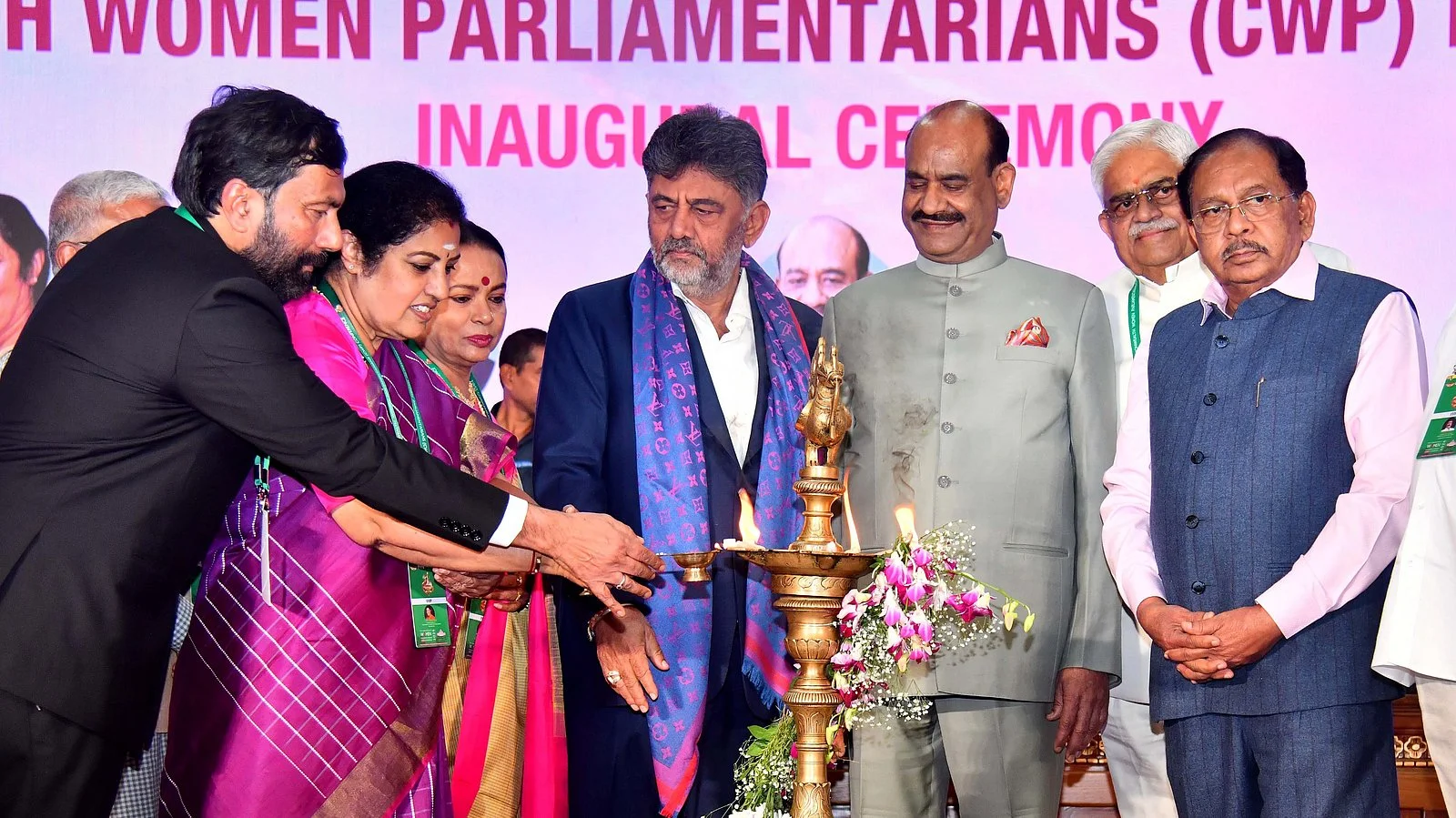
Lok Sabha Speaker Om Birla on Tuesday called for greater participation of women in policymaking and governance, emphasising the need to digitally empower elected women representatives and equip them with AI and technology skills to strengthen democratic institutions.
Inaugurating the first Commonwealth Women Parliamentarians (CWP) India Region Conference at Vidhana Soudha in Bengaluru, Birla said women were leading in every sector, and it was now time for them to play a greater role in policy-making and lawmaking.
"This is the time for change. Women’s participation in democratic institutions, policy-making, lawmaking and important decisions will strengthen our democracy. Women are sensitive and can help create a more responsive and strong democracy. The greater their participation, the stronger our democracy will become," he said.
The two-day conference, held on November 17 and 18, brought together 135 women lawmakers from Parliament and state legislatures. Its theme was 'Strong Foundations, Stronger Voices: Inclusive Cyberspace and Mentorship Pathways for New Women Legislators'.
Women's reservation in focus
Referring to the 2023 Nari Shakti Vandan Adhiniyam, Birla said several states had already provided 33 per cent or 50 per cent reservation for women in panchayats and urban local bodies. He expressed hope that 33 per cent reservation would soon be implemented in state assemblies and the Lok Sabha.
Karnataka Chief Minister DK Shivakumar, who delivered the keynote address, said women's reservation would strengthen their political participation and decision-making.
"We are hopeful that the historic Women's Reservation Bill will be passed in the upcoming winter session of Parliament. This December session will create history," Shivakumar said. He added that women must not merely occupy seats but influence decisions, shape legislation and give a new direction to governance.
Deputy Chief Minister G Parameshwara called on the Union Government and Prime Minister Narendra Modi to establish a clear, lawful and time-bound roadmap for implementing 33 per cent reservation for women in Parliament and state assemblies at the earliest possible elections.
Digital empowerment and mentorship
The conference held two plenary sessions. The first, on November 17, was on 'Empowering Women Digitally: Safe Cyberspace, Smart Choices', and focused on enabling women to engage safely and effectively in the digital space. The second, on November 18, was on 'Capacity Building and Mentorship for Women Legislators'.
UN Women India organised a side event on menopause on November 17. The conference was scheduled to conclude on Wednesday, November 18, with a valedictory address by Karnataka Governor Sudha Yadav.
Birla urged women elected representatives to shoulder the responsibility of mentoring others and creating better platforms for women in their constituencies. He said such conferences gave elected representatives an opportunity to exchange ideas and share best practices.
He highlighted India's democratic legacy, referring to the Anubhava Mantapa, regarded as one of the earliest parliamentary institutions, and Karnataka's legacy of women leaders such as Kittur Rani Chennamma. He also noted Bengaluru's global reputation in IT and AI.
Shivakumar said over 15 lakh women had entered local bodies across the country and played a significant role in grassroots development. He recalled former Prime Minister Rajiv Gandhi's efforts to introduce reservation for women in Panchayati Raj institutions and Congress leader Sonia Gandhi's earlier efforts to secure women's reservation in Parliament.