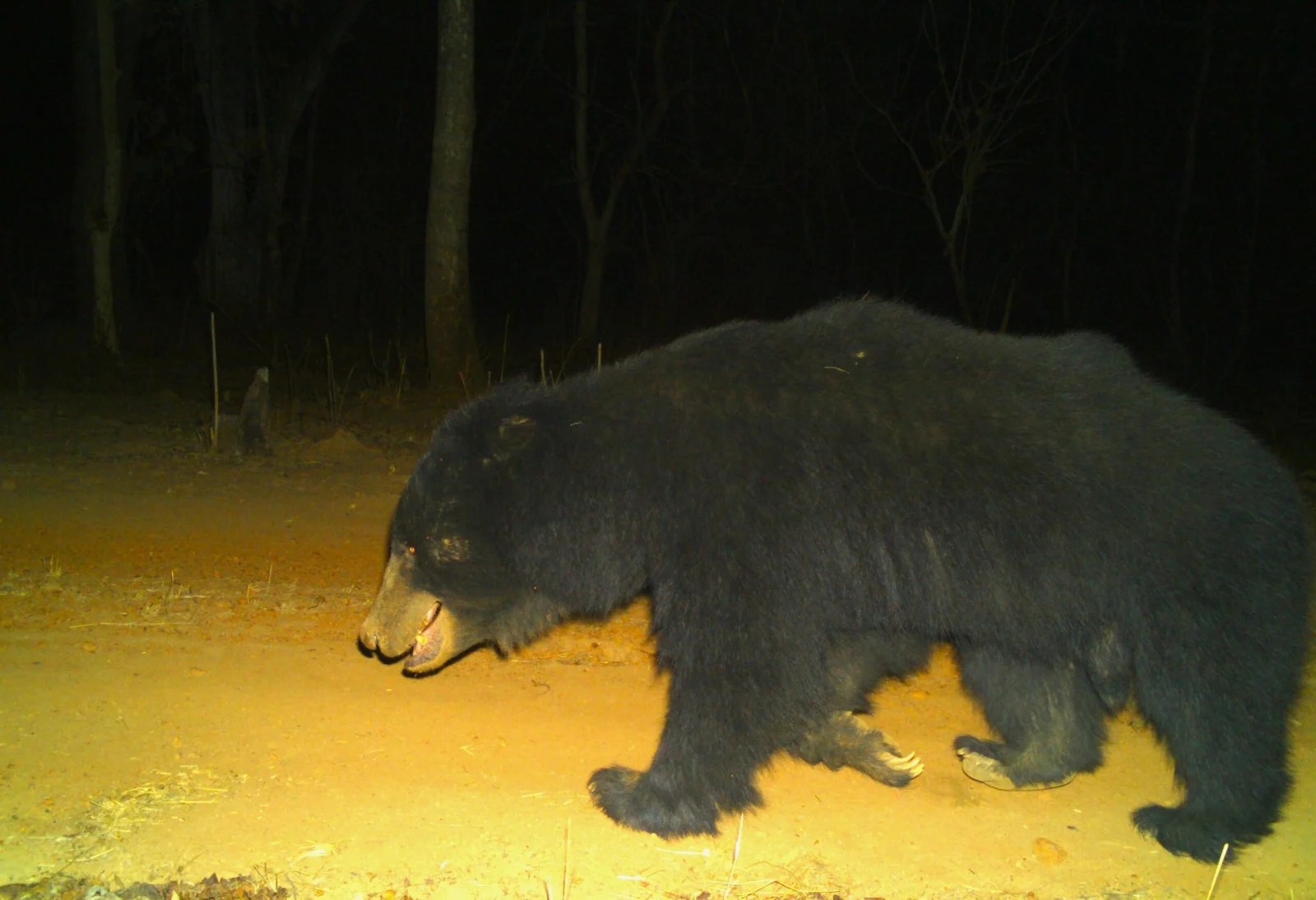
Sloth bear mothers go weeks without food or water while nursing their young in caves or rocky crevices, eventually emerging from their maternal dens with cubs clinging to their backs. But how reproduction shapes their behaviour has remained poorly understood. A new study from Panna Tiger Reserve in Madhya Pradesh now provides the first evidence of how female sloth bears with offspring and lone adults use the same forest differently.
For the study, published in the journal Ecology and Evolution, researchers analysed camera-trap data from over 47,800 trap nights, collected over six seasons, two summers and four winters, between 2018 and 2021 in Panna Tiger Reserve. They found that while lone adults preferred mixed forest landscapes and cooler habitats, females with offspring occupied hotter, more rugged terrain and areas used less frequently by lone adults.
"Space-wise, they (females with offspring) are actually avoiding lone adults very distinctly," said Sankarshan Chaudhuri, a project scientist at the Wildlife Institute of India and the study's lead author. He added that the consistent use of hotter areas by sloth bear mothers may impose physiological costs.
Mothers take the hotter ground
The differences were not only about where the bears went, but when. Although sloth bears are largely nocturnal and most active between dusk and dawn, females with offspring showed slightly greater daytime activity across seasons. "There is a fine-scale [temporal] segregation, which we didn't expect," Chaudhuri said. "They are also adjusting their activity patterns with respect to the activity pattern of lone adults," he explained.
The team categorised the camera-trap data into two groups based on demographic state: lone adults, and females with cubs less than a year old or dependent yearlings. Since the presence of offspring is the only reliable way to identify a sloth bear as female in photographs, lone adults could not be differentiated as male or female, Chaudhuri explained.
The researchers analysed timestamps of camera-trap images to determine activity patterns and modelled space use along with environmental variables like tree cover and land surface temperature, using multi-state occupancy models. "We found that females with offspring actually preferred areas which are less resource-rich compared to lone adults, and also kind of unfavourable to them," said Chaudhuri.
Panna Tiger Reserve's dry, deciduous forests lie in the water-scarce Bundelkhand region, where the river Ken is a major water source. The study found that females with offspring avoided such riverine areas, especially during summer. Researchers speculate this may be to protect their cubs, as water sources can attract large predators. Lone adults also frequent these areas, often in search of honey, Chaudhuri said.
Why segregation may happen
Researchers hypothesise that females with offspring may segregate to reduce competition for resources or to protect their cubs from infanticide, if it occurs among sloth bears. Infanticide, the killing of offspring by unrelated adults of the same species, acts as a selective pressure in some large, solitary carnivores, where females segregate themselves as a counter-strategy. But Chaudhuri cautioned: "So far, there is no hard-and-fast evidence or solid proof that sloth bears are showing infanticide." Only a 1999 study from Nepal had speculated about the possibility of undetected cub mortality in sloth bears.
If infanticide does occur, it may be one possible explanation for the avoidance the researchers observed. Curbing resource competition may be another. "If the population density is high, then they have to segregate. They have to ensure resources for their offspring," Chaudhuri said. The study also could not rule out the possibility of random movement.
During summer, however, there was less evidence of spatial avoidance by females. "When fruits are abundant, then they have to share spaces with lone adults. There is no better option," Chaudhuri said, adding that breeding females also have nutritional needs to meet. Referring to their space and time-wise segregation, he observed, "It's a very delicate balance they are maintaining."
Avoiding other adults could come with trade-offs. Sloth bears do not hibernate but use natural shelters to rest during the day and avoid heat stress. Although pregnant and lactating mammals produce more internal heat and require greater thermoregulation, female sloth bears with offspring were associated with hotter areas. If lone adults occupy available denning sites, it could force females with cubs into habitats with less terrain complexity to avoid confronting other adults, the authors suggest. This, along with greater daytime activity, could expose females to higher heat stress, and researchers say these potential physiological costs need further study.
What the study could not see
Solitary and elusive, sloth bears are hard to study in the wild. A lack of species-specific funding and a greater research focus on other charismatic species like tigers and leopards have also left sloth bears relatively understudied, explained Nishith Dharaiya, director of the Centre of Excellence for Wildlife and Conservation Studies at BKNM University and co-chair of the IUCN Sloth Bear Expert Team. He called the findings an "important contribution in the breeding ecology of sloth bears, as very few such studies are conducted in India."
The study has limits. Researchers were unable to conduct surveys during the monsoon, as heavy rainfall limited their access. Only 8.4 per cent of the total bears detected were females with offspring. While this number is low, Chaudhuri said, "We are certain that we did not miss any detection, or misclassify detections of mother and cubs." The camera traps themselves were part of the All India Tiger Estimation programme, so the sloth bear images were, in his words, "bycatch data".
Since the study was conducted only in the reserve's core zone and not in the human-dominated buffer zone, "we do not know whether humans are also shaping these behaviours or not," Chaudhuri noted. He added that future research must extend to human-dominated landscapes, as they can shape sloth bears' population biology in terms of cub survival and interaction with humans. Differences in habitat use and activity between the two groups could lead to varied levels of exposure to human-dominated landscapes, and since reports of conflict often involve females with cubs, Dharaiya said the study will help in understanding the activity patterns of sloth bears around conflict-risk zones.