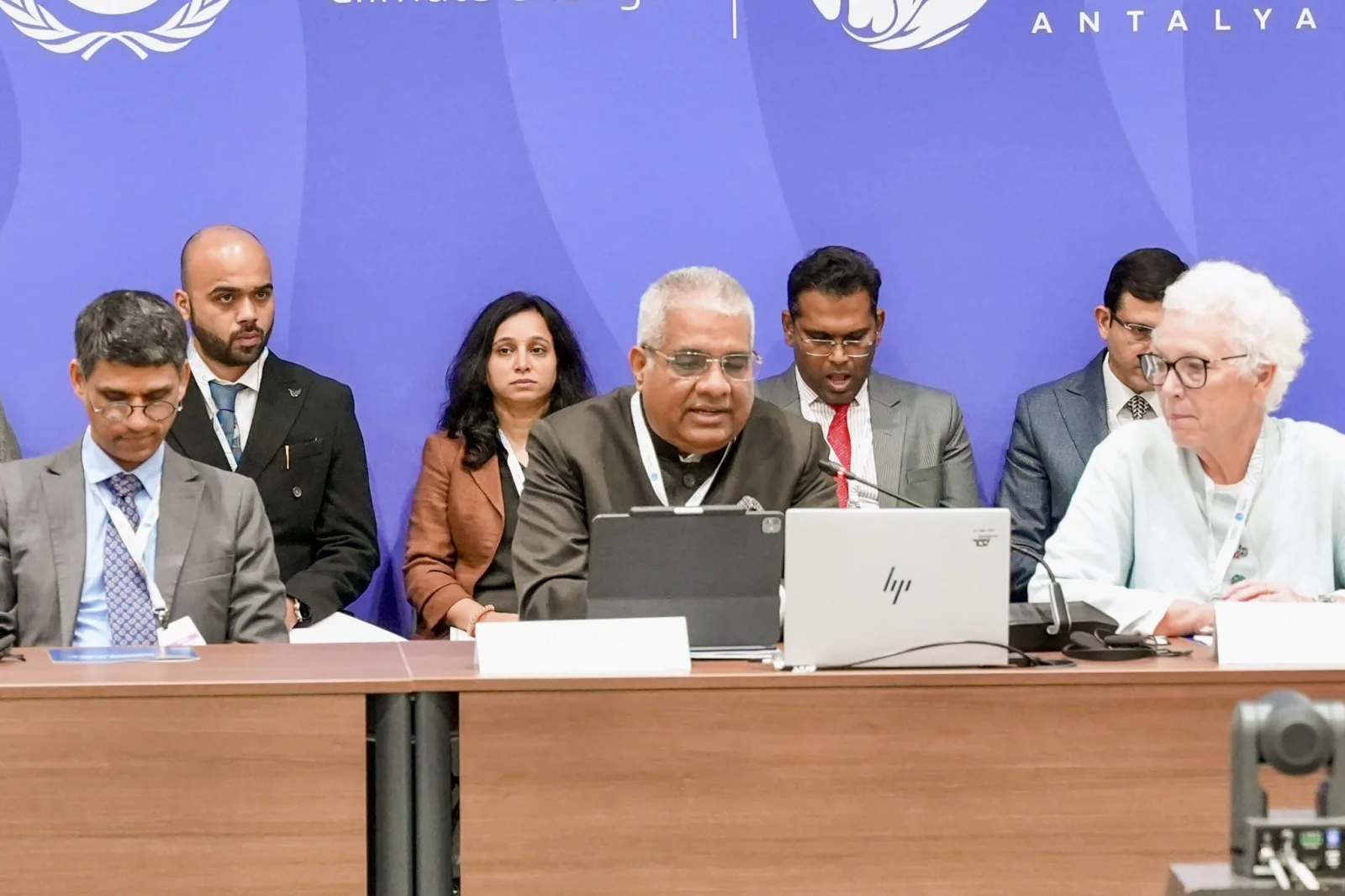
India and Sweden on Tuesday launched the third phase of the Leadership Group for Industry Transition, LeadIT 3.0, at the Industry Leaders' Roundtable during the United Nations Climate Change Conference (COP31) in Antalya, Turkiye, with Brazil joining the initiative as its newest country member.
Union Environment, Forest and Climate Change Minister Bhupender Yadav announced the launch, co-chairing the roundtable with Helena Dyrssen, State Secretary at Sweden's Ministry of Climate and Enterprise. Selwin Hart, Special Adviser and Assistant Secretary-General for UN Climate Action, was also present at the roundtable.
The new phase, covering 2027 to 2030, will shift the platform's focus from establishing partnerships to scaling industrial projects, mobilising capital and delivering measurable results, Yadav said.
LeadIT's membership has grown to 20 countries and 33 companies. Welcoming Brazil, Yadav said its entry strengthens the voice of the Global South and creates further opportunities for South-South cooperation.
Three priorities for 2027-2030
LeadIT 3.0 will be guided by three priorities: technology development and diffusion through industrial projects; capital mobilisation and de-risking to connect projects with investment and finance support; and capacity building and policy support, including carbon markets and workforce transition.
Steel, cement and transport will remain the initiative's core sectors, while the platform stays open to new sectors and technologies. Yadav urged countries and companies to move from feasibility studies to pilots, demonstration and replication, and to connect technology providers with industrial demand.
Yadav said global cooperation on climate action faces significant challenges, including geopolitical conflicts, volatile energy markets, energy insecurity and competing development priorities. He said these challenges make cooperation more important, particularly in industry, where emissions are hard to abate and competitiveness, jobs and national security are closely linked.
What LeadIT has delivered so far
LeadIT was launched jointly by India and Sweden in September 2019 at the UN Climate Action Summit in New York, with the support of the World Economic Forum. Its secretariat is hosted by the Stockholm Environment Institute. The prime ministers of the two countries announced a renewed mandate for the initiative in May 2026.
In its second phase, LeadIT moved from dialogue to delivery, Yadav said, facilitating 11 pre-pilot projects in steel and cement under the India-Sweden Industry Transition Partnership, and expanding cooperation into low-carbon heavy-duty transport. The projects cover hydrogen-based ironmaking, electrification of industrial heat, carbon capture and utilisation, clinker substitution, industrial circularity and the use of artificial intelligence to reduce cement demand.
The platform also supported South Africa's investment plan under the Climate Investment Funds and Ethiopia's public-private engagement on low-carbon cement, and runs green steel and green cement technology trackers, Yadav said.
India's climate record
Yadav cited India's climate achievements, saying the country cut the emissions intensity of its economy by 37.38 per cent between 2005 and 2022 and reached 50 per cent non-fossil fuel-based installed electricity capacity five years ahead of its target. He said India's additional forest carbon sink has reached about 2.44 billion tonnes of carbon dioxide equivalent.
He said India carries the dual responsibility of lifting millions out of poverty, expanding energy access, creating jobs and building infrastructure while pursuing a sustainable, low-carbon future, and that these objectives must advance together.
Yadav said India's climate initiatives were applauded at the session, and that participants described the country's commitment as a guiding light for other nations in the fight against climate change. The launch comes at a COP31 that the Turkish presidency has called the COP of Implementation.