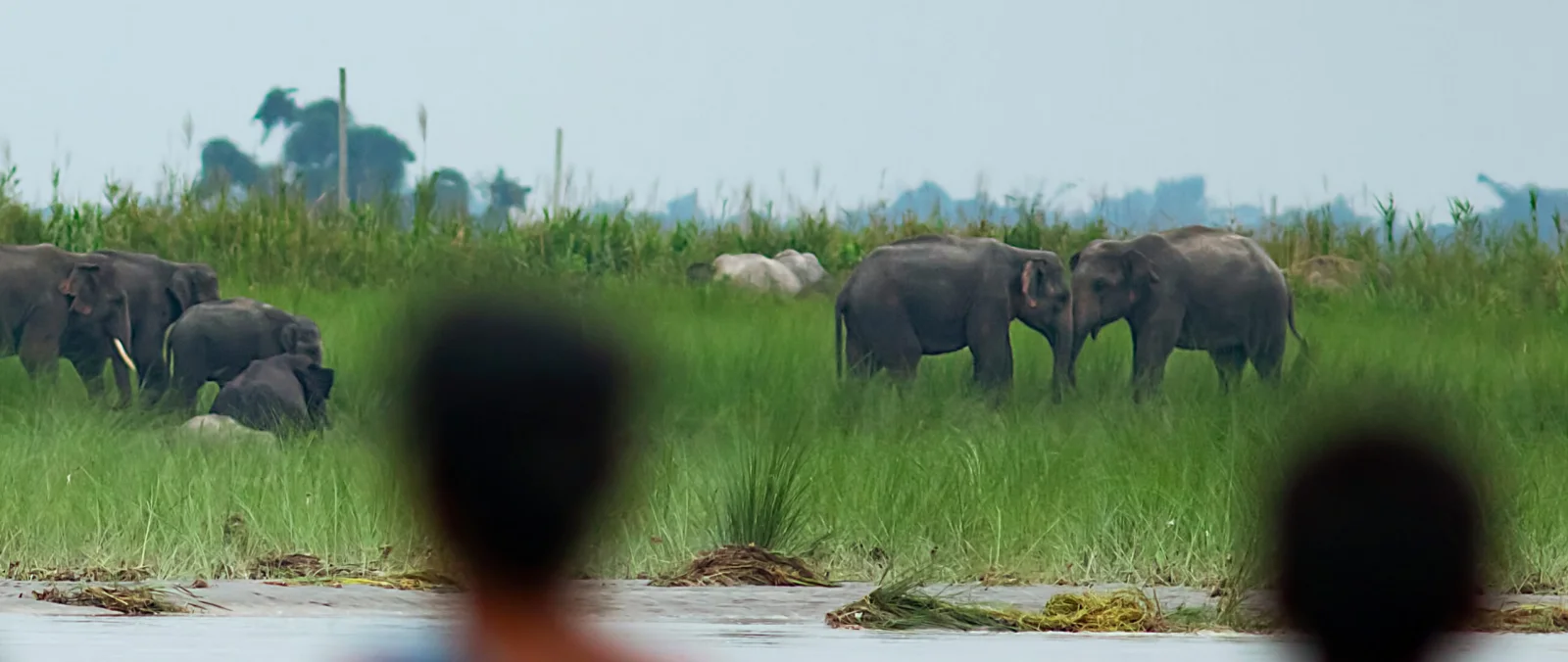
On the shifting sandbars of the Teesta in West Bengal, migrant farmers cultivate seasonal crops that are increasingly attracting elephants from nearby forests. The elephants feed on these crops, bringing people and wildlife into close contact on land that belongs to neither of them. A new Mongabay India documentary, published on November 17, follows both through the same uncertain landscape at Premganj Char in Jalpaiguri district.
The chars, as the sandbars are known, are dynamic riverine landforms built from Himalayan sediment and constantly reshaped by floods and erosion. As the Teesta changes course, floods and erosion reshape the sandbars, forcing farmers to move their fields and adapt to the changing landscape. Elephants, meanwhile, follow the seasonal crops and return to the sandbars to feed.
Migrants from West Bengal and Assam, who lost their homes to river erosion, occupy and farm these lands, growing paddy and maize, despite having no formal ownership and no guarantee the land will remain. Field researcher Avijan Saha, who appears in the documentary, explains that the chars are formed by sediment carried down from the Himalayas and are remade by every flood season.
Farming land that may wash away
The farmers of Premganj Char live with two kinds of uncertainty. The river can take their fields in a single flood, and the elephants can take their harvest in a single night. Farmers lose crops, see elephants damage their homes and spend sleepless nights guarding their fields.
Because the land belongs to the Irrigation Department, farmers receive no formal compensation for crop losses despite annual damage. They farm land they do not own, on sandbars the river may reclaim, and when the elephants come, there is no authority that will pay for what is eaten or trampled.
Yet the documentary shows a coexistence without severe retaliation. Despite years of living alongside elephants, the farmers have not turned on the animals, and the film presents their shared life on the chars as one of wary adjustment rather than open conflict.
The elephants follow the crops
The elephants come from the nearby Baikunthapur forests, and their movement follows the agricultural calendar. Numbers have risen sharply: from 15 to 40 elephants visiting in 2018, around 100 elephants now come to the sandbars annually, according to the documentary.
The herds peak during the maize season, from March to July, and again during the paddy season, when the standing crops offer easy feeding. The crops attract elephants, particularly mature bull bachelor groups known locally as 'maljurians', which scout new territories beyond the forest.
Farmers describe nightly watches, using lights and noise to deter the herds. But lone bulls often ignore the lights and noise and charge, and a single bull can destroy a season's work in one visit. The elephants are not passing through by accident: they have learned the farming calendar, and they return each year to the same sandbars.
The Teesta's shifting course is what makes this meeting possible at all. The same floods that force farmers to move their fields also lay down fresh sandbars, and the same crops that feed farming families draw the elephants out of the forest. Neither the farmers nor the elephants chose this ground, and neither can be sure it will still be there next year.