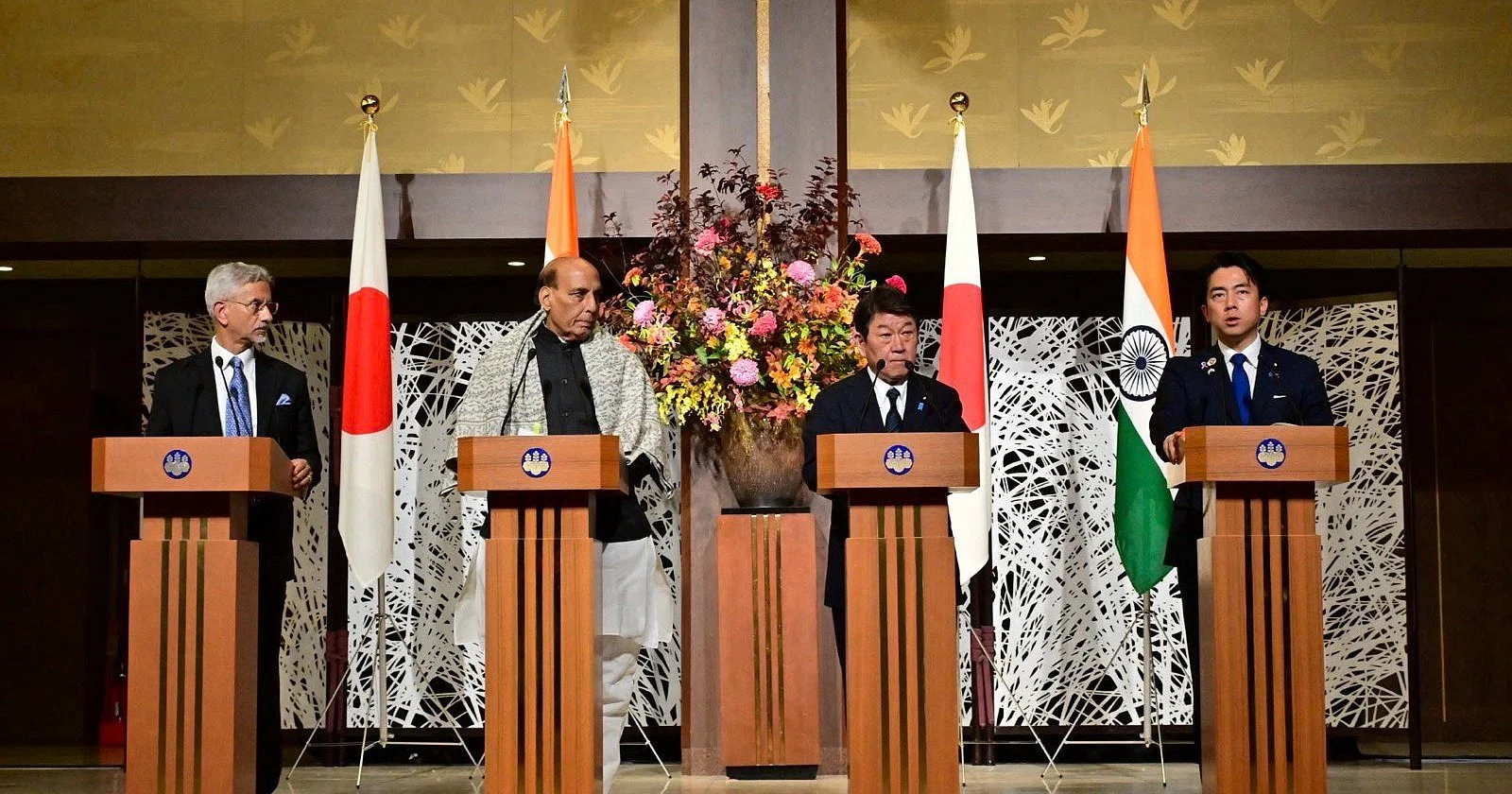
Tokyo, Japan — India and Japan have agreed to allow Japanese forces to conduct live-fire missile training at firing ranges in India for the first time, in a major step forward for defence ties between the two countries. The agreement came at the fourth India-Japan 2+2 Foreign and Defence Ministerial Meeting in Tokyo on Thursday, November 19, where the two sides signed a Letter of Intent on the use of Indian ranges by the Japan Self-Defence Forces.
Defence Minister Rajnath Singh and External Affairs Minister S Jaishankar represented India at the talks. Japan was represented by Foreign Minister Motegi Toshimitsu and Defence Minister Koizumi Shinjiro. The drills are expected to begin next year and will include exercises involving surface-to-ship missiles.
"We agreed that the Japan Ground Self-Defence Force will use a firing range in India for the first time. This is a major strategic move," Koizumi said after the meeting. The two sides agreed to speed up coordination between their defence authorities so the training can begin early.
Japan is likely to use the facility to train with its new Type-25 surface-to-ship missile, an upgraded version of the Type-12 missile with a reported range of around 1,000 km, as well as small attack drones. Defence sources said the DRDO Integrated Test Range at Chandipur on the Odisha coast is the likely venue. Japan has limited space at home to fire long-range missiles safely without affecting civilian air and sea traffic, which is one reason it looked to ranges overseas. A Japanese military delegation visited India last month to study the feasibility of the plan.
UNICORN mast deal and wider defence cooperation
The two sides also set a timeline for the transfer of Japan's UNICORN communication system to India. The Unified Complex Radio Antenna is expected to improve the stealth, electronic warfare and communication abilities of Indian Navy warships. India is expected to grant Acceptance of Necessity for the project by February 2027, after which NEC Corporation of Japan and Bharat Electronics Limited will work together on its design and production in India.
The ministers also agreed to strengthen mine countermeasure capabilities to protect undersea cables, expand cooperation in cybersecurity and space, and renew the existing memorandum of cooperation on cybersecurity. The next India-Japan Cyber Dialogue will be held at an early date.
Shared message on terrorism and UN reform
The joint statement named Pakistan-based groups Lashkar-e-Taiba and Jaish-e-Mohammed in a strong message on cross-border terrorism. The two sides reaffirmed their commitment to a free and open Indo-Pacific based on the rule of law and respect for national sovereignty and territorial integrity.
India and Japan also backed each other's bids for permanent seats in an expanded United Nations Security Council and agreed to support reform of the world body. The next 2+2 dialogue will be held in India as the two countries mark 75 years of diplomatic ties.