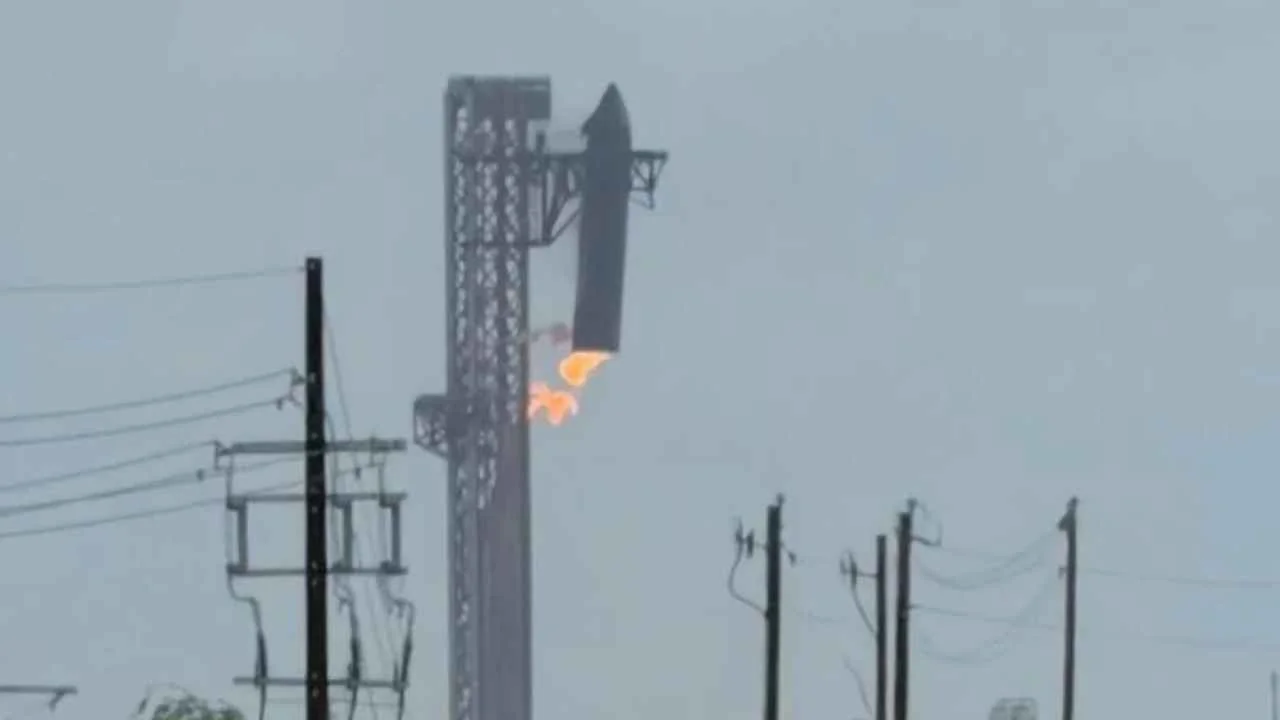
SpaceX has caught a Starship upper stage returning from orbit for the first time, plucking the spacecraft out of the sky with the mechanical arms of its Texas launch tower after a mission lasting nearly a full day. The catch on Saturday, November 14, marked a milestone for the company as it works toward a fully reusable rocket.
The spacecraft, known as Ship 42, lifted off from Starbase in South Texas on Friday, November 13, at 5:47 pm Eastern time, on the 15th test flight of the Starship system. It spent about 22.5 hours in space, circling Earth 14 times at an altitude of around 275 kilometres, and deployed 26 next-generation Starlink V3 satellites before beginning its return.
The 52-metre upper stage then flew back to the launch site, re-entered the atmosphere in a horizontal belly-flop position, flipped upright, fired its Raptor engines and descended between the tower's two chopstick arms, which closed around it and held it in place. It was only the second time a Starship has reached orbit, and the first time the company has caught an upper stage coming back from one.
Booster lost in the Gulf after abort
The flight had been planned as a double catch, with both the Super Heavy booster and the upper stage returning to the launch tower on the same mission. That plan failed within minutes of liftoff. The booster's boostback burn ended early after a low-fuel alarm, and its guidance, navigation and control system triggered an automated abort, diverting it to a contingency site in the Gulf of Mexico.
The booster completed a landing burn over the water before its flight termination system destroyed it, ending in a fireball above the Gulf. SpaceX spokesperson Dan Huot said the system detected the booster was outside the position required for a safe catch and did what it was supposed to do. Chief executive Elon Musk said the booster was also slightly low on fuel, and SpaceX has said the root cause of the abort is still under investigation.
SpaceX had already caught Super Heavy boosters with the same tower system on three earlier test flights, but recovering both stages on a single mission remains unproven. The company must still show it can catch both stages on one flight and turn them around quickly for reuse.
A step toward the Moon and Mars
NASA administrator Jared Isaacman praised the flight on X, saying it brought NASA one step closer to the Moon. NASA plans to return humans to the lunar surface in 2028 and has contracted SpaceX and Blue Origin for the mission. Starship is central to those plans, and Musk has said the caught spacecraft could fly again after a few weeks of refurbishment.
Musk has said SpaceX plans to raise Starship test flights to a weekly pace and then to twice a week, with the goal of making the rocket rapidly reusable, landing and taking off much like an airplane. Together, the booster and spacecraft stand 124 metres tall, making Starship the largest and most powerful rocket ever flown.