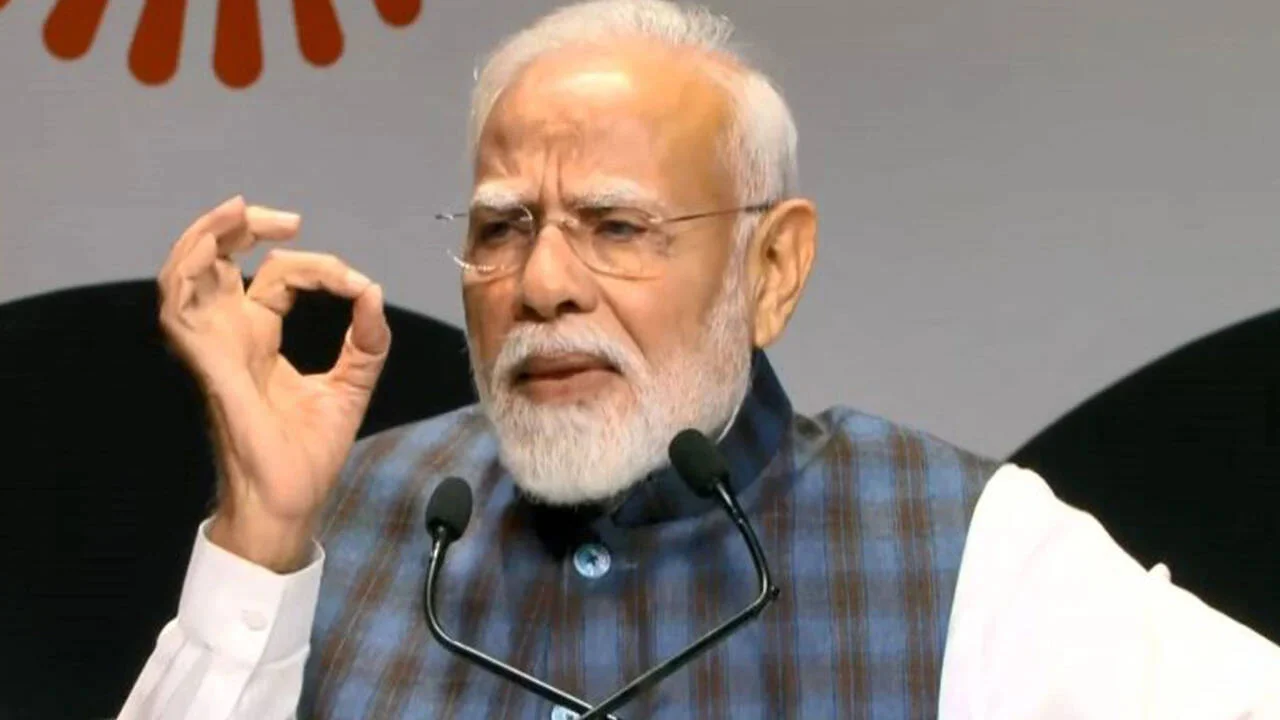
Prime Minister Narendra Modi on Thursday inaugurated the annual general meeting and convention of the Federation of Indian Chambers of Commerce and Industry (FICCI) at Bharat Mandapam in New Delhi and asked Indian industry to make India First the foundation of every long-term investment decision over the next 20 years. He said the approach would make the country self-reliant and open new growth opportunities for businesses, and he urged companies to look beyond domestic demand and build products that find demand in international markets.
"In every long-term investment decision you make over the next 20 years, make India First your foundation. This will make the country self-reliant, and new opportunities will also open up for the growth of your businesses," Modi said in his keynote address. He added that industry must start preparing to serve the needs of the world and see what India can offer to the globe, so that Indian products become a key part of the country's identity abroad.
The convention, themed Bharat 2047, brought together more than 2,500 delegates, including industry leaders, chief executives, ambassadors, diplomats and policymakers. Discussions are centred on India's economic growth, global competitiveness, manufacturing, the next phase of reforms and artificial intelligence. The year 2026-27 marks FICCI's centenary year, as the chamber completes 100 years of its establishment on 7 April 2027.
Fastest-growing major economy, says Modi
Modi said India had become the world's fastest-growing major economy and would continue to expand at around 7 per cent. He said goods exports in October touched nearly 50 billion dollars, the highest monthly figure ever, and pointed out that agencies such as Moody's, S and P, the World Bank and the Asian Development Bank were revising India's growth forecasts upwards.
Reflecting on India's economic journey, Modi recalled the licence-quota regime, nationalisation and the period when the country was counted among the world's Fragile Five, and contrasted those phases with the present growth trajectory. He said the change over the last 12 years had come from the hard work of the country's youth, farmers, workers and industry leaders. He also cautioned that industry would have to prepare for future national and global requirements, particularly as resources increasingly became instruments of geopolitical leverage.
Poverty claim and the reply to Rahul Gandhi
Modi also highlighted poverty reduction, saying around 50 crore people had moved out of poverty over the past 12 to 13 years. He cited the World Bank's October 2026 Poverty and Equity Brief, which estimated that 496 million people moved above the lower-middle-income poverty line of 4.20 dollars a day between 2011 and 2023, with the share below that threshold falling from 57.7 per cent to 16.1 per cent.
The remarks came a day after Leader of Opposition Rahul Gandhi, speaking at Columbia University in New York, described India as sitting on an economic disaster, citing unemployment, a struggling manufacturing sector and problems in education. Modi took aim at the policies of the 1970s, when Garibi Hatao was a prominent political slogan, saying poverty could have been eradicated even then but the country lacked the necessary policy direction and intent. He asked industry leaders to set their sights on the next two decades and expand their contribution to the government's vision of Viksit Bharat and Atmanirbhar Bharat.