Gaganyaan is India's first human spaceflight programme. It aims to send a three-member crew into an orbit around 400 km above Earth for about three days and bring them back safely, landing in Indian waters. For the first crewed mission, four astronaut-designates were chosen, all of them Indian Air Force officers: Group Captains Prasanth Balakrishnan Nair, Ajit Krishnan and Angad Pratap, and Wing Commander Shubhanshu Shukla.
The multi-tier selection was run jointly by the Indian Space Research Organisation and the Indian Air Force, with the selection criteria defined jointly by the two. The evaluation was handled by the Institute of Aerospace Medicine in Bengaluru, which screened the candidates through psychological, physical and clinical tests. The first level of selection drew only on the IAF's pool of test pilots, shortlisted from their dossiers before the medical and psychological screening began.
Why test pilots go first
Space agencies have historically chosen military test pilots as their first astronauts. Test pilots fly new, modified or experimental aircraft, work closely with aerospace engineers and help find design flaws in a vehicle that has never flown with people on board. They stay calm under stress, decide quickly and are trained to survive emergencies such as high acceleration and sudden cabin depressurisation.
There are no universal criteria to become a spacefarer, so each agency defines its own standards. The Karman line, an imaginary line 100 km above sea level, is widely treated as the boundary of space, and anyone who crosses it is considered an astronaut. The youngest spacefarer was 18 and the oldest 90, both on suborbital flights, which shows how wide the range of people who have been to space already is.
Training across three countries
Generic training was done in Russia. ISRO's Human Space Flight Centre contracted Russia's Glavkosmos to train the Indian astronauts at the Yuri Gagarin Cosmonaut Training Center, with centrifuge runs, weightlessness in parabolic flights, and winter and sea survival drills. Generic skills are the same on any spacecraft: living in microgravity, surviving a landing in a remote place and handling the body's reaction to launch forces.
Two of the four also trained in the United States. Shukla and Balakrishnan Nair trained at NASA's Johnson Space Center ahead of the Axiom-4 mission, a commercial flight to the International Space Station. Shukla flew as the mission pilot on Axiom-4, launched on 25 June 2025, spent 18 days on the station and splashed down on 15 July 2025, while Balakrishnan Nair was part of the backup crew. ISRO was reported to have spent about Rs 550 crore on the mission, a reported figure, not an audited one.
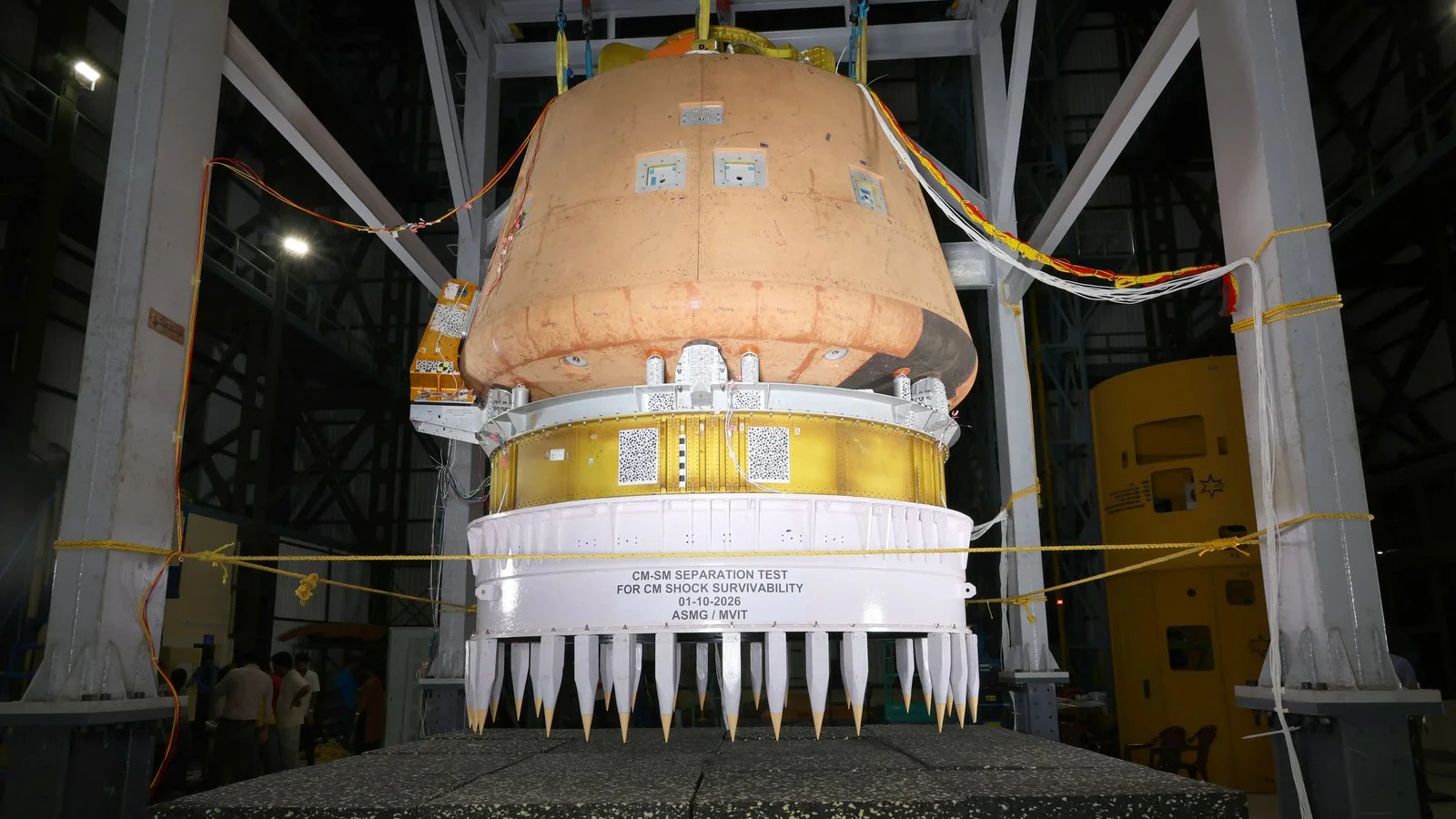
Mission-specific training has been done in India. By December 2022 the astronaut-designates had been identified and were in mission-specific training at Bengaluru, using full-scale fixed and motion-base simulators, part-task trainers and virtual and augmented reality systems. The Gaganyaan crew module is India's own design, so its controls and emergency drills can only be taught where the module and its simulators are.
Quarantine and the road ahead
A roughly two-week isolation before launch keeps infections out of the small, sealed crew module. The Hindu's explainer notes that a medical evacuation from the International Space Station in January 2026 was the first in the station's 26-year history, a reminder of why crew health is treated so seriously.
Building crew selection and training capacity at home lays the base for long-term human space activity and boosts bioastronautics, the study of the behavioural and medical aspects of humans living in space. That expertise will be needed for later goals such as the Bharatiya Antariksh Station, India's planned space station. The pattern followed by space agencies is to send test pilots first, then mission specialists such as scientists, doctors and engineers once the launch system is proven, and later civilians and private citizens after proper training.