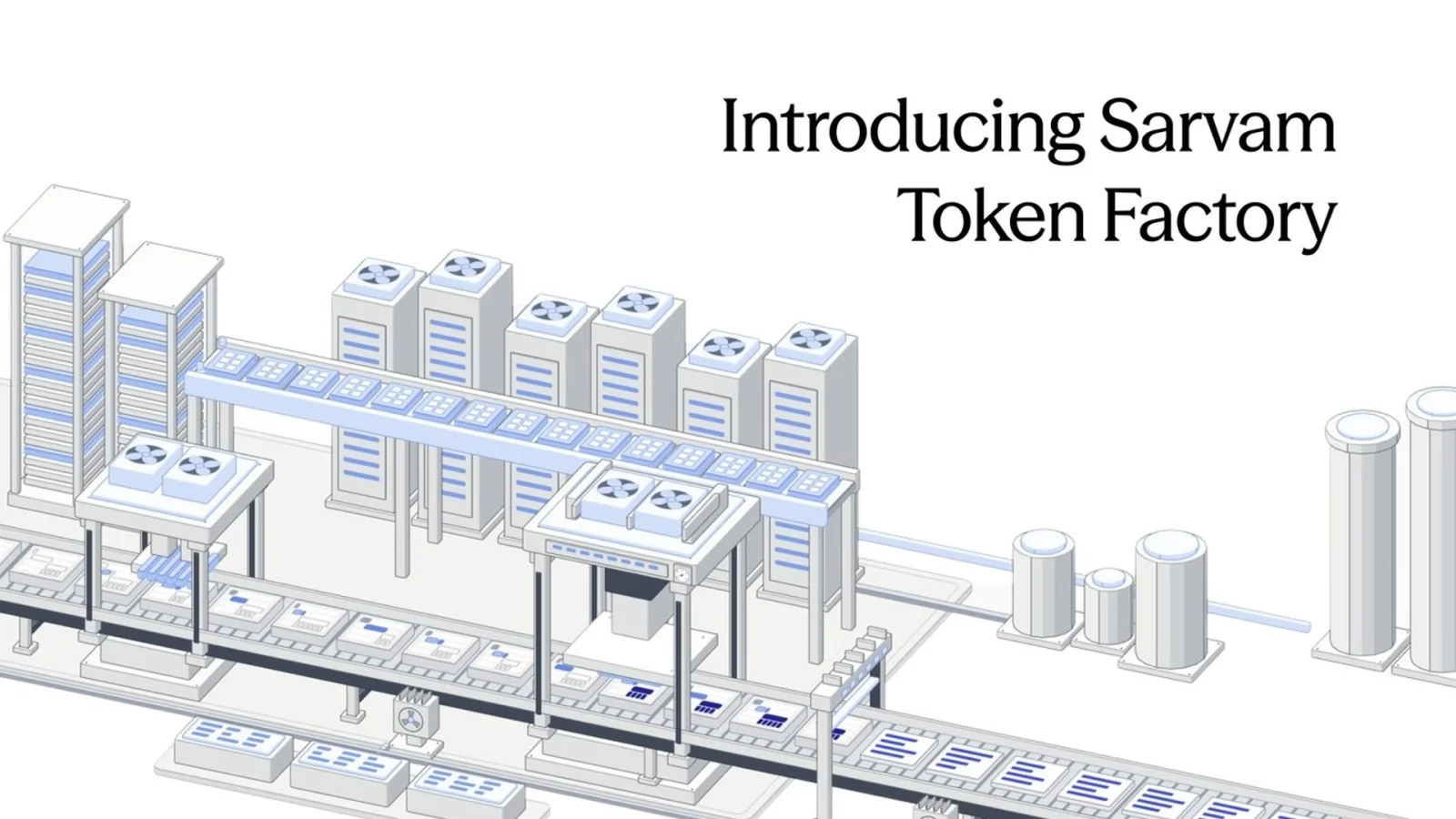
India's push to develop its own artificial intelligence capabilities has thrown up an interesting contradiction. Sarvam AI, one of the country's most prominent homegrown AI startups and a key beneficiary of the government's sovereign AI programme, is now offering models developed by Chinese companies through its newly launched inference platform, Token Factory.
On Monday, November 16, Sarvam announced Token Factory to developers and enterprises, allowing them to access several leading open-weight AI models, including those developed by Chinese companies DeepSeek, Moonshot AI, Z.ai and Alibaba. The platform also offers Google's Gemma models and Sarvam's own proprietary models. Sarvam is offering models such as DeepSeek V4.1 Flash, Kimi K3.1 Pro, GLM 5.3 and Qwen 3.8 27B, alongside its own Sarvam 105B model.
Token Factory is an AI inference platform. It allows businesses to run different AI models using Sarvam's computing infrastructure located in India, without buying expensive hardware or managing the infrastructure themselves. Inference providers offer access to models through application programming interfaces, typically charging customers based on the number of tokens processed. The model is well established globally, with companies such as Together AI, Fireworks AI and DeepInfra providing inference services for models developed by other firms. Sarvam claims it is already serving more than 450 billion tokens daily through DeepSeek V4.1 Flash.
Why Chinese models make commercial sense
Chinese AI companies have emerged as some of the strongest players in the open-weight model ecosystem, offering powerful models that other companies can download and deploy on their own infrastructure. For Sarvam, offering these models creates a separate business opportunity beyond developing its own foundation models. It can attract customers seeking the capabilities of DeepSeek or Kimi, without having to build an equally competitive model for every application.
Importantly, hosting Chinese models in India also means that businesses do not necessarily have to send their data to servers operated by Chinese companies. However, local hosting alone does not resolve every security concern, including those around model behaviour, software dependencies and access controls. Sarvam is effectively competing with global inference providers on pricing, speed and computing efficiency, and some have pointed out that its offering may not be the cheapest available. Atharva Ingle, an AI engineer at Jarvislabs, an Indian inference provider that is part of E2E Networks, said his company had benchmarked three open-weight models available on both platforms and found its own service as fast as or faster than Sarvam, while charging lower prices.
The sovereignty question
Sarvam's decision is particularly significant because of its position in India's indigenous AI ecosystem. The Bengaluru startup, founded in August 2023 by Vivek Raghavan and Pratyush Kumar, was selected under the government's Rs 10,370 crore IndiaAI Mission to develop homegrown foundation models, with financial and computing support amounting to Rs 246.72 crore, according to government disclosures. A central objective of the programme is to reduce India's dependence on foreign AI technologies and build domestic capabilities across the AI technology stack.
Yet the move also shows there are two interpretations of AI sovereignty. The first is around domestic ownership of foundation models, training capabilities and intellectual property. The second prioritises control over computing infrastructure, data and deployment, irrespective of where the underlying models originate. Using open-weight foreign models does not necessarily undermine domestic AI development, since such models can help Indian companies build applications and develop technical expertise while indigenous capabilities mature. Hemant Mohapatra, partner at venture capital firm Lightspeed India, one of Sarvam's largest investors, wrote on X that global players are already making money by hosting global models, including Chinese ones, in India and serving global customers from here, because they cannot find GPUs elsewhere right now. Sarvam is not the first Indian company to host Chinese models either: Krutrim has hosted DeepSeek models on Indian servers since January 2025.
The criticism
Though the discourse around Sarvam's decision has largely supported it as a business move, there is also an argument that it could dilute the initial fanfare around Sarvam being India's foundational model answer to the United States and China. Nischal Jain, co-founder of Egma AI, wrote on X that Sarvam was supposed to be India's answer to the US and China, and that when frontier labs do not do these kinds of things, it looks demotivating in an already tough situation. The irony is sharpened by co-founder Vivek Raghavan's own warning, made in July and repeated this week, that if India does not create a full-stack AI alternative to the big global players, the country risks becoming a digital colony.