
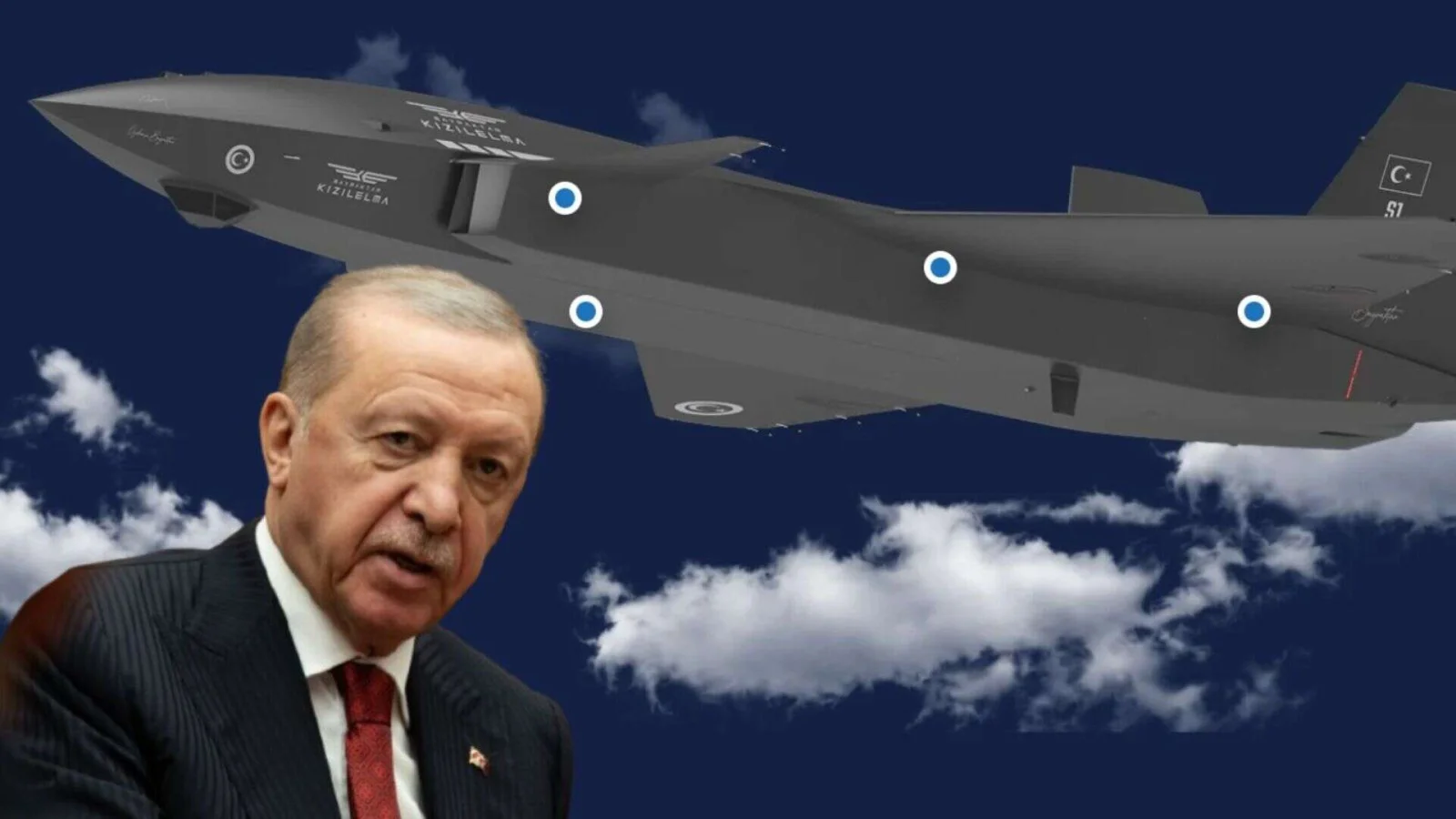
Turkey has become the first country in the world to officially induct an unmanned fighter jet into its armed forces, with the Bayraktar Kizilelma joining the Turkish military. Turkish drone maker Baykar said in a statement that it has handed over three of the jets to the country's armed forces. Defence experts say the induction marks a new beginning for the future of air warfare.
The Kizilelma is not a conventional drone. It is a stealth-capable, unmanned fighter jet powered by a fighter jet engine rather than a drone engine, which gives it a maximum speed of Mach 0.9. According to Baykar's website, the aircraft is 14.5 metres long with a wingspan of 10 metres, a maximum take-off weight of 8,500 kg and a payload capacity of 1,500 kg. Its speed ranges from Mach 0.6 to Mach 0.9, its operational altitude is 25,000 feet, its service ceiling is 40,000 feet, its combat range is 500 nautical miles, and it can fly continuously for about three hours.
The jet carries the Aselsan Murad AESA radar, along with electro-optical targeting and infrared search-and-track systems. It can take off automatically, cruise on its own, and operate as a loyal wingman alongside manned fighter jets. It can carry air-to-air missiles in internal and external bays, and Turkey plans to integrate its own Gokdogan and Bozdogan missiles on the platform. It can also strike targets with guided bombs.
More than an advanced drone
Baykar has integrated artificial intelligence, onboard sensors, radar systems and autonomous flight control into the platform, which is why the company describes it as a full fighter jet without a pilot rather than an advanced drone. That design means it can operate in environments that would be too dangerous for expensive manned fighters and their pilots. Unlike the drones now in service around the world, which drop bombs or act as one-way weapons, the Kizilelma can fire air-to-air missiles, attack ground targets, gather intelligence and carry out reconnaissance missions.
Baykar is already well known for advanced drones, having built the Bayraktar TB-2, TB-3, Akinci and Anka, which are operated by countries around the world. The Kizilelma takes that work a step further, combining drone autonomy with the speed, sensors and weapons of a fighter aircraft. Analysts say that combination is what makes the induction a milestone, since no other country has yet put an unmanned fighter jet into military service.
Export interest and the Pakistan question
The jet has already drawn export interest. Indonesia has placed an order for 12 Kizilelma jets, and deliveries are likely to begin from 2028. Turkey has also opened the platform for export, which has raised questions about whether Pakistan could buy it. No official announcement or agreement has been made on such a sale, but analysts note that the possibility cannot be ruled out given the close defence ties between the two countries. Pakistan already operates Baykar's TB-2 and Akinci drones.
Two hurdles stand in the way of any sale to Pakistan. The Kizilelma uses the Ukrainian AI-25TLT engine, so Turkey would need Ukraine's permission before exporting it. Budget is the other constraint, and Pakistan recently signed an agreement with a Turkish company for 100,000 FPV and kamikaze drones, which suggests its immediate priorities lie elsewhere. For now, Turkey alone flies the world's first unmanned fighter jet in military service.
**Q:** What is the Bayraktar Kizilelma? A: It is Turkey's stealth-capable unmanned fighter jet, built by Baykar, with a fighter jet engine, a maximum speed of Mach 0.9 and the ability to fire air-to-air missiles. **Q:** Why is its induction significant? A: Turkey is the first country to officially induct an unmanned fighter jet into its armed forces, a step defence experts describe as a new beginning for future air warfare. **Q:** Has any other country ordered the Kizilelma? A: Indonesia has already ordered 12 jets, with deliveries likely to begin from 2028. Turkey has opened the platform for export, but no sale to Pakistan has been announced.