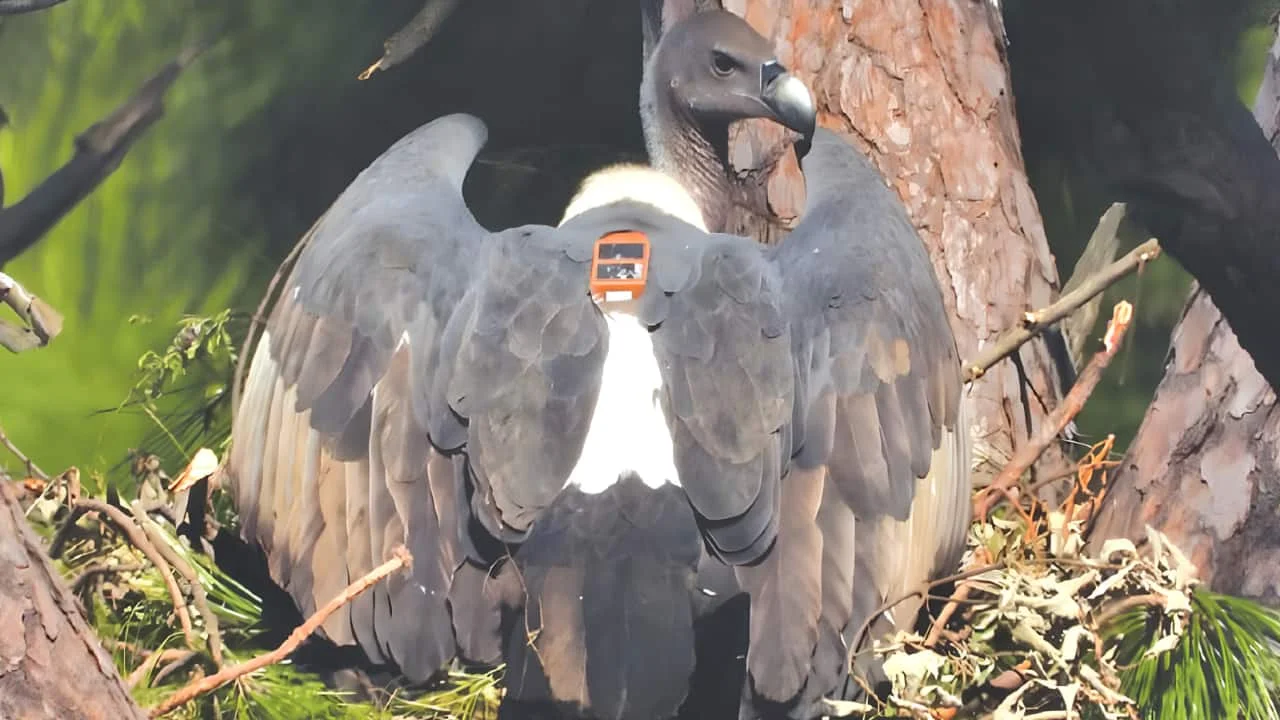
A critically endangered vulture that travelled nearly 600 km from Nepal to Himachal Pradesh has been spotted sitting on a nest alongside its mate, offering fresh hope for the conservation of the threatened bird species. Identified by its satellite tag number J81, the White-rumped Vulture reached the Pong region in Kangra district in April 2026. Its discovery has also drawn attention to the region's growing importance as a breeding habitat for vultures.
The bird's journey across an international border, and its decision to settle and breed in a new landscape, gives scientists rare evidence of how endangered birds use habitats across countries, and how a recovering nesting stronghold can draw them in.
Tagged in Nepal in March
The adult White-rumped Vulture (Gyps bengalensis) was captured and fitted with a satellite transmitter at Nepal's Shuklaphanta National Park on March 16, 2026. The tagging exercise was jointly conducted by teams from Nepal's Department of National Parks and Wildlife Conservation, Bird Conservation Nepal and the Royal Society for the Protection of Birds.
After spending around two weeks near the national park, the bird began moving westwards towards Uttarakhand before reaching Himachal Pradesh in mid-April. Satellite tracking showed that it had travelled approximately 600 km. Since arriving in the state, J81 has been moving within an area of around 45 km around the Pong region, which is a known nesting habitat for the species.
Spotted with its mate at Pong
The remarkable development was recorded on November 4, when vulture biologist Malyasri Bhattacharya spotted the satellite-tagged bird sitting on a nest alongside its mate in the Pong area.
Bhattacharya, a member of the International Union for Conservation of Nature's (IUCN) Vulture Specialist Group, said researchers had located a bird that travelled from Nepal, paired up and was now occupying a nest.
The observation provides valuable information about the species' long-distance movements, habitat selection and breeding behaviour. It also highlights how endangered birds can use habitats across international boundaries, a fact that makes conservation a shared responsibility rather than a national one.
Kangra records more than 615 vulture nests
J81's arrival comes as Kangra district records a significant increase in vulture nesting activity. More than 615 vulture nests have been documented in the district, compared with just 26 in 2004-05.
The turnaround reflects years of conservation work to protect the birds, whose numbers crashed across South Asia after the veterinary drug diclofenac poisoned the carcasses they fed on. The Pong region, with its reservoir, cliffs and quiet nesting sites, has become one of the most important breeding areas for the species in India.
For researchers, J81 is now more than a data point on a tracking map. A bird that crossed a border, found a mate and settled on a nest is living evidence that the habitat is working, and that the long effort to bring vultures back from the edge of extinction is bearing fruit.