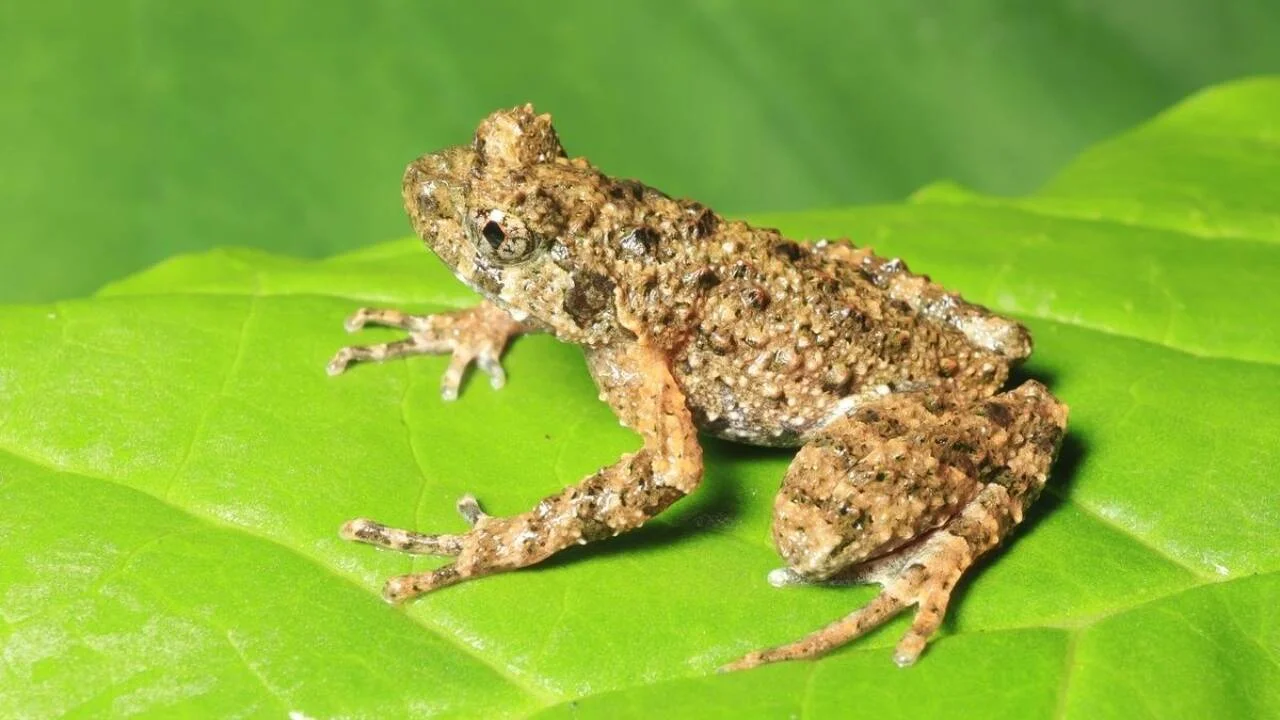
Scientists in India's eastern Himalayas have stumbled upon five new species of tiny horned frogs, including one that does something truly odd: it swallows land snails whole, shells and all. The discovery more than doubled the global count for this frog group, and suddenly India's amphibian diversity looks much richer.
It took five years of fieldwork by a team from the University of Delhi and Harvard University, led by Dr. Sonali Garg, working out of Harvard's Museum of Comparative Zoology. They combined DNA analysis, frog calls, and traditional identification methods, and their results, published in Royal Society Open Science on November 11, 2026, not only highlight new species but also shed light on how the Himalayas became a hotbed for frog evolution. The study credits local communities too, as their deep forest knowledge and hands-on help made these discoveries possible.
Five new members of a tiny genus
The frogs belong to the genus Jingophrys, or diminutive horned frogs. They are tiny, with small bodies and odd horn-like skin patches above their eyes. Previously, scientists knew of only six Jingophrys species worldwide. Now, five more join the list, pushing the count to 11: seven times more recorded species in India than before.
Meet Jingophrys taniitatii (Tanii horned frog), Jingophrys tanogogo (snail-eating horned frog), Jingophrys siangensis (Siang horned frog), Jingophrys hrdy (Hrdy's horned frog), and Jingophrys wularsoni (Wu-Larson's horned frog).
The snail-eater stands out
By far, Jingophrys tanogogo stands out due to its food preferences. Using advanced micro-CT imaging, scientists discovered entire snail shells inside its digestive tract, making it the first recorded Indian frog known to eat snails, shells and all, and the first in its family displaying such behaviour.
The species name itself is a nod to local language: "tanogogo" comes from Apatani words tied to both snails and frogs. The frog's diet is not just a curiosity. It shows how a tiny animal can occupy a feeding niche no other frog in its family has been recorded using.
Five years searching in Himalayan wilds
Catching these frogs is tricky, as some are nocturnal, shy, and vanish outside their brief breeding windows. The team worked at night in rugged mountains, sometimes in freezing weather with little or no shelter. According to Delhi University professor SD Biju, some sites were practically unreachable.
They combined DNA sequencing with physical traits and frog calls to prove these were indeed new species. The researchers did not just find new frogs; they documented everything from their unique vocal sounds to overlooked tadpole features.
Local tribes played a crucial role in this research, guiding the scientists through challenging terrain, sharing forest secrets, and helping locate these elusive frogs. In gratitude, the team named some frogs after communities and regions: the Tanii horned frog recognises the Tanii people, while the Siang horned frog takes its name from the Siang area.
What it means for Himalayan biodiversity
This is not just about new names on a list; it changes how we see the region's wildlife. The eastern Himalayas are not only a bridge for species moving between India and Southeast Asia. Based on DNA, the rise of these mountains and the powerful South Asian monsoon drove frog diversification. Rivers and changing heights kept populations apart, leading to multiple new species living surprisingly close together, sometimes just 10 kilometres apart. Four Jingophrys relatives share that tight space.
What is even more optimistic is that more research is underway, as scientists still need to figure out where these frogs live, what habits they have, and how best to protect them. As of now, this discovery is a reminder that India's forests are not done giving up stunning secrets. Sometimes, you have to look closely, even at the tiniest creatures, to find them.