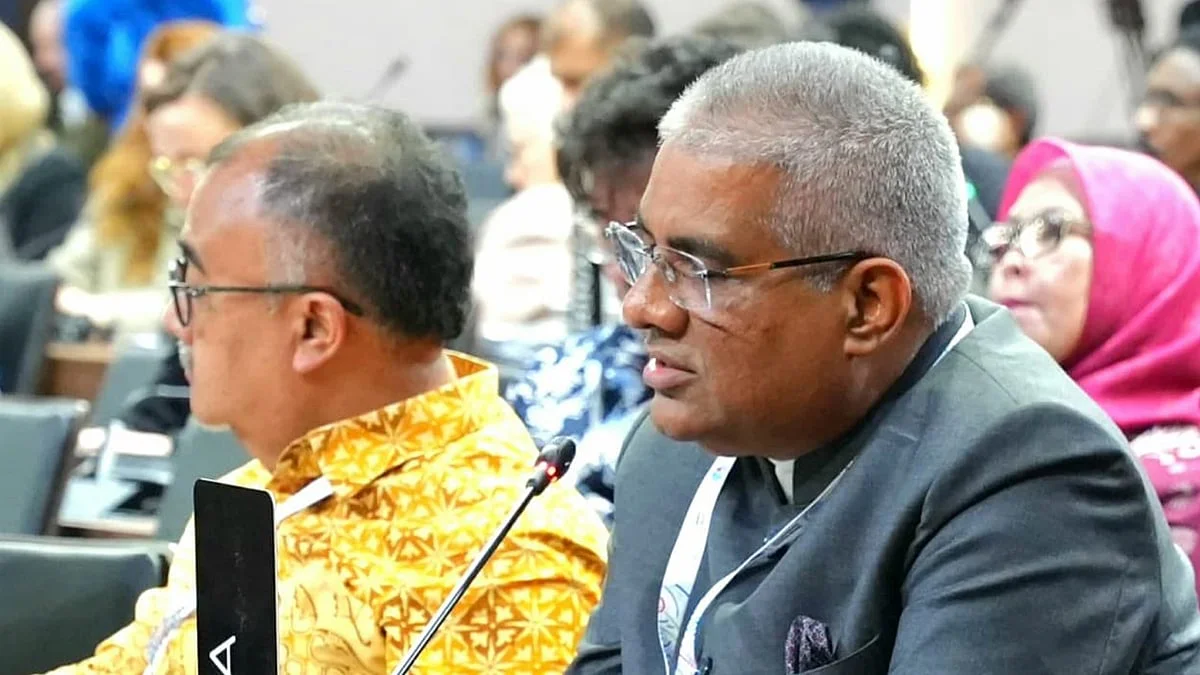
Union Minister of Environment, Forests and Climate Change Bhupender Yadav on Tuesday called for strengthening India's partnership with Small Island Developing States, known as SIDS, to build resilient coasts and oceans through knowledge sharing, technology partnerships and practical cooperation. He was speaking at the 31st Conference of Parties, or COP31, in Antalya, Turkiye.
At the high-level ministerial event on India-SIDS partnership for resilient coasts and oceans, Yadav said healthy oceans and resilient coastlines are fundamental to economic security, ecological stability and people's wellbeing.
"Guided by the vision of Prime Minister Shri Narendra Modi and the principle of Vasudhaiva Kutumbakam, India believes that environmental protection and development must advance together, with climate resilience centred on people, livelihoods and ecosystems," Yadav said.
Four priority areas
Yadav set out four priority areas for cooperation with island nations: coastal risk assessment and early warning systems; ecosystem restoration and protection; technology partnerships focused on renewable energy and water security; and institutional cooperation and capacity-building.
India also stressed ecosystem-based approaches covering mangrove conservation, coral reef and seagrass protection, wetland restoration and sustainable management of coastal and marine resources, along with technology partnerships to preserve coastlines and protect the communities living around them.
India's coastal experience
Sharing India's experience in coastal resilience, Yadav highlighted India's 11,099-km coastline and its efforts in scientific assessment, ecosystem conservation, shoreline management and disaster preparedness. He spoke about India's Mangrove Initiative for Shoreline Habitats and Tangible Outcomes, known as MISHTI, an initiative to advance mangrove conservation and restoration while supporting coastal livelihoods.
India's experience in scientific coastal assessments, ocean forecasting and early warning systems, particularly in the states of Odisha and Andhra Pradesh, will be significant areas of knowledge exchange with island nations, Yadav said. India said it was ready to share its knowledge, technology and experience with island countries facing rising sea levels, coastal erosion, ocean warming, coral bleaching, stronger storms and marine pollution.
Who was in the room
The meeting, titled India-SIDS Partnership for Resilient Coasts and Oceans: Sharing Knowledge, Technology and Solutions, was organised by The Energy and Resources Institute, known as TERI, and India's Environment Ministry, in partnership with the International Solar Alliance. Ministerial representatives from Mauritius, Kiribati and the Marshall Islands attended, alongside senior officials from Fiji, TERI and the International Solar Alliance.
Through the International Solar Alliance, the Coalition for Disaster Resilient Infrastructure, Infrastructure for Resilient Island States and the Forum for India-Pacific Islands Cooperation, India is also seeking to expand cooperation in renewable energy, disaster preparedness and climate-resilient infrastructure.
Countries being affected by coastal degradation have already been woken up into action. A working paper released by the World Resources Institute on Monday highlighted that 95 per cent of the latest nationally determined contributions from coastal and island countries include ocean-based climate action, compared to 73 per cent in the previous round. The report said the challenge would now be to translate that growing recognition into delivery, while strengthening commitments in sectors with substantial potential to cut emissions.