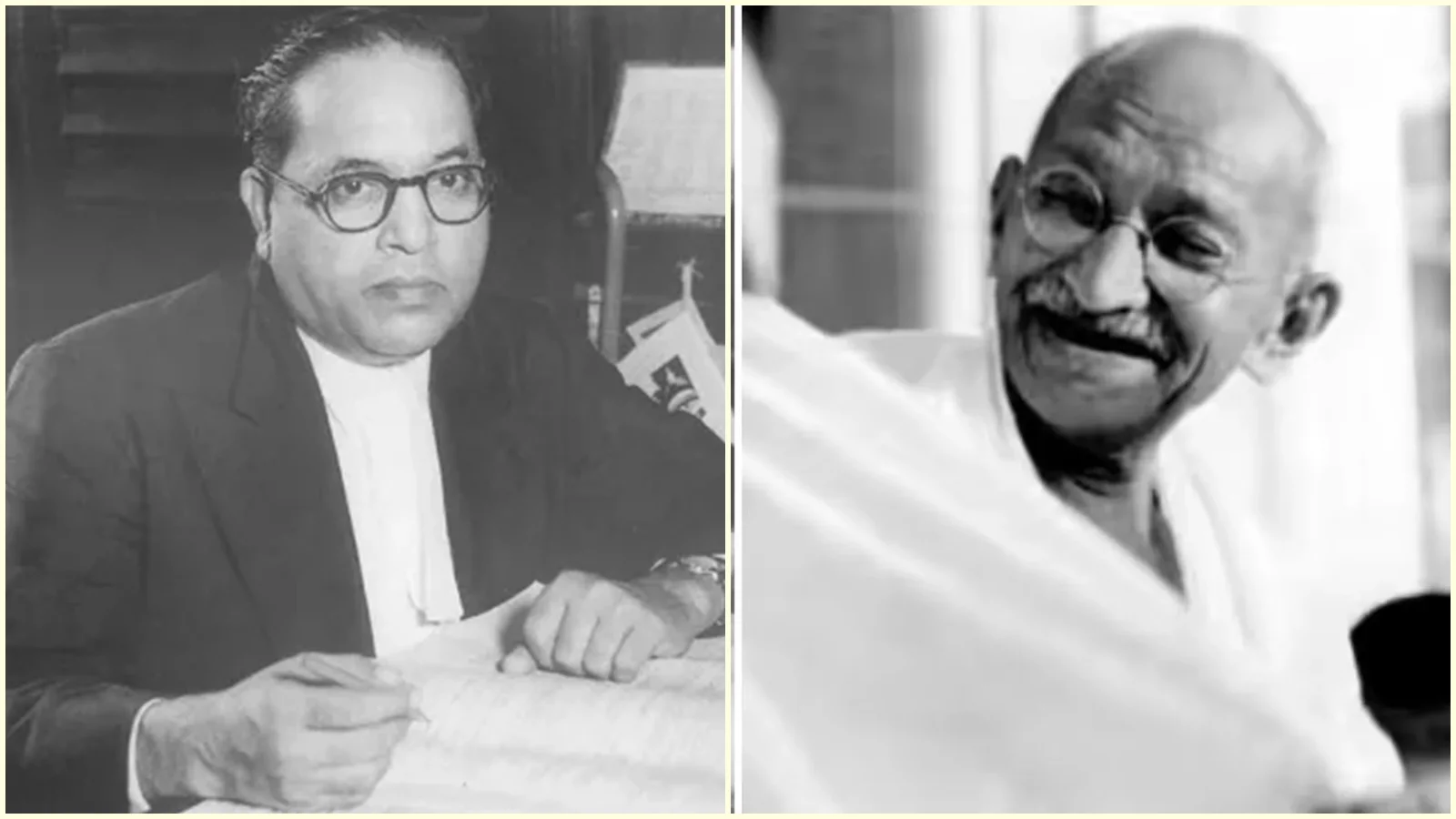
Gandhi and Ambedkar were never friends in life, but their legacies are converging now. That is the argument of Yogendra Yadav, member of Swaraj India and national convenor of Bharat Jodo Abhiyaan, in a column in The Indian Express. Ramachandra Guha's recent book, "Arguments with Gandhi", traces "The Life and Afterlife of the Gandhi-Ambedkar Debate", and Yadav says the debate has entered a new phase.
Two phases of a rivalry
For the first three decades after Independence, Yadav writes, Gandhi was deified and Ambedkar was erased. His own course on Modern Indian Political Thought at Jawaharlal Nehru University in 1982 did not mention Ambedkar, Lohia or Periyar.
After Ambedkar's birth centenary in 1989 and the rise of BAMCEF, the balance flipped. Ambedkar became the new icon, and Gandhi became suspect. The two figures were cast as rivals, and their followers as opposing camps.
The Lohiaites built the first bridge
Yadav credits the Lohiaites with building the first bridge. Their call of "jati todo", break caste, resonated with Ambedkar's Annihilation of Caste, and Lohia described himself as a kujaat Gandhian, a Gandhian of low caste.
The bridge produced political offshoots: the Samata Sangathan, the Socialist Front of Maharashtra, the Samajwadi Jan Parishad and the Sarvodaya Karnataka Paksha. These groups tried to carry forward both legacies at once.
Scholarship reassessed Gandhi on caste
Scholarship has also reassessed Gandhi's views on caste. D R Nagaraj's essay "Self-Purification versus Self-Respect", in The Flaming Feet (1993), argued that Gandhi and Ambedkar transformed each other. Mark Lindley's 1997 essay examined Gandhi and intermarriage. Raosaheb Kasbe's Marathi writings culminated in "Gandhi: Parajit Rajnitigya Aur Vijayi Mahatma" (2020).
Nishikant Kolge's "Gandhi Against Caste" (2018) traced five phases in Gandhi's views on caste, arguing that he was a gradualist for strategic reasons, and defended Gandhi against Arundhati Roy. Shashi Bhushan Upadhyaya's "Gandhi and the Caste Question in Colonial India" (2025) identified three strands in Gandhi's thinking: untouchability, which he opposed absolutely; jati, on which he was ambivalent; and varna, towards which he was positively inclined.
A new future on the streets
The convergence is now visible on the streets, Yadav writes. Images of Babasaheb and Bapu on the same stage, and "Jai Bhim" slogans alongside Gandhi quotes on placards during the July kranti, signalled a new future.
Babasaheb and Bapu are friends now, Yadav concludes, and for all of us, that is a reason for hope.