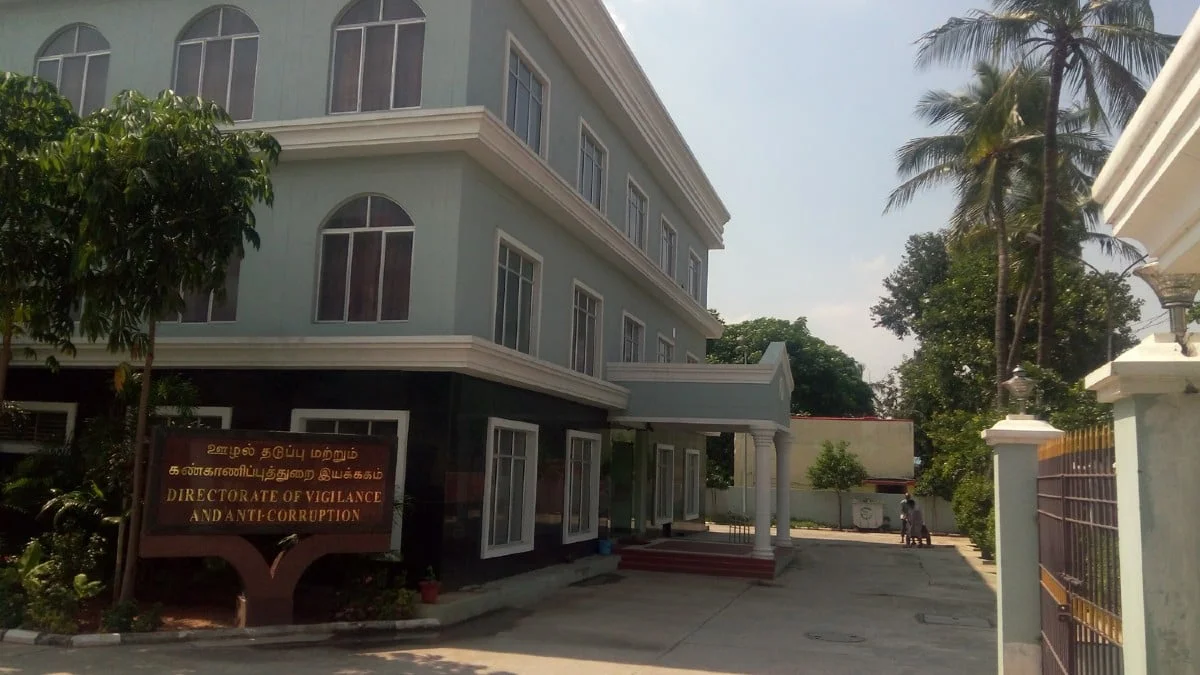
Tamil Nadu's Directorate of Vigilance and Anti-Corruption has arrested publisher R Mohan over allegations that books carrying fictitious authors' names and material drawn from websites and ChatGPT were supplied to government libraries across the state. Mohan owns Agalvilakku Publishers and Phoenix Publications, which operate from the same address in Chennai's Madipakkam, according to the FIR.
The agency says the two firms received Rs 1.74 crore for supplying books to public libraries. DVAC teams searched premises linked to Mohan and the publishers, including a publishing facility at Kudavasal in Tiruvarur district and district libraries in Ranipet, Tirupattur, Kancheepuram and Tenkasi. The FIR was registered on Sunday, 15 November, and names Mohan, unidentified public servants at the Directorate of Public Libraries, the Anna Centenary Library in Chennai and Periyar Arivulagam in Coimbatore, and other unidentified people.
The case began with a visit by acclaimed Tamil novelist Perumal Murugan to the newly inaugurated Periyar Arivulagam library in Coimbatore, built at a cost of around Rs 300 crore and inaugurated by Chief Minister C Joseph Vijay on 16 October. In an essay published on 6 November, Murugan flagged nearly 1,800 Agalvilakku books and more than 100 Phoenix books at the library, noting that they appeared poorly produced, overpriced and of doubtful authenticity.
The errors he found were striking. One book, Surya Balu's Naladiyar: A Guide to Life, priced at Rs 1,445 for 300 pages, described the Naladiyar anthology of classical Tamil verses as a poet and a philosopher. Another, Dev Nilan's Madurai Kanchi, described the classical work's author as a king. Economist Jean Dreze found a book attributed to him that he never wrote.
Fictitious authors, impossible output
The FIR alleges that Mohan created books under fictitious names using material from websites and online applications, including ChatGPT, and that the contents were vague, irrelevant, misleading and of substandard language. The scale of the alleged invention is laid out in the numbers: the FIR credits "Monika Ravi" with 162 books, "Lakshmi Mohan" with 124, "Thamarai Panneer" with 123, "Thamarai Murali" with 115 and "Jothi Hariharan" with 114, across unrelated subjects.
Seventy-four author names appeared under both publishers. The book Deepfakes: The Coming Infocalypse appeared under "Manisha Saravanan" at Agalvilakku and "Charulatha Vivek" at Phoenix. The FIR identifies the original author as Nina Schick. Mohan submitted 2,339 Agalvilakku titles and 99 Phoenix titles, and purchase orders covering 1,857 books were issued in February 2026, when the DMK was ruling the state.
The alleged operation depended on more than invented authorship. The FIR says the lists of the two publishers were accepted without scrutiny, and that books the experts had not recommended entered the procurement lists and were paid for. Murugan himself belonged to the recommendation committee for libraries, and the FIR draws a distinction between what that committee recommended and what was subsequently submitted for selection.
How the checks failed
Tamil Nadu's Transparent Book Procurement Policy, introduced in March 2024, required ISBNs and subject-expert evaluation of books before purchase. The FIR traces eight checkpoints in the process: recommendation, selection, negotiation, approval, purchase order, receipt, verification and payment. It alleges that the two publishers' lists passed through them without scrutiny.
A coordination committee comprising S Kamatchi, V Dinesh Kumar, S Santhana Karthikeyan and S Santhana Krishnan, constituted on 18 November 2025, allegedly added books from publishers the experts had not recommended, without noting the additions in the file. Selection took place on 9 January 2026, price negotiations on 24 January, and high-level consideration on 5 February. Purchase orders followed from 7 February, with Phoenix orders on 13 February and Agalvilakku orders on 14 February.
The procurement formed part of a Rs 50-crore allocation for Periyar Arivulagam's books and e-books, with a Rs 30-crore advance authorised. That allocation is not the alleged loss, which the agency puts at the Rs 1.74 crore paid to the two publishers.
Courts, suspensions and a statewide audit
The School Education Department sought a DVAC enquiry on 6 November, and the agency began a detailed enquiry the next day. On 10 November, the Madurai Bench of the Madras High Court, comprising Justices G R Swaminathan and M D Sumathi, heard a contempt petition alleging non-compliance with earlier court directions on transparent procurement, and directed the DVAC to register an FIR, freeze bank accounts and initiate disciplinary action. Three accounts holding Rs 22 lakh were frozen.
Five officials were suspended on 15 November: S Kamatchi, Dinesh Kumar, V Santhanakrishnan, S Santhana Karthikeyan and chief accounts officer J Juliet. The state government has launched a statewide audit that has so far identified and removed 70,674 books from library shelves, and cancelled all pending orders.
School Education Minister A Rajmohan has called the case the world's first AI books scam. Chief Minister Vijay blamed the previous DMK regime for the alleged irregularities and thanked Murugan for bringing them to light. The DMK has sought an independent inquiry and alleged political exploitation of the case. The offences invoked in the FIR include criminal conspiracy, cheating, criminal breach of trust, fabrication of documents, criminal misconduct by public servants and offences under the Copyright Act.