
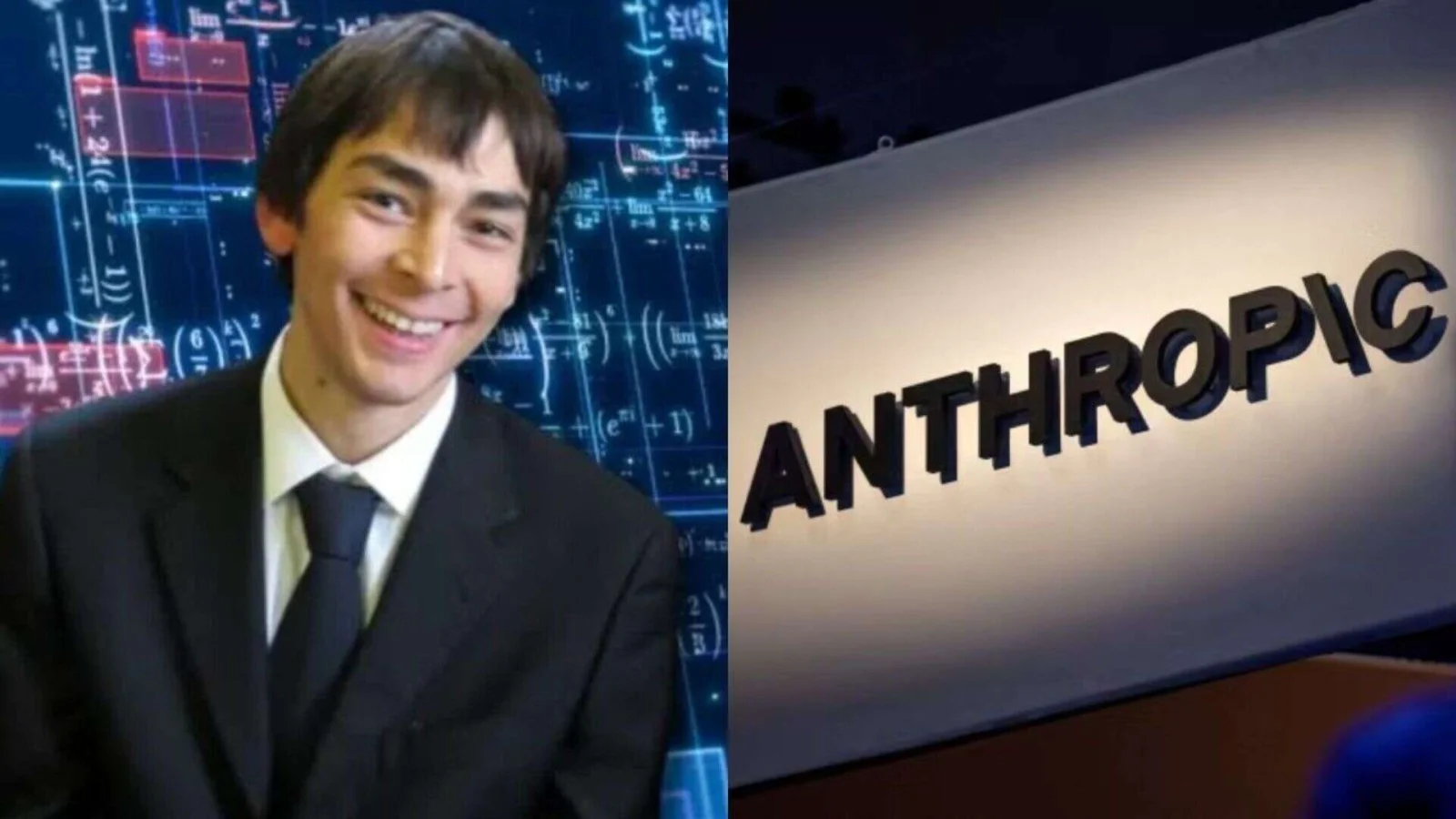
A mathematician at Anthropic has claimed to have solved the Riemann Hypothesis, the most famous unsolved problem in mathematics, with the help of the company's artificial intelligence model Claude. Levent Alpöge announced on Friday that he believes he has discovered a proof of the conjecture, which has resisted every attempt at a solution since it was proposed in 1859. The claim, if verified, would be one of the most significant moments in the history of mathematics, and a landmark for AI assisted research, The Times of India reported.
The Riemann Hypothesis concerns the distribution of prime numbers, the numbers divisible only by themselves and one. Proposed by German mathematician Bernhard Riemann in 1859, it predicts a precise pattern in how primes are spread along the number line. It is one of the seven Millennium Prize Problems chosen by the Clay Mathematics Institute in 2000, each carrying a prize of 1 million dollars for a correct solution. The hypothesis has guided research across number theory for more than a century and a half, and its proof has eluded the best minds in the field.
A proof written in code, not on paper
Alpöge did not publish a traditional mathematical paper. Instead, he posted a four-page statement on his personal website and released the full argument as computer code written in Lean, a programming language that lets computers check mathematical arguments line by line. The code runs to more than 1.7 crore lines, and Alpöge described the complete AI-written version as incredibly long, running to more than 250,000 pages. He also said the method extends to the generalised Riemann Hypothesis, a broader version of the same conjecture.
In his statement, Alpöge wrote, "I believe I have, working with Claude, discovered a proof of the Riemann Hypothesis." He said he had worked with Claude over several months and that the AI system eventually moved far beyond his own pace of reasoning. "Claude far outpaced me near the finish line. No, Claude flew, and danced, and sparkled near that finish line," he wrote. He added that the approach combined ideas from several branches of mathematics, including an adaptation of a technique known as Stepanov's method, with Claude suggesting the use of mathematical operations called theta lifts to overcome a key difficulty.
Verification still pending
Mathematicians have urged caution, because the claim has not yet been independently verified or formally accepted. The Clay Mathematics Institute still lists the hypothesis as unsolved. Andrew Sutherland, a mathematician at the Massachusetts Institute of Technology, said he had independently compiled Alpöge's result in Lean and described the development as a historic moment, and two separate proof-checking systems have accepted the result, according to The Hindu. Even so, experts stress that checking the code is not the same as understanding the ideas behind it, and Alpöge himself has acknowledged that he does not yet fully understand every argument Claude used.
The announcement drew a reaction from Google chief executive Sundar Pichai, who wrote on X, "Somewhere Euler, Gauss and Riemann in awe today!" The remark referred to Leonhard Euler, Carl Friedrich Gauss and Bernhard Riemann, three of the most influential figures in the history of mathematics. Alpöge said the result came late on Sunday night, days before Anthropic went public, and that he messaged chief executive Dario Amodei to ask permission to announce it. Anthropic did not respond to a request for comment after his post, as its shares fell 13.04 percent on the first full day of trading, The Times of India reported.
**Q:** What is the Riemann Hypothesis? A: It is a conjecture proposed in 1859 about the distribution of prime numbers, and one of the seven Millennium Prize Problems carrying a 1 million dollar prize. **Q:** Who claims to have proved it? A: Anthropic mathematician Levent Alpöge, who says he developed the proof working with the AI model Claude. **Q:** Has the proof been accepted? A: No. It has not been independently verified or formally accepted, and the Clay Mathematics Institute still lists the hypothesis as unsolved.