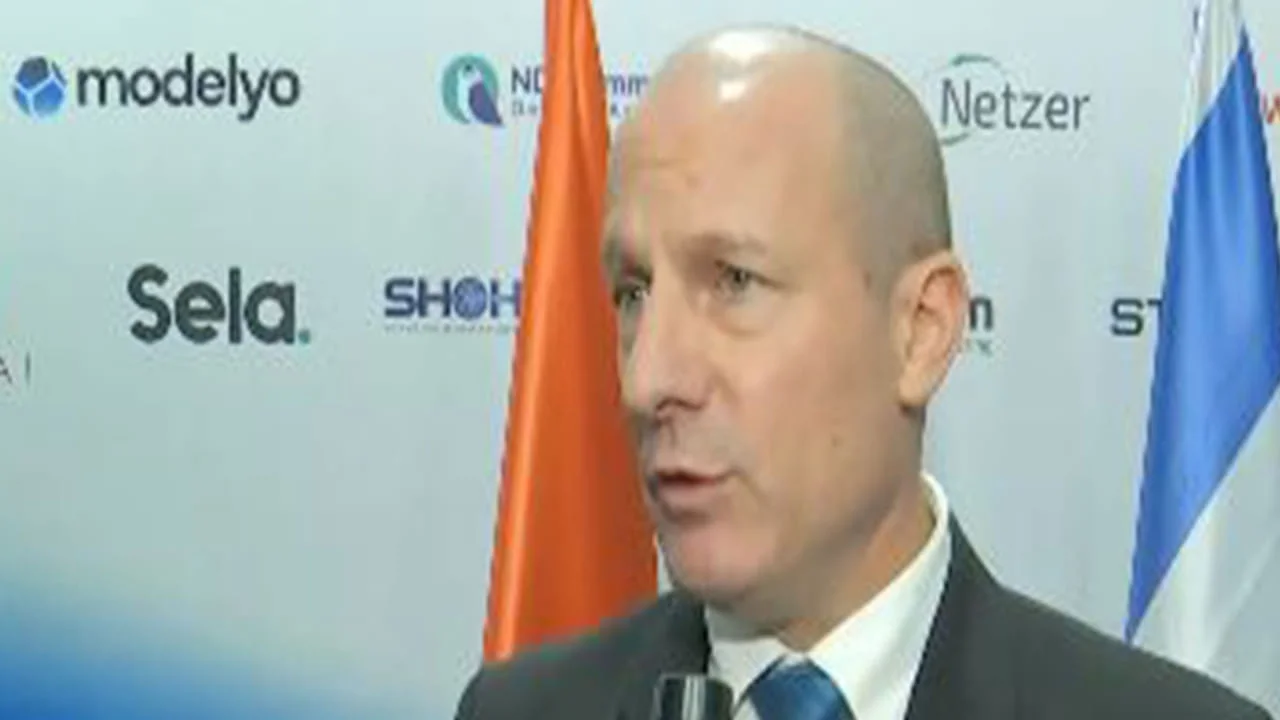
Israel will launch a new programme called Landing Pad on Wednesday to help Israeli companies identify Indian partners, secure financing and navigate legal requirements, Israeli Ambassador to India Reuven Azar said at the Bengaluru Tech Summit 2026.
Speaking to ANI at the summit on Tuesday, Azar said the initiative would receive government support to help companies from both countries build partnerships. "We are launching tomorrow a new program called Landing Pad for Israeli companies. We are going to help companies more diligently in trying to find partners here with the companionship of the government to help them to find the partners, to find the financing, to help with the legal work," he said.
From selling products to co-production
Azar said India-Israel technology cooperation was moving beyond product sales towards joint development and manufacturing. India brings manufacturing scale and cost advantages, he said, while Israel brings technological capabilities and access to Western markets. "We are now moving on from just selling products to co-production. India has a huge advantage when it comes to scalability, and we can create competitiveness together," he said.
Twenty-seven Israeli companies are taking part in this year's summit, representing artificial intelligence, cybersecurity, defence and radar technologies. Azar said these companies were looking for Indian partners to jointly manufacture and market products around the world, rather than simply selling technology in India.
Data centres, R&D and semiconductors
Azar said Israel also wanted to build data centres and research and development facilities in partnership with Indian private companies and academic institutions. "We want to build together data centers and also centers for R&D," he said.
On semiconductors, Azar said several cooperation initiatives were already underway, including one in Gujarat covering chip research and manufacturing. He cautioned, however, that building a semiconductor industry would take several years because of its complexity and the competition from established global companies.
The ambassador said existing defence cooperation was also being extended into dual-use and civilian technologies, pointing to the Drishti project in Hyderabad, which involves India's Defence Research and Development Organisation and Israel's defence development agency.
On investment, Azar said venture capital was flowing in both directions in growing volumes, with Indian investors also beginning to invest in Israeli companies. He added that both countries needed to strengthen supply-chain resilience amid geopolitical uncertainties.
Israel and India are already linked through the Israel-India Industrial R&D and Technological Bilateral Fund, known as I4F, and Israel fielded its largest-ever national pavilion at the Bengaluru Tech Summit in 2025, with around 20 deep-tech companies. The 29th edition of the summit runs from 17 to 19 November at the Bangalore International Exhibition Centre under the theme AI and Beyond.