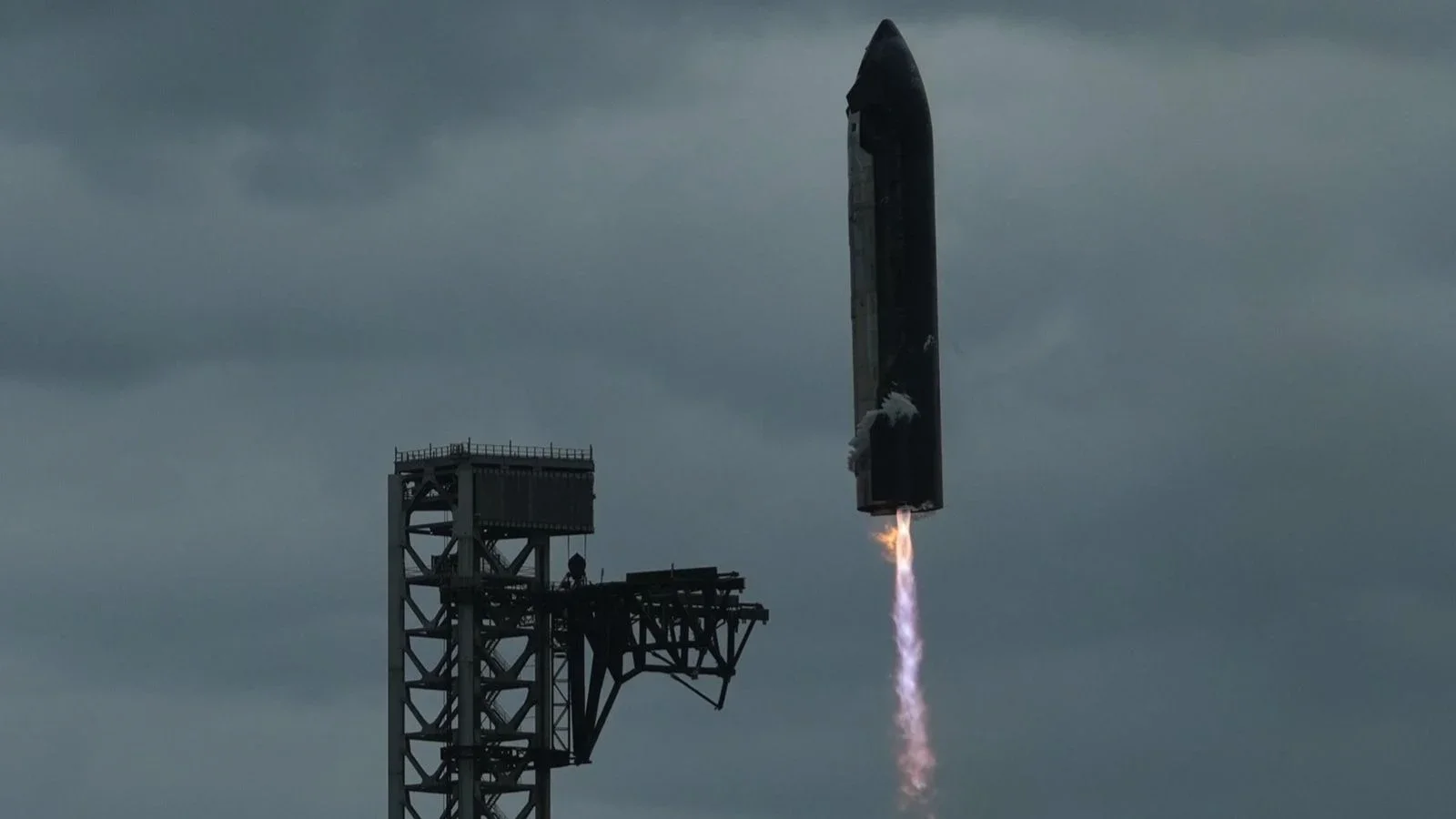
Flight 15, known as IFT-15, lifted off from SpaceX's Starbase facility in Texas on Friday, 13 November, at 5.47 pm local time. The mission's upper stage, Ship 42, stood 171 feet (52 metres) tall. After completing its orbital test objectives, the spacecraft re-entered the atmosphere and was steered back to the launch site, where the tower's "chopstick" arms, a system SpaceX calls Mechazilla, caught it above Launch Pad 2 at about 3.20 pm local time.
SpaceX had previously caught only the Super Heavy booster, the first stage of the rocket. The catch on Saturday was the first for a spacecraft returning from orbit. The company had earlier abandoned a plan to catch the booster and the spacecraft on the same flight, after the booster failed during its own recovery attempt.
Booster lost in the Gulf
The Super Heavy booster, which had powered the first phase of the flight, failed to complete its planned return. SpaceX said the booster's engines stopped firing too soon and its guidance system sensed it was in the wrong position, so controllers diverted it to the Gulf of Mexico, where it was destroyed before impact. The planned double catch, of both the booster and the spacecraft, did not happen.
SpaceX played the 1977 hit "Baby Come Back" by Player during the livestream of the Starship catch. "The spacecraft looks great," Elon Musk wrote on X after the recovery. SpaceX communications manager Dan Huot called the catch a major breakthrough, and said the company would use the recovered Starship to learn how to make the system fully reusable.
Why the catch matters
The catch matters because a fully reusable rocket system would cut the cost of spaceflight, and because Starship is central to NASA's plan to return astronauts to the Moon. NASA has selected a version of Starship as the lunar lander for its Artemis programme. The Artemis IV mission, which would use Starship, is due no sooner than 2028.
SpaceX's next challenge is to catch both the booster and the spacecraft on the same flight, and to turn Starship around quickly between launches. The company has now flown Starship 15 times since its first test flight in April 2023.