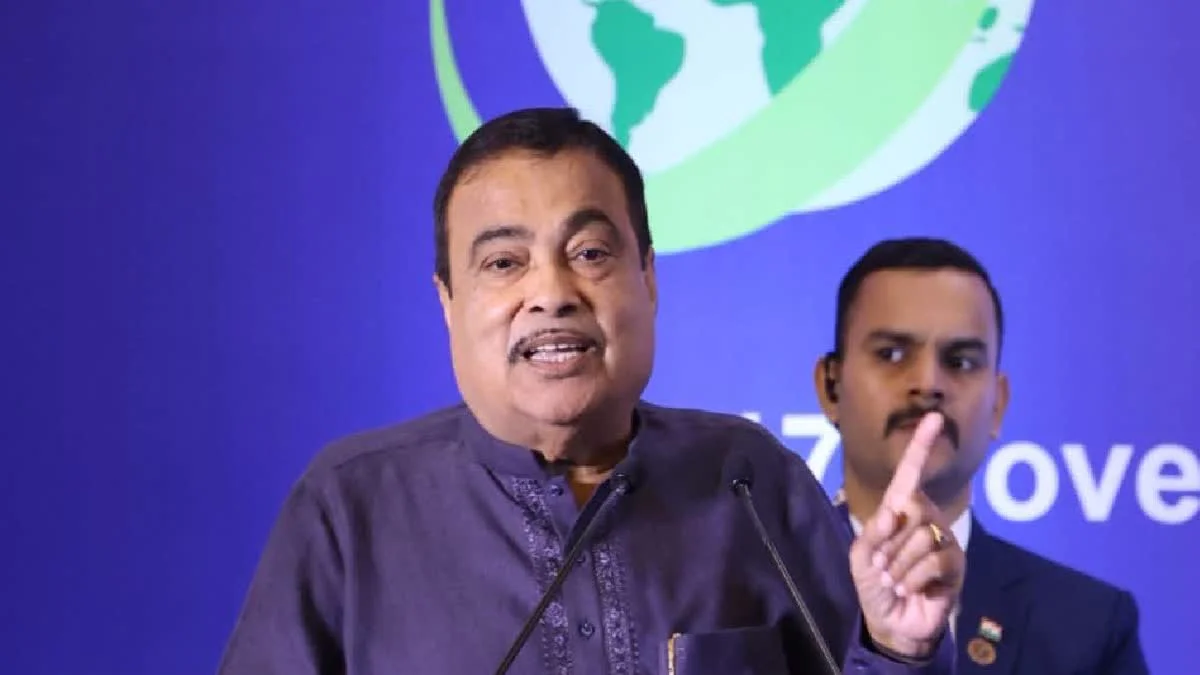
Union Road Transport and Highways Minister Nitin Gadkari on Tuesday set a target of making India the world's number one automobile industry within five years, arguing that the country had the manufacturing capabilities, skilled workforce and cost advantages required to achieve the ambition.
Speaking in New Delhi, Gadkari said India's automobile industry had grown from Rs 14 lakh crore when he took charge as transport minister to Rs 22 lakh crore currently. He said India had overtaken Japan to become the world's third-largest automobile market, behind the US, valued at Rs 78 lakh crore, and China, valued at Rs 47 lakh crore.
The minister also said the automobile industry had generated around 4.5 crore jobs and contributed significantly to state revenues through GST collections. He said employment generation remained a major priority, expressing his ambition to create employment opportunities for 12 crore young people over the next two to three years.
He also flagged the poor economic condition of farmers and people in rural and tribal areas, stressing the need to improve their livelihoods.
Safety standards for e-rickshaws
Gadkari said the government was preparing safety standards for e-rickshaws on the lines of the Bharat New Car Assessment Programme (Bharat NCAP), as part of efforts to improve road safety.
Highlighting the scale of the challenge, he said India witnesses nearly five lakh road accidents every year, resulting in around 1.8 lakh deaths. Bharat NCAP, launched in 2023, currently evaluates the crash safety of passenger cars and awards ratings from one to five stars based on occupant protection.
The minister outlined the agenda at the 14th CII Bioenergy Summit, where he also acknowledged the transport sector's contribution to air pollution, saying he considered himself responsible for nearly 40 per cent of the country's pollution because the sector falls under his ministry.
"We are building good roads in the country. People are buying vehicles, and everyone is driving on the roads, releasing smoke and increasing pollution," he said, linking rising emissions to expanding road infrastructure, increasing vehicle ownership and the growth of the automobile industry.
Alternative fuels and the e-bus gap
Gadkari pitched alternative fuels, including ethanol, methanol, biodiesel, compressed biogas, hydrogen and liquefied natural gas, as ways to address the pollution challenge while reducing India's dependence on imported fossil fuels.
Pointing out that India imports nearly 87 per cent of its fuel requirements and is the world's third-largest oil importer, Gadkari said the country needed to accelerate domestic bioenergy production.
He also highlighted the shortage of electric buses, saying India needs around 1.5 lakh electric buses, while its current production capacity stands at approximately 7,000.
The minister discussed the possibility of producing Sustainable Aviation Fuel from ethanol and rectified spirit, besides experiments involving isobutanol as an alternative to diesel. He said technologies were also being explored to convert industrial carbon dioxide into products such as urea and dimethyl ether (DME). According to him, blending up to 40 per cent DME with LPG could help reduce imports.
Rs 1,483 crore road projects for Delhi region
Separately, Gadkari announced approval for road infrastructure projects worth Rs 1,123.56 crore on the Delhi-Agra corridor and Rs 359.63 crore for upgrading a stretch of NH-9 in West Delhi, together worth Rs 1,483.19 crore.
The Delhi-Agra corridor project will cover parts of Haryana's Faridabad and Palwal districts and Uttar Pradesh's Mathura and Agra districts. It includes the construction of three road overbridges, four flyovers and four vehicle underpasses along National Highways 44 and 19.
The corridor handles approximately 68,000 passenger car units daily, including freight, industrial, commuter and tourist traffic. The proposed infrastructure is expected to reduce delays at railway crossings, ease congestion at intersections and separate local traffic from through traffic.
For West Delhi, the Centre has approved Rs 359.63 crore for upgrading a 12.4-km, six-lane stretch of NH-9 (Rohtak Road), from Udyog Nagar Metro Station to Tikri Border. The project will include improvements to the main carriageway and service roads, durable concrete pavement and better-designed junctions. Areas including Punjabi Bagh, Peeragarhi, Nangloi, Mundka and Tikri Border are expected to benefit, along with commuters travelling between Delhi and Bahadurgarh in Haryana.
On infrastructure financing, Gadkari said monetisation of highway projects could potentially generate at least Rs 15 lakh crore. He added that the government did not face a shortage of money or resources for highway development, but its challenge was the inability to spend the available funds effectively.