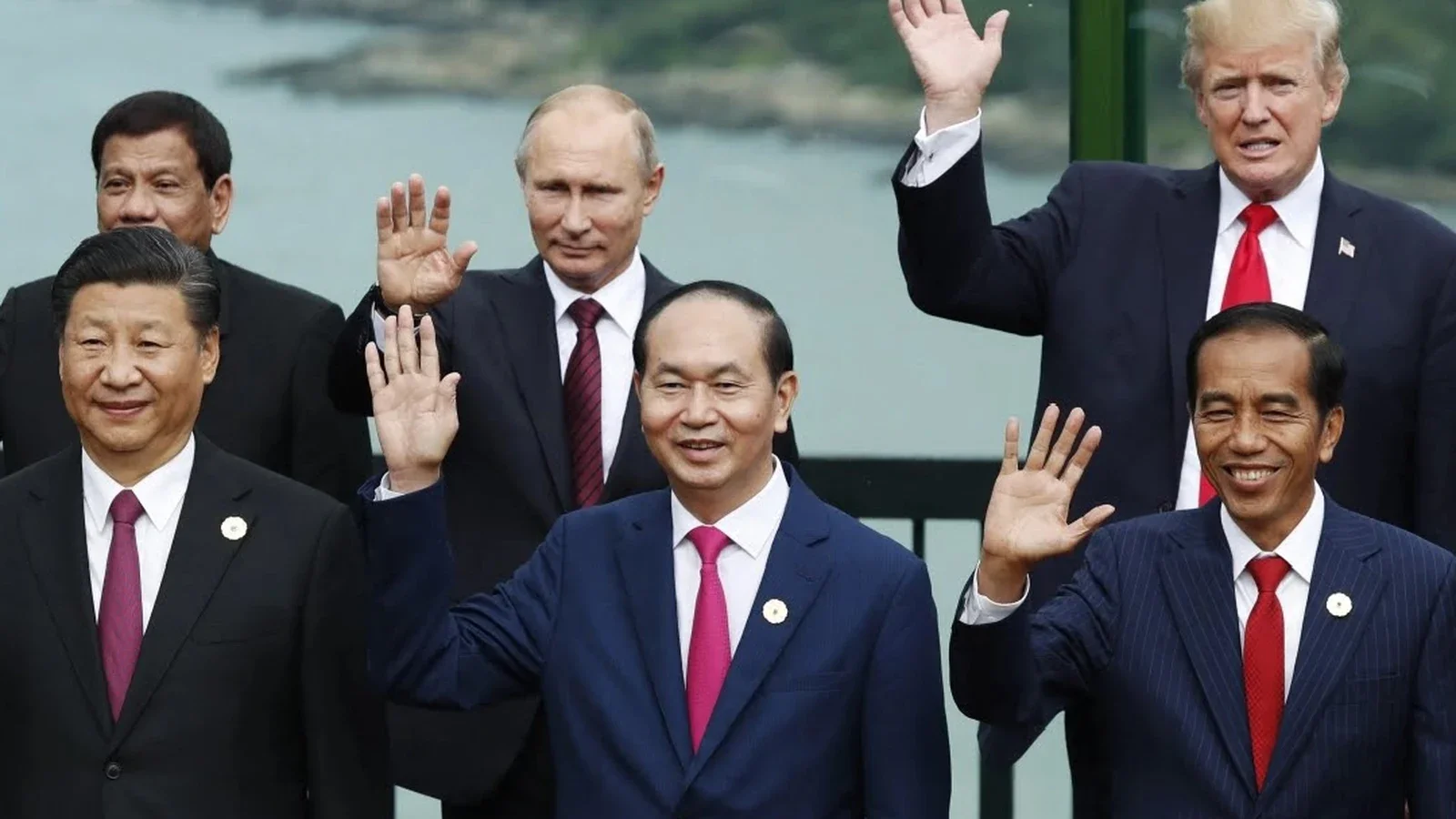
The leaders of the United States, China and Russia plan to meet on 19 November on the sidelines of next week's Asia-Pacific Economic Cooperation summit in Shenzhen, in an unprecedented gathering of the heads of the world's biggest nuclear powers. Plans for the three-way meeting of Donald Trump, Xi Jinping and Vladimir Putin were confirmed on Friday by the White House.
The meeting will take place during the 33rd APEC Economic Leaders' Meeting, scheduled for 18 and 19 November in Shenzhen, China's southern tech hub. The summit brings together 21 economies and marks a major moment for China to show off the coastal metropolis that grew from a small fishing village into a global technology and economic centre in just a few decades.
White House spokeswoman Olivia Wales said Trump's top priority at the trilateral talks would be efforts to reduce global nuclear arsenals. Trump has said the meeting would provide an opportunity for the three leaders to discuss the US war with Iran and his goal of reaching a three-way agreement on their nuclear arms stockpiles.
US officials also confirmed that Trump intends to raise the war in Iran during the meeting, but does not plan to discuss the war in Ukraine in the same forum. Ukrainian President Volodymyr Zelenskyy has voiced concern that the meeting could become a place to discuss a Ukraine deal behind Kyiv's back.
Nuclear arms at the centre
The main topic is nuclear weapons. The last arms treaty between Washington and Moscow, New START, expired in February, removing caps on the two largest atomic arsenals for the first time in more than half a century. The treaty had capped deployed strategic warheads at 1,550 and delivery vehicles at 700 for each side.
Putin had offered to keep the treaty's limits for one more year if Washington did the same. Trump has previously said a trilateral meeting would focus on denuclearisation, an unlikely prospect given China's reluctance to discuss limits on nuclear stockpiles with Russia and the United States, both of which hold much larger arsenals.
The Stockholm International Peace Research Institute says Russia holds the most nuclear warheads, followed by the United States, with China third. Analysts say expectations are low that the talks will lead to major breakthroughs, and that the meeting will be heavier in symbolism than substance.
A senior Trump administration official told reporters that no agreement was expected from the first meeting, though it could begin a process. The White House said the trilateral summit would take place towards the end of Trump's visit to Shenzhen, following his scheduled bilateral meeting and working lunch with Xi on Thursday afternoon.
A packed Asia trip
Trump will leave Washington on 16 November and stop in the Philippines on 17 November to attend the ASEAN summit before flying to Shenzhen for APEC. His bilateral meeting with Xi on 19 November will be their latest in a series of meetings this year, and the two leaders are also scheduled to hold a working lunch.
The US president does not plan to hold a separate bilateral meeting with Putin during the trip. Billionaire Elon Musk will travel with Trump but will not attend the trilateral meeting, according to US officials.
Kremlin spokesman Dmitry Peskov has dismissed comparisons with the Yalta conference, while Kremlin aide Yuri Ushakov said a three-way meeting would not be without merit. China's Foreign Ministry said on 6 November that Beijing was in communication with relevant parties about a meeting of the three leaders, having earlier called it neither fair, reasonable nor realistic to ask China to join trilateral arms talks.