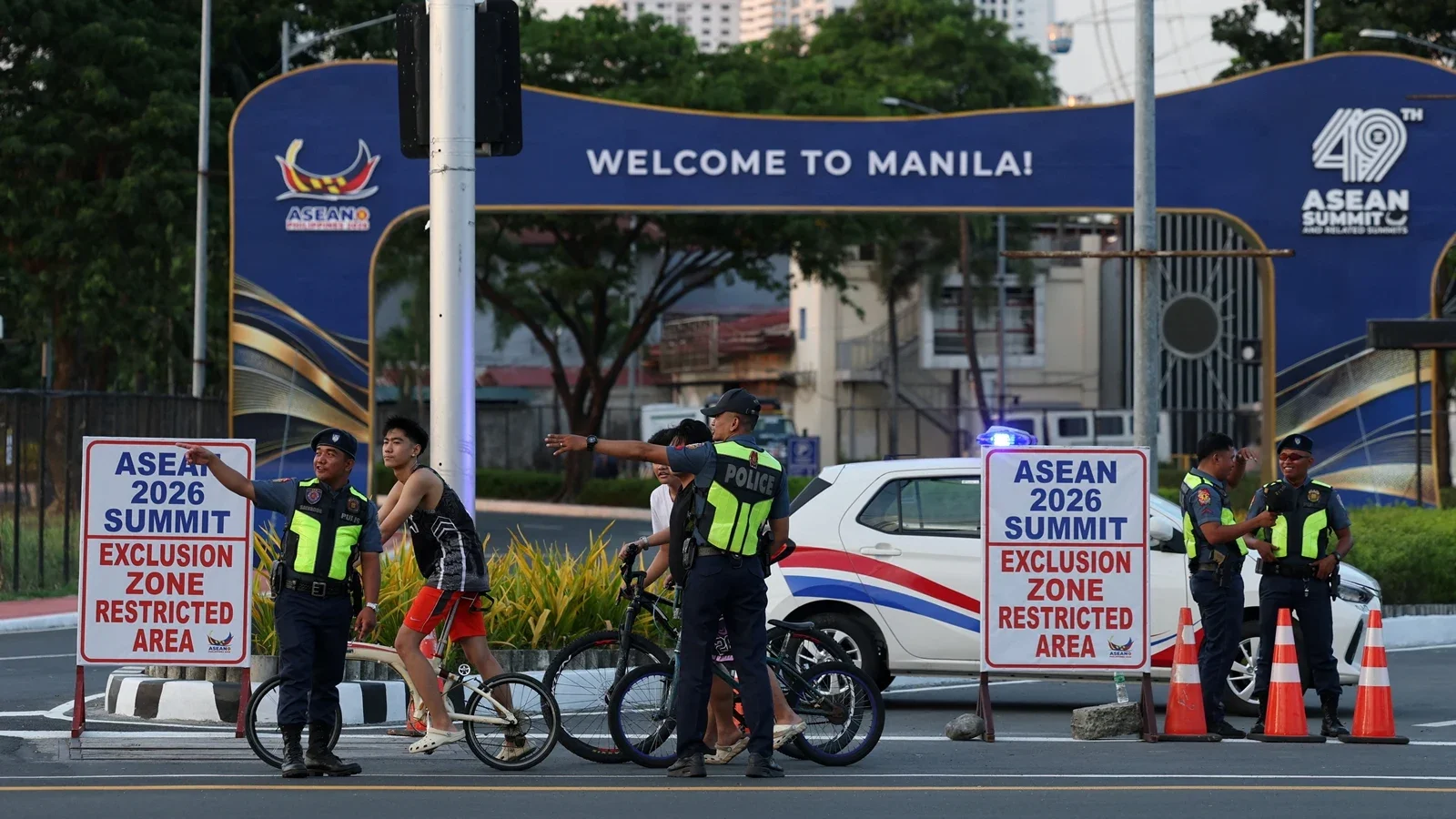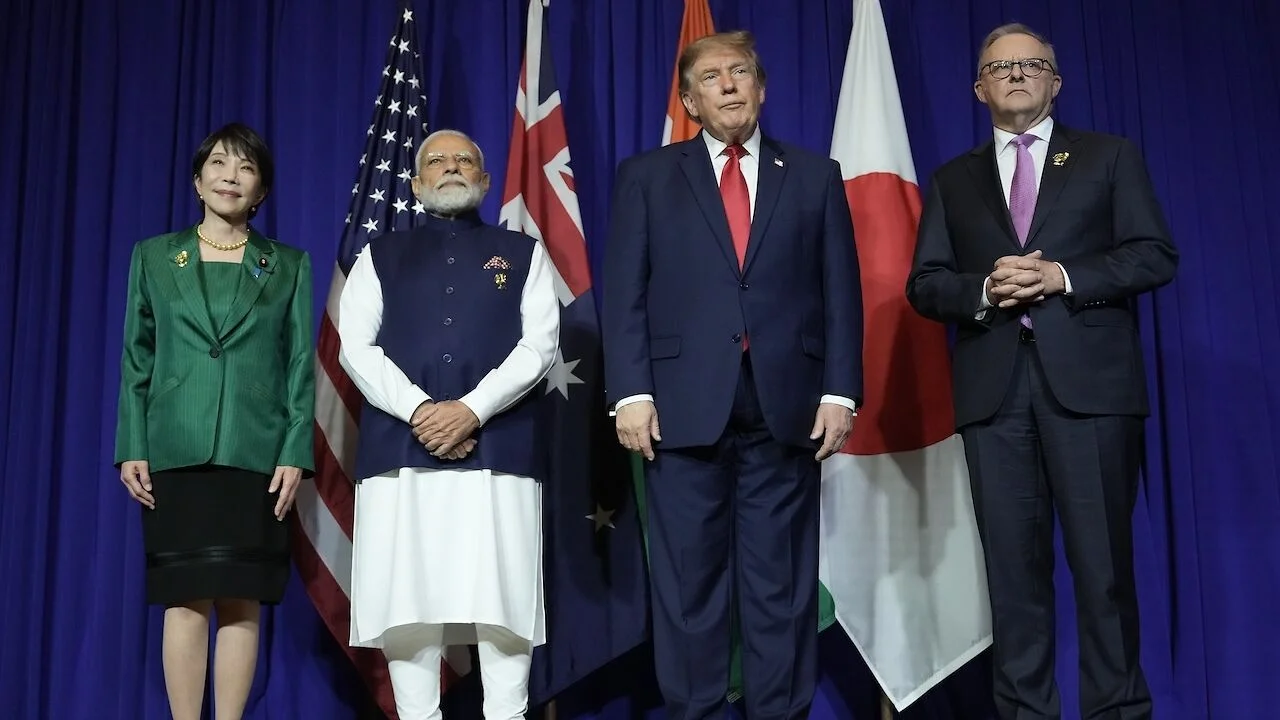
The leaders of the Quad countries, India, the United States, Japan and Australia, announced five outcomes at their summit in Manila on Tuesday, in their first meeting as a group since 2024.
Prime Minister Narendra Modi, US President Donald Trump, Australian Prime Minister Anthony Albanese and Japanese Prime Minister Sanae Takaichi attended the 7th Quad Leaders Summit, held on the sidelines of the ASEAN and East Asia summits. It was Takaichi's first Quad leaders' meeting.
In a joint statement, the four leaders said they strongly opposed destabilising or unilateral actions that seek to change the status quo, including by force or coercion, and expressed grave concerns about economic coercion, including through arbitrary export restrictions.
"We are securing critical supply chains, protecting freedom of navigation and overflight, driving growth through technologies of the future, including investments and deployment of trusted artificial intelligence, and responding to disasters with life-saving assistance," the statement said.
Mumbai to host first Quad Business Leaders Forum
The first outcome was the inaugural Quad Business Leaders Forum, which India will host in Mumbai in early 2027. The forum will bring together business leaders, government officials and policy experts from the four countries to build commercial partnerships.
"As four major market economies, we have a shared responsibility to create greater trade opportunities and build stronger supply chains," Modi said. "To turn our strategic cooperation into commercial partnerships, India has announced the QUAD Business Leaders Forum."
Modi said that if Australia's mining experience, Japan's recycling technology, America's expertise and India's manufacturing base came together, they could give new strength to supply chains, pointing to cooperation in critical minerals and manufacturing.
Patrol aircraft to fly together for the first time
The second outcome was closer counterterrorism cooperation, with the four countries unequivocally condemning terrorism and violent extremism in all its forms and manifestations, including cross-border terrorism.
The third was the Indo-Pacific Maritime Surveillance Collaboration, a new initiative to improve information sharing and maritime domain awareness. Under it, the four countries' P-8 and P-3C maritime patrol aircraft are scheduled to fly in a joint maritime exercise in 2027, the first such exercise in a Quad context.
Modi also proposed a QUAD Sea Lanes Safety Initiative, saying the safety of seafarers must come first. "Safeguarding maritime trade begins with ensuring the safety of the seafarers who keep it moving," he said.
Cables, cyber cooperation and AI
The fourth outcome was the Quad Partnership for Cable Connectivity and Resilience, which will now extend beyond communications cables to electricity cables, with Australia expanding its contribution and new undersea cable projects planned in the Indian Ocean.
The fifth was enhanced Quad Cyber Cooperation, after the leaders acknowledged the rapid increase in the number and scale of cyber incidents in the region. The leaders also affirmed the importance of the Quad AI Accelerator, which is meant to coordinate and fund trusted AI access and deployment across the Indo-Pacific.
Trump said his door was always open to the other three leaders. "My phone is always open, and the Oval Office is always open to you," he said, recalling that the Quad was revived in Manila in 2017.
Modi called the Quad a constructive and trusted partnership and said it would be "a partner in progress, a friend in crisis, and a source of confidence for the future." The summit marked nearly a decade since the grouping was revived and ten years since the vision of a free and open Indo-Pacific was first articulated by former Japanese prime minister Shinzo Abe in 2016.