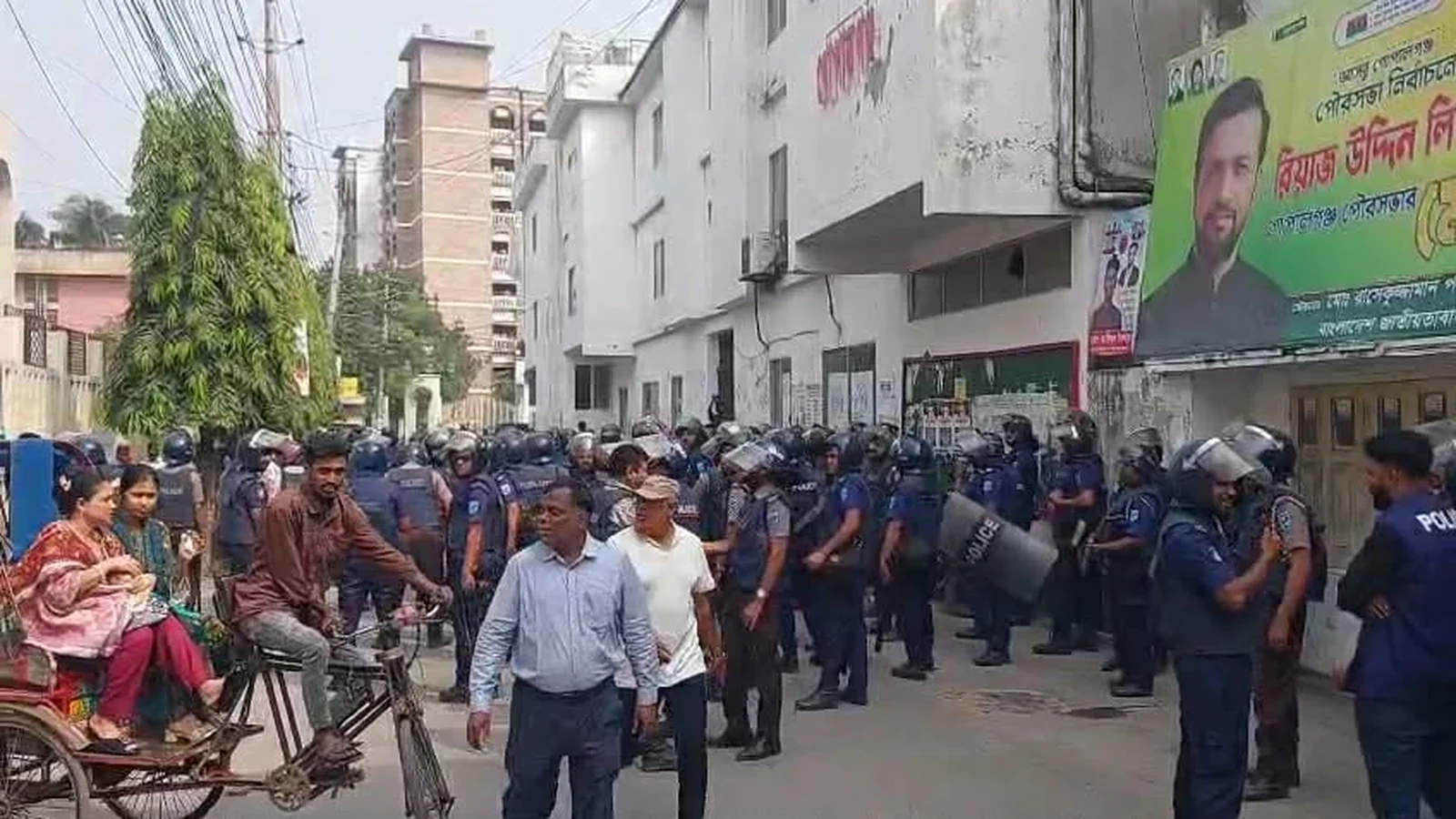
Hundreds of activists of the banned Awami League and its affiliated organisations staged a mass procession through Gopalganj town in Bangladesh on Sunday, breaking police barricades, vandalising the July Memorial Monument and police property, and setting tyres on fire. The demonstrations took place on several roads in the district town from around 11am to 1:45pm, with hundreds of activists joining processions and chanting slogans in support of ousted Awami League leader Sheikh Hasina and the party.
According to local sources quoted by The Business Standard, activists from different unions began gathering at the house of Salauddin Khan, organising secretary of the Gopalganj Municipal Awami League, in Ghosherchar Uttarpara from around 8am. Several thousand supporters later assembled at the Gabtala intersection before marching into the town through the BSCIC Bridge. Other processions emerged from Ghosherchar Dakshinpara, the Mia and Nabinbagh areas, and smaller groups from different neighbourhoods and unions gradually joined the demonstrations.
How the procession unfolded
Around noon, activists also gathered near Shishu Park and the BSCIC area before marching through different parts of the town. The processions passed through Launch Ghat, Women's College and Shilpakala Academy before converging near the old Launch Ghat Bridge. The demonstrators then marched to the Awami League district office in Bankpara, opened the premises, which had remained locked for a long time, and celebrated inside.
Many protesters carried national flags as well as locally made weapons, including sticks, machetes, Chinese axes, spears, pikes and traditional oars and bamboo poles, locally known as logi-baitha. A significant number of women activists also took part. The procession broke through police barricades and entered several roads across the town, disrupting traffic on the Gopalganj-Patgati road from around 11am until 1:45pm.
What was damaged
During the demonstrations, protesters damaged the July Memorial Monument near Launch Ghat and vandalised the nameplate of Hadi Square at Gopalganj Science and Technology University, restoring its previous name, Joy Bangla Chattar. They also removed the nameplate at the main gate of Gopalganj Government College and replaced it with a banner reading "Government Bangabandhu College", restoring the institution's previous name.
Protesters allegedly vandalised the glass frontage of FNF, a supershop, and set tyres on fire at several locations, including roads in front of the old Launch Ghat, the government college and the Press Club. Some activists climbed onto a police armoured personnel carrier and chanted slogans. They damaged its rear-view mirror and painted the vehicle red, writing "Joy Bangla, Joy Bangabandhu" on it. The glass panels of a police box were also damaged.
Government response and why Gopalganj matters
Authorities maintained a heavy security presence across the district town ahead of the demonstrations. Police, Border Guard Bangladesh, the Special Response Battalion, the Armed Police Battalion and other law enforcement agencies were deployed in large numbers, particularly around Launch Ghat, the market area and the Deputy Commissioner's office. The Business Standard reported that although police personnel were stationed at important locations, no significant police intervention was visible during the vandalism and road blockades.
The government said it was closely monitoring the situation in Gopalganj. A senior official at the Ministry of Home Affairs told Prothom Alo that the government would not allow the situation to spiral out of control, but did not want to use force immediately and risk casualties and damage to property. Six platoons of Border Guard Bangladesh personnel were deployed in Gopalganj, three of them additional platoons sent on Sunday. The government also transferred the district's deputy commissioner and superintendent of police at around 5:15pm. The situation began returning to normal around 1:30pm as demonstrators gradually left the town.
Gopalganj is the hometown of former prime minister Sheikh Hasina, who was ousted in the July mass uprising and has lived in exile in India since August 2024. Since the fall of the Awami League government, party leaders, activists and supporters have staged protests there on various occasions, and for the past few days Awami League activists have been holding processions and blocking roads in the district.
The protests are part of a programme announced by the Awami League for 14 to 19 November, with 17 November declared a Black Day to mark the anniversary of the tribunal verdict against Hasina, and a nationwide lockdown announced for 19 November. Awami League organising secretary S. M. Kamal Hossain has claimed that Hasina will return to Bangladesh in December, saying the party is preparing the ground for her return through nationwide protests. Speaking about the Gopalganj demonstrations, Ilyas Haque, office secretary of the banned Gopalganj district Awami League, said, "The people of Gopalganj are uncompromising when it comes to Bangabandhu and Sheikh Hasina. Our movement on the streets will continue until we can bring former prime minister and Bangabandhu's daughter Sheikh Hasina back to the country."
What happens next
The Awami League programme runs until 19 November, with 17 November marked as a Black Day and a nationwide lockdown announced for 19 November. The government has kept Border Guard Bangladesh personnel deployed in Gopalganj and transferred the district's top two officials. The coming days will show whether the protests spread beyond Gopalganj and how the interim government responds.