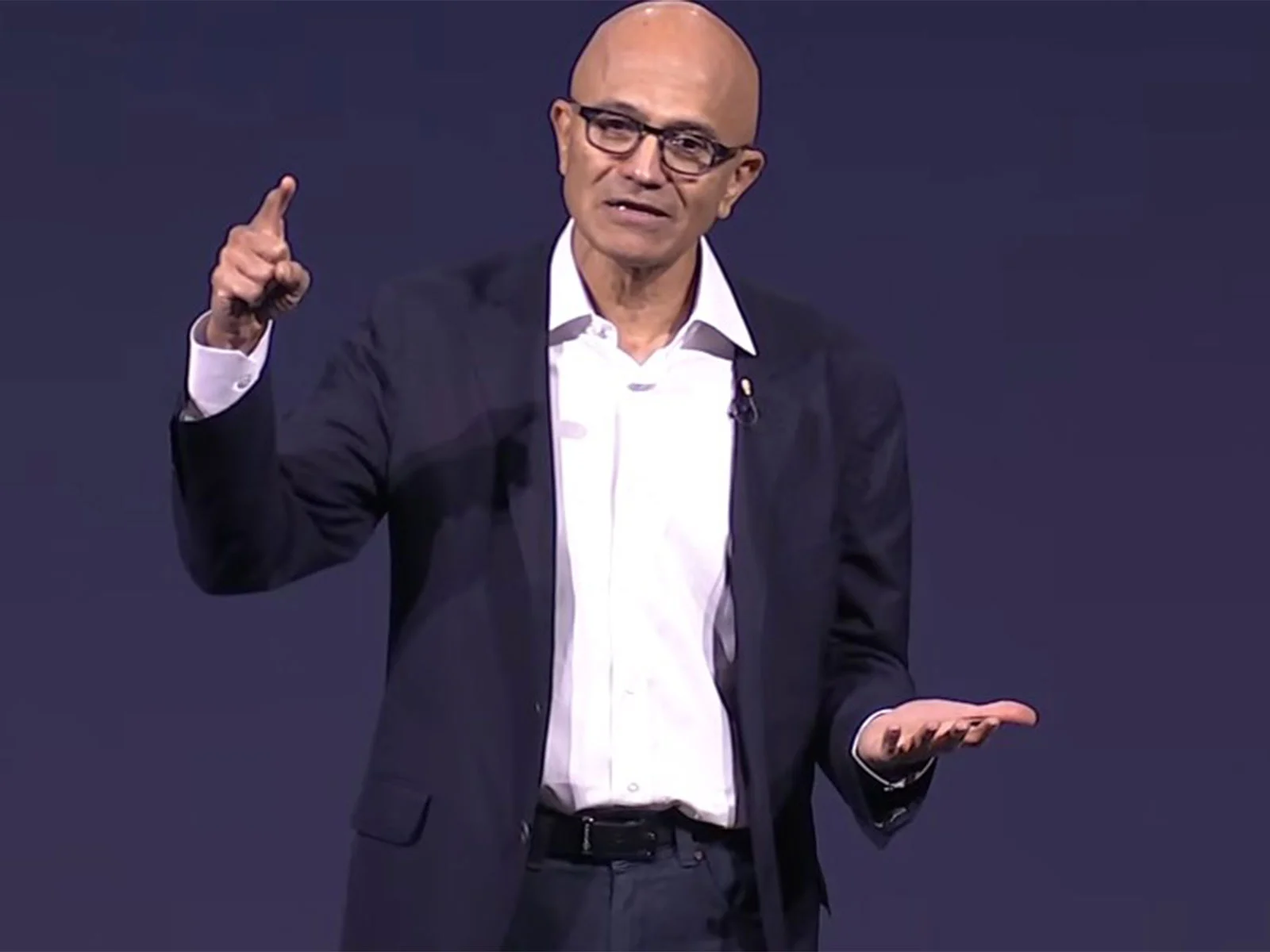
Microsoft chairman and CEO Satya Nadella launched the AI Transparency Initiative at the company's Ignite 2026 conference on Tuesday, a collaboration with more than 40 organisations to establish open standards for securing and governing AI models and agents across providers.
The initiative reflects a simple principle, Microsoft said: greater AI autonomy requires greater transparency. The participating organisations include Accenture, Adobe, KPMG, Mastercard and Volvo Cars.
Nadella announced the effort during his keynote at the Chase Center in San Francisco, where Microsoft introduced new AI models, Copilot Workspaces and other products under the theme of human ambition, intelligence and trust.
Closing the evidence gap
Microsoft says enterprises are connecting AI models to data, tools, credentials and infrastructure, allowing agents to take actions without human approval at every step. Existing controls can observe much of the activity around AI models, but they cannot see what happens within them or independently verify the models' own accounts of their behaviour.
That evidence gap creates security, compliance, audit and accountability risk, the company said. Microsoft compares agents with access to data, tools and credentials to privileged insiders operating at machine speed and scale.
"What the model says about itself is not independent evidence," Nadella said. "We should not be forced to choose between innovation and safety. We need standards that can confirm and verify AI's behaviour."
"For security controls to be effective, every organization needs greater transparency into the model itself," said Hayete Gallot, executive vice president of Microsoft Security. "With this work, we will bring more transparency to all models."
See, verify, control
The initiative is organised around three tasks: see, verify and control. Under "see", organisations should know what an AI was asked and authorised to do, which model and runtime were used, what data and tools it accessed, and what actions it took, with agent activity monitored continuously against policies and thresholds.
Under "verify", evidence covering agent identity, delegated intent and actions should identify its source, whether the model, the runtime around it, or independent identity and policy systems, so model-reported signals can be checked against independently observed records.
Under "control", organisations should stay in charge of what AI is permitted to do, enforcing policies before consequential actions occur and reconstructing what happened during investigations, containment, recovery and audits.
"As AI agents become more deeply integrated into enterprise operations, security teams need clear visibility into what those agents are accessing, what actions they're taking and how those actions can be verified," said Aanchal Gupta, chief security officer at Adobe.
Standards work and product plans
The initiative has three parts. First, Microsoft will expand its participation in the National Institute of Standards and Technology's SI Agent Standards Initiative and draw on its research to develop open, industry-wide standards for AI transparency, security and governance.
Second, Microsoft is working with the more than 40 partner organisations to help develop open standards for AI systems that are accountable, independently verifiable and safe by design, regardless of the model or provider.
Third, Microsoft will incorporate the work into Microsoft AI, Microsoft Foundry and Microsoft Copilot, enabling customers to use the resulting evidence with their security and compliance tools, whether from Microsoft or other providers.
Accountability stays with the organisation deploying the AI, Microsoft said. When something consequential happens, leaders answer to customers, employees, boards, auditors and regulators. "Blaming the AI isn't an answer, and 'trust the model' isn't a control," the company said.
New models and Copilot Workspaces at Ignite
Alongside the transparency initiative, Microsoft unveiled new AI models at Ignite, including the MAI Code 2 coding model and the MAI Cyber 2 Flash security model. Microsoft said MAI Code 2 delivers about 98 percent of the performance of OpenAI's GPT-6.1 Sol on everyday programming benchmarks at about 40 percent of the cost.
Nadella also introduced Copilot Workspaces, a shared environment where people and AI agents work together with shared context towards a common goal. "The time has come to move beyond single-player AI to a world where people and their agents work together," he said.
Microsoft also announced that the full functions of Word, Excel and PowerPoint would be built into Copilot, and a partnership bringing Salesforce context into Copilot, Teams and Fabric. Nadella acknowledged during the keynote that Microsoft had work to do on service resilience following the previous week's Microsoft 365 outage, according to The Register.