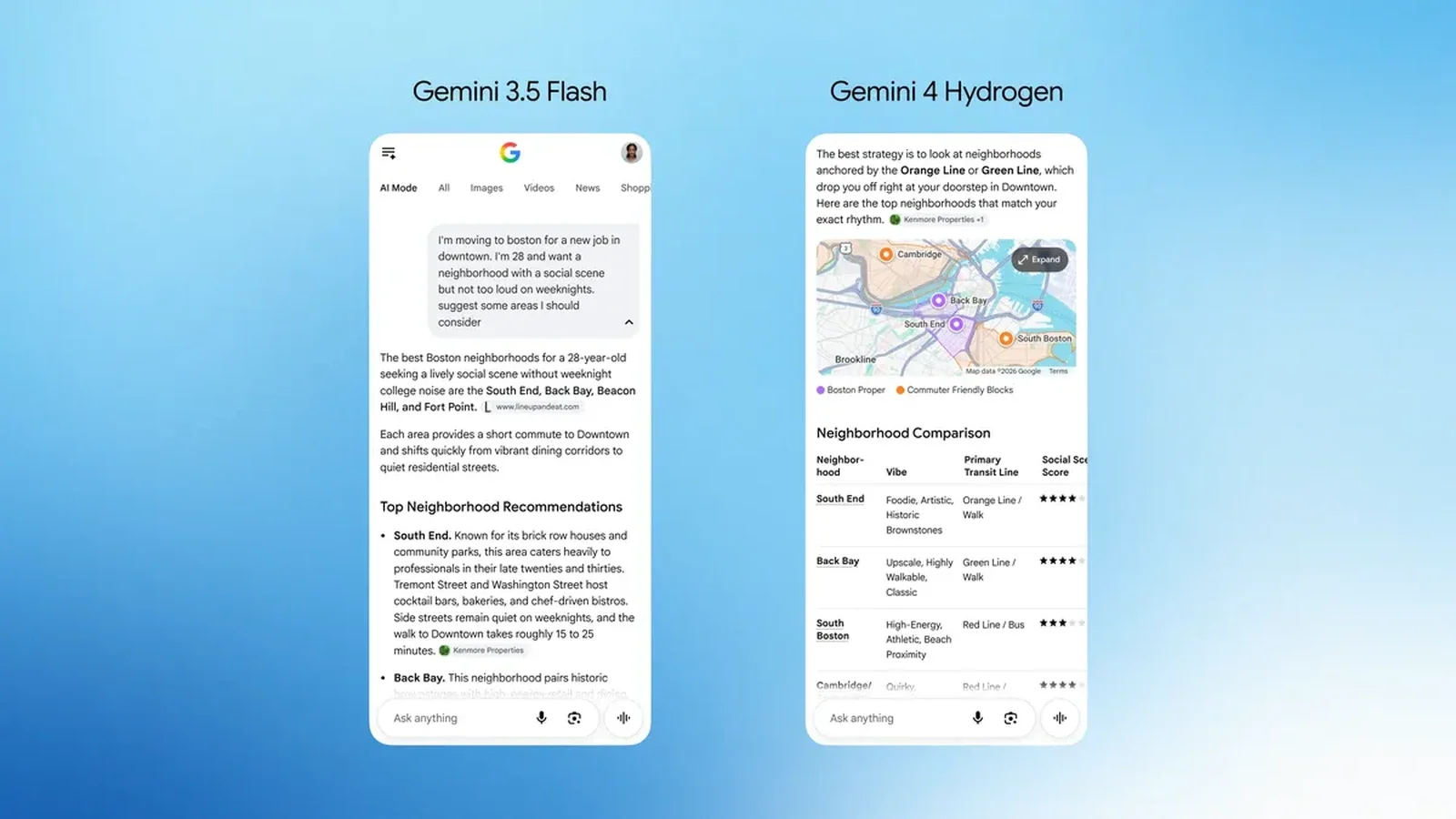
Google has launched Gemini 4 Hydrogen, a faster and cheaper member of its Gemini 4 family, built for everyday coding and agentic workflows. The model is rolling out globally from Thursday across Google Search, the Gemini app, Google AI Studio, the Gemini API and Google Antigravity.
Hydrogen sits below Google's frontier models, Gemini 4 Carbon and Gemini 4 Argon, which are built for deep, long-horizon reasoning on hard problems. Hydrogen is designed for rapid execution: writing code, running tests, verifying changes and carrying out multi-step tasks on its own, or acting as the fast execution engine alongside Carbon and Argon in multi-model workflows.
Beats Argon on one benchmark, Google says
At its default high thinking level, Hydrogen scores 51 on the Artificial Analysis Intelligence Index, against 50 for Argon, and reaches 54 at its highest xhigh setting, according to Google. The company says it often completes tasks faster than models in its class.
Hydrogen has four thinking levels: low, medium, high as the default, and a new xhigh tier, so users pay and wait only for the reasoning depth a task requires.
The model is priced flat across its 1 million-token context window at $1.50 per million input tokens and $7.50 per million output tokens.
A big upgrade from Gemini 3.8 Flash
Google says Hydrogen finishes tasks 2.5 times faster than Gemini 3.8 Flash at its high default setting, more than triples Terminal-Bench 4.1 scores, 57 percent against 18.2 percent, and cuts fabricated claims by more than five times.
In early testing with partners, Hydrogen ran two to 2.8 times faster while cutting token use by 12 to 23 percent compared with 3.8 Flash, according to Google. It also leads its class on HLE-Diamond at 58.8 percent and ranks first overall on the Vals Tax Agent Bench at 52.3 percent.
Google also introduced Orchestrator in Google Antigravity, which dynamically switches between models like Carbon and Hydrogen within the same session. On Terminal-Bench 4.0, Orchestrator reached near-Carbon task success rates while using 24 percent less quota and finishing 19 percent faster.
Search gets its biggest upgrade yet
In Google Search, Hydrogen is available globally for all users from today. Google says it better understands the intent behind multi-part queries, hard-to-understand typos and highly specific requests, gives more visual and easy-to-scan responses, and connects users to a wider range of links through an upgraded query fan-out technique.
In the Gemini app, Hydrogen is available in the model dropdown. Google says it follows instructions more closely across multi-turn conversations, calls the right tools more often, and sticks more closely to the user's tone and format in writing and research tasks.
Safety and availability
Google says Hydrogen reduces overreach in agentic tasks by up to 81 percent and cuts misaligned actions and task shortcutting by 12 times compared with 3.8 Flash. Against indirect prompt injection attacks, it is more than 2.3 times more resilient on the Gray Swan IPI benchmark.
The model card lists hallucinations among Hydrogen's known limitations and gives its knowledge cutoff as March 2026. Google says a full Safety and Security Report for the model will follow in the coming days.
For developers, Hydrogen is available through the Gemini API in AI Studio and the paid tier in Android Studio. Enterprises can deploy it through Gemini for business, and paid Google AI Pro and Ultra subscribers can use it in Google Antigravity and in Gemini in Google Sheets.