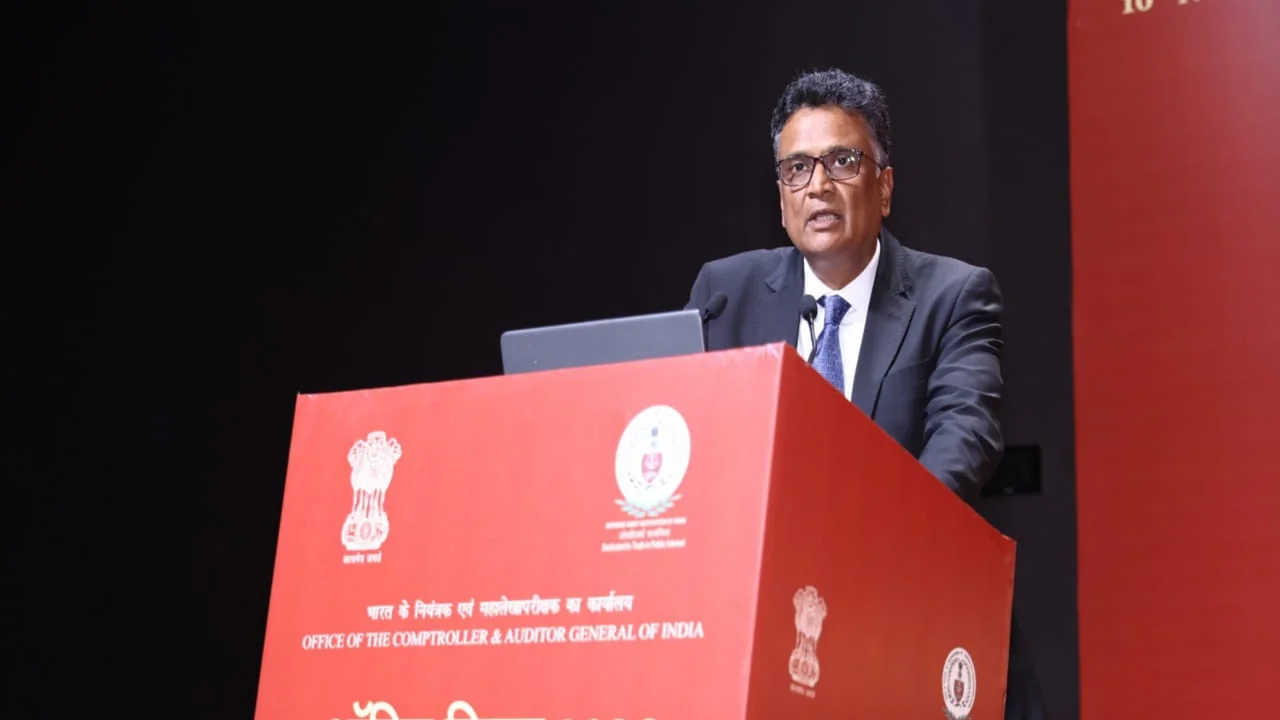
Prime Minister Narendra Modi has urged the Comptroller and Auditor General (CAG) to make public audits more citizen-centric, with greater focus on ease of doing business for micro, small and medium enterprises, ease of living in urban areas and the functioning of local bodies.
In a message read out on Audit Diwas and released by the CAG on Tuesday, Modi said audit findings in these areas could help governments improve policies and make governance more responsive to people's needs, adding that audits can contribute to more efficient use of resources.
"Audit insights relating to the ease of doing business for MSMEs, ease of living in urban areas and the functioning of local bodies can help governments improve their policies and delivery of public services. Thus, audits can contribute to making governance more responsive to people's needs and more efficient in the utilisation of resources," the Prime Minister said.
The CAG celebrated Audit Diwas and organised the Accountants General Conclave on the theme 'Fostering Excellence: People, Process and Partnerships', with a focus on strengthening public auditing through institutional reforms, emerging technologies, capacity building and improved stakeholder engagement. Audit Diwas marks the establishment of the office of the Auditor General on November 16, 1860.
Technology must aid auditors, not replace them
Emphasising the role of emerging technologies in auditing, PM Modi said new tools could help examine large volumes of financial data and identify unusual patterns, while stressing that the experience and independent judgement of professionals remained central to the value of an audit.
"Emerging technologies offer useful tools to examine large volumes of financial data and identify unusual patterns. They can make the work of auditors more effective, but it is the experience of the professionals and their independent judgement that give audit its true value. As emerging technologies reshape different domains, the Indian Audit and Accounts Department's ability to adapt and equip its officials with new capabilities will become increasingly important," he said.
Ahead of the celebrations, the department had said its new Large Language Model 2.0, developed with IIT Madras and trained on around 65,000 internal inspection reports, would be unveiled at Audit Diwas, with dedicated streams for compliance, financial and works audits.
Murthy: trust is the department's real task
Addressing the gathering, Comptroller and Auditor General of India K Sanjay Murthy said the department's responsibility went beyond protecting public money and also involved earning people's trust. He said that to build this trust, the department must examine issues that matter to people and draw conclusions supported by evidence.
Recalling the address of President Droupadi Murmu at Audit Diwas 2023, Murthy said the President had expected the institution to act as a fellow traveller and guide in the country's journey of development. He said the reforms undertaken over the last two years, including breaking departmental silos, auditing themes such as ease of living and ease of doing business, and increasing the focus on local bodies, were steps towards fulfilling this vision.
Murthy also highlighted the department's responsibility to ensure that the accounts of local bodies were prepared on time and remained reliable. He spoke about measures taken to reduce arrears in the accounts of autonomous bodies and assist their management in assessing risks and strengthening control systems.
Speaking about data-led auditing, Murthy said access to digital systems allowed audit teams to examine complete sets of transactions. He added that analysing data before fieldwork helped guide field enquiries and had shortened the audit cycle. He further said the department was developing audit-specific artificial intelligence tools instead of relying solely on general AI applications, adding that projects were ready for pan-India rollout.
Book release, awards and an executive MBA
A book on the Institution of the CAG of India, brought out by the National Book Trust, was also released during the event. Releasing the book, National Book Trust Director Yuvraj Malik described the CAG as one of the few public institutions in the history of the Indian Republic that had consistently upheld credibility, public trust, efficiency, vision and integrity while continuously evolving.
Delivering the keynote address, former Executive Director of Tata Sons R Gopalakrishnan said executives in institutions such as the CAG should continuously assess whether their organisations were future-ready. He emphasised that introspection within an institution must be accompanied by openness to ideas from outside.
The CAG presented its Awards for Innovation and Excellence in Public Auditing and Accounting to six teams. Prizes were also awarded to six teams under the CAG's 101 Innovative Ideas initiative. Additionally, awards were presented to the seven national-level winners of the CAG-ICSSR Research Article Competition, which followed a colloquium series organised across 28 states and three union territories that brought together around 20,000 auditors, academicians and students.
An Executive MBA programme for officers of the Indian Audit and Accounts Department was also launched in collaboration with IIM Mumbai. The programme will provide officers with training in management, strategy and decision-making, which is expected to help them assess the performance of various programmes and schemes in a changing environment.
The CAG has also launched a four-year performance audit of power distribution companies to assess their financial health and operational efficiency, and is separately examining high urea consumption and the efficiency of the fertiliser subsidy system, having identified 169 districts across 15 states where consumption exceeds state and national averages.