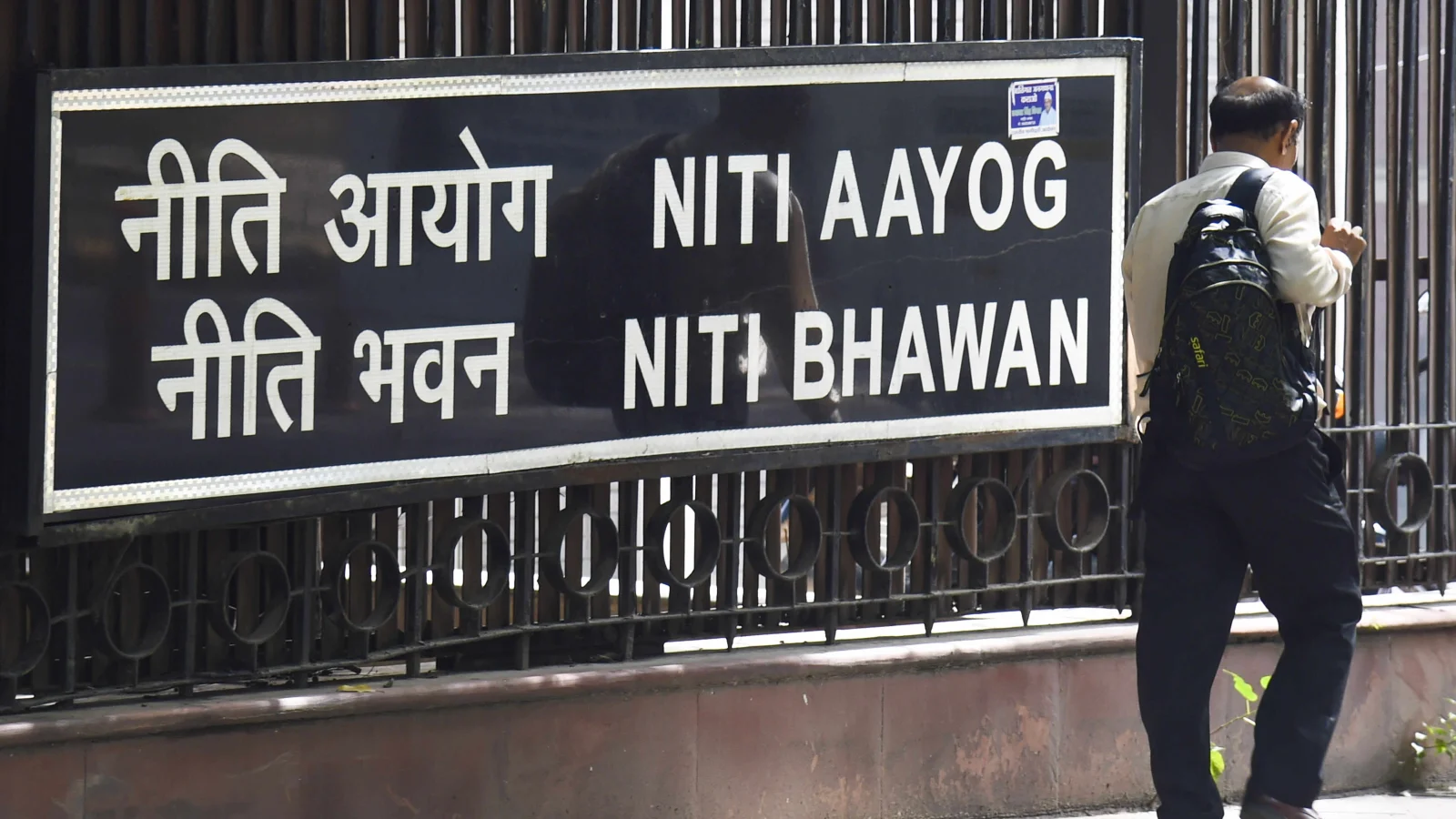
Government think tank NITI Aayog on Tuesday launched a series of five national workshops to document the lessons from Prime Minister Narendra Modi's 25 years as head of government and convert them into formal training material for civil servants ahead of Viksit Bharat by 2047.
The inaugural workshop, titled 'Leadership as Mission', was held at Bharat Mandapam in New Delhi and brought together more than 900 participants, including senior Union and state government officials, district collectors from Aspirational Districts, academics, university students and representatives of communities benefiting from government programmes.
The series marks the completion of 25 years since Modi assumed office as Chief Minister of Gujarat on October 7, 2001. He became Prime Minister in May 2014 and is currently serving his third consecutive term, completing 25 years as head of government on October 7, 2026, the longest continuous tenure at the head of an elected government in India.
The five workshops will examine the governance approach associated with the principles of Pradhan Sevak, Antyodaya and Jan Bhagidari, along with the vision of Sabka Saath, Sabka Vikas, Sabka Vishwas, Sabka Prayas.
'Decisive leadership, vision into action'
Addressing the inaugural workshop, Principal Secretary to the Prime Minister P K Mishra delivered the keynote address, highlighting how decisive leadership and mission-oriented administration have shaped major national initiatives.
Mishra said India's governance journey over the past two-and-a-half decades has been marked by decisive leadership and the ability to translate vision into action, citing examples from the reconstruction of earthquake-hit Kutch in 2001 to India's response to the Covid-19 pandemic, the expansion of the space sector and the Lakhpati Didi initiative.
He said the focus should be on citizen experience, not the number of schemes, and outlined milestones that showcase strong leadership and impactful governance.
NITI Aayog Chief Executive Officer Anurag Jain said the central objective was to document lessons from the Prime Minister's leadership journey and translate them into institutional knowledge for the future. He outlined four key lessons from the leadership journey.
NITI Aayog Vice Chairman Ashok Kumar Lahiri said the role of strong political and administrative leadership is crucial in driving India's development journey.
Case studies for future administrators
A key component of the workshop was the Case Clinic, where mixed groups of government officers, community representatives and students examined specific governance decisions and their outcomes.
The discussions followed a five-stage framework of Learn, Analyse, Reflect, Apply and Commit, designed to connect real-world administrative experiences with practical leadership lessons.
The case studies developed from these discussions, along with accounts shared by speakers, will be made available on the iGOT Karmayogi platform, and will feed into learning material for civil services training institutes, educational institutions and universities.
Cabinet Secretary T V Somanathan delivered the closing remarks and launched the Karmayogi Sankalpa on the iGOT Karmayogi platform.
Five themes through to September 2027
The five workshops will focus on the themes of 'Leadership as Mission' in November 2026, 'Governance as Delivery' in January 2027, 'Development as Inclusion' in April 2027, 'Civilisational Identity' in July 2027 and 'India as a Global Force' in September 2027.
The series will continue until October next year, with the proceedings streamed on the iGOT Karmayogi platform.
The wider objective is to build an Indian body of knowledge on public leadership, drawing on decisions, institutions and governance experiences from the past 25 years, and to incorporate these lessons into civil services training, academic research and policy discussions as India works towards the Viksit Bharat 2047 vision.
Over the course of the series, the learning from these 25 years will also be taken forward through research and teaching material that sets out directions for policy and administration in the years leading up to Viksit Bharat by 2047.