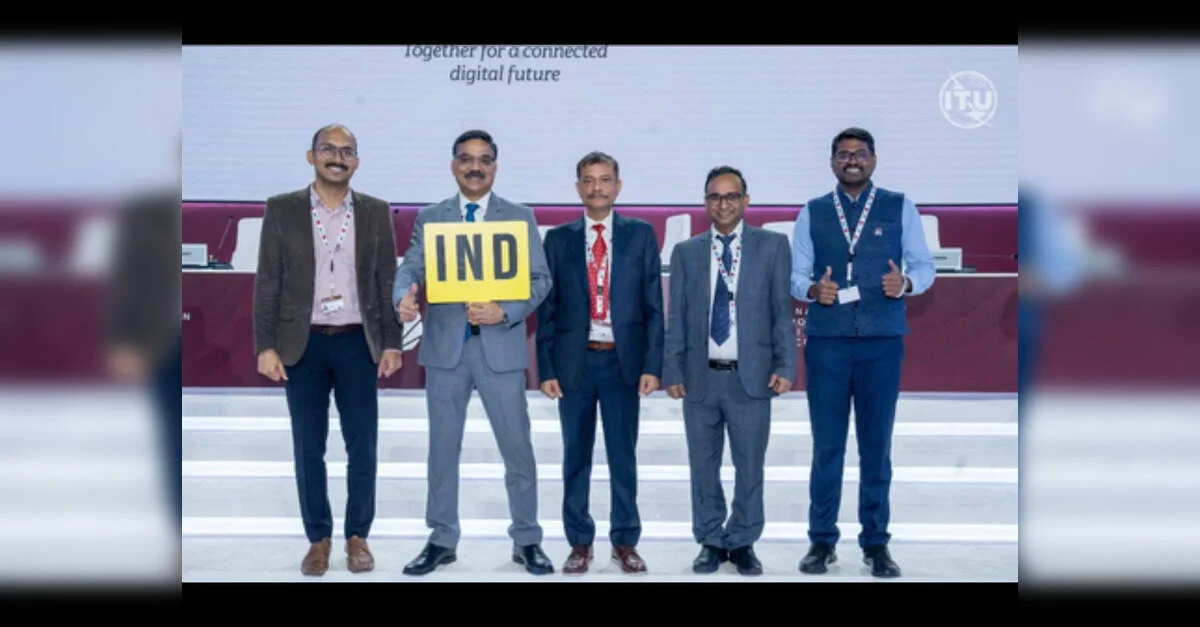
India has been re-elected to the Council of the International Telecommunication Union (ITU) for the 2027-2030 term at the ITU Plenipotentiary Conference 2026 (PP-26) in Doha, Qatar, the Permanent Mission of India to the UN in Geneva said.
The election was held on November 16. Reports said India secured 151 votes, the third-highest among the countries contesting from the Asia and Australasia region, which has 13 seats in the 48-member ITU Council.
"India re-elected to the ITU Council for the next term at ITUPP26 in Doha, Qatar. This renewed mandate reflects the trust and confidence of the international community in India's continued contribution to global telecommunications and ICT development," the Permanent Mission said on social media platform X.
Reaffirming India's commitment to a connected digital future, the Mission said: "India remains committed to working with all Member States towards a connected, inclusive, secure and sustainable digital future for everyone."
What the Council does
The 48-member ITU Council acts as the organisation's governing body between Plenipotentiary Conferences, overseeing global telecommunication policies, strategic and financial plans and working groups.
The Plenipotentiary Conference is the ITU's supreme decision-making body. It meets every four years to set the organisation's direction and elect Council members. The 2026 conference is being held in Doha from November 9 to 27.
India has been a member state of the ITU since January 1, 1869, and a continuous member of the ITU Council since 1952. Member states in Doha also elected the Radio Regulations Board.
Modi: mobile phone is a tool of good governance
Addressing the 10th edition of India Mobile Congress (IMC) 2026 on October 8, Prime Minister Narendra Modi said India's telecom sector has evolved beyond networks, spectrum and internet speeds, with mobile connectivity emerging as a key enabler of governance and access to public services.
Modi said mobile phones had transformed over the past decade from conventional communication devices into important tools for delivering governance. "Mobile phone has become a tool of good governance," he said.
Recalling the evolution of IMC, the Prime Minister said the event had played an important role in India's telecom journey, from the launch of 5G in 2022 to the country's hosting of the International Telecommunication Union in 2024.
He cited the experience of the Covid-19 pandemic to underline the importance of India's digital ecosystem, saying offices, banks and educational institutions were able to continue functioning even when activities in several parts of the world had come to a standstill.
WTSA 2024 set the stage
In October 2024, as the ITU World Telecommunication Standardisation Assembly (ITU-WTSA 2024) concluded in New Delhi, Union Minister of Communications Jyotiraditya Scindia said India had played a pivotal role in shaping the future of global telecommunications.
"Through its proactive engagement, India successfully proposed groundbreaking resolutions and contributed to the modification of existing ones, receiving widespread endorsement from member nations," Scindia said.
"India is ready to play its part in this shared journey, and we will champion international collaboration and actively contribute to the development of global standards," he added.