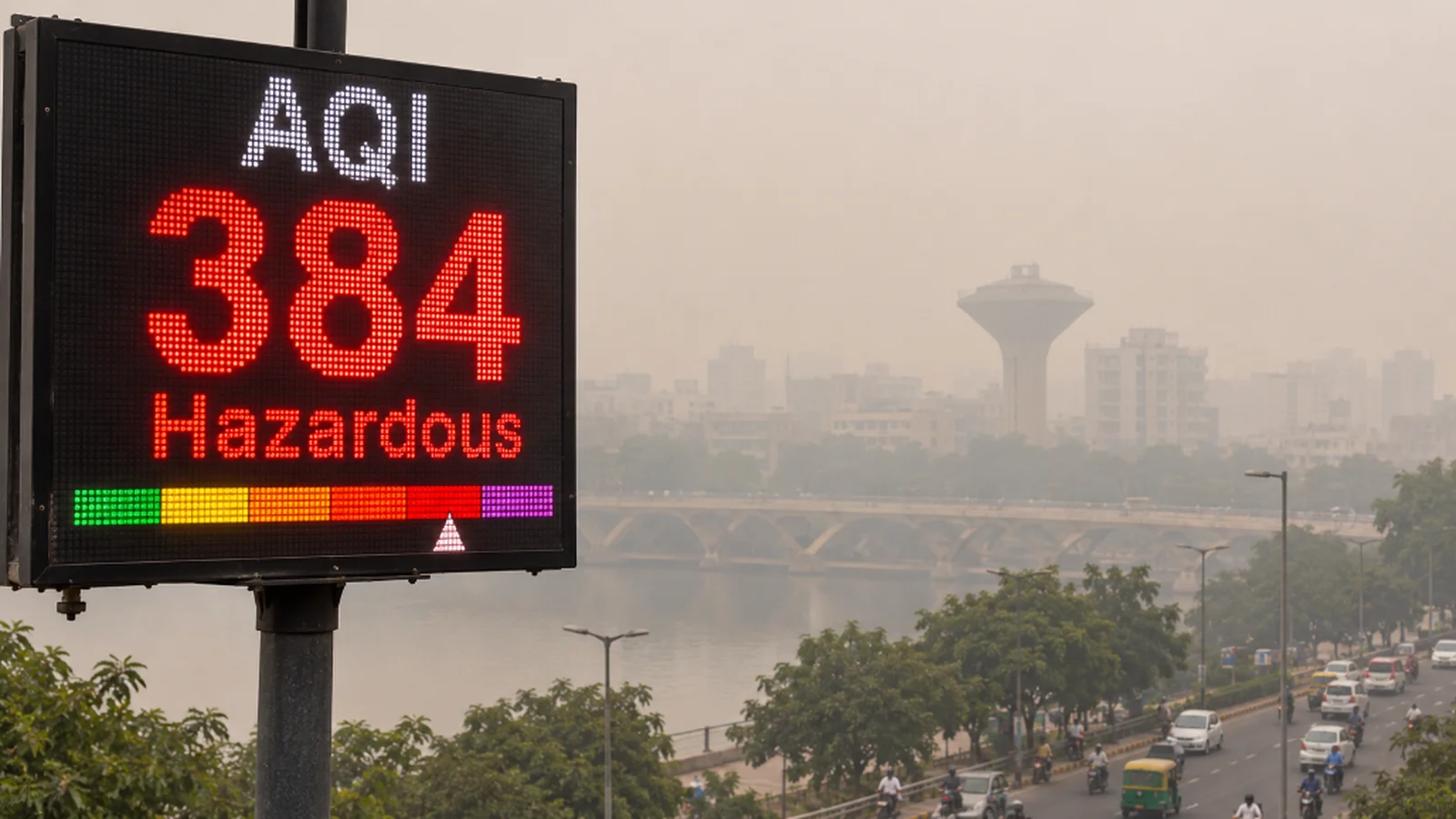
Ahmedabad's air quality has deteriorated sharply during the Diwali period, with the Air Quality Index (AQI) touching 384 on Saturday night and remaining unhealthy across several parts of the city on Sunday afternoon. Health experts have advised children, senior citizens and people with existing health conditions to avoid stepping outdoors unless necessary.
AQI crosses 350 during late-night hours
Data from a private weather website showed that Ahmedabad's AQI climbed sharply on Saturday night, crossing 350 before reaching a peak of 384 around 1 am.
The readings recorded during the night were 228 at 10 pm, 268 at 10.30 pm, 260 at 11 pm, 355 at 11.30 pm, 373 at midnight, 383 at 12.30 am, 384 at 1 am, 268 at 1.30 am and 240 at 2 am.
The sharp overnight rise highlights the deterioration in air quality during the festive period.
Pollution levels high across several areas
Government data recorded on Sunday afternoon showed elevated AQI levels at several monitoring locations in and around Ahmedabad.
According to data from the Indian Institute of Tropical Meteorology (IITM), under the Union Ministry of Earth Sciences, Ahmedabad recorded an average AQI of 195 on Sunday afternoon. The reading indicates that pollution levels remained a concern even during daylight hours, rather than rising only at night due to firecracker emissions.
The Airport recorded an AQI of 295, while Rabiyaval and Rakhial registered 275 and 255, respectively. Chandkheda recorded 233, and Maninagar stood at 172. The comparatively lower readings at ISRO-Bopal and Gyaspur were 74 and 111, while Gandhinagar, Sector 10, recorded 214.
Construction dust, vehicles and industry under scrutiny
The rising pollution has also raised questions over the effectiveness of measures taken by the Ahmedabad Municipal Corporation (AMC), the Gujarat Pollution Control Board (GPCB) and the police.
The source material alleges that enforcement has largely focused on construction sites, while industrial units allegedly violating pollution norms and vehicles emitting excessive pollutants have not faced adequate action.
Dust from construction activity, including a government-led project, has also been cited as a concern. In newly developed areas, unpaved roads and stretches without proper paving or reinforced cement concrete (RCC) surfaces are adding to dust pollution.
Children, elderly and patients advised to limit outdoor exposure
With pollution levels remaining elevated, health experts have advised children, elderly people and patients to avoid unnecessary outdoor activity.
An AQI reading of up to 50 is generally considered good, while levels above 150 indicate unhealthy air quality. Readings above 200 indicate severe pollution, and levels exceeding 300 fall into the hazardous category under the classification cited in the source material.
The sharp rise in Ahmedabad's AQI during both night and daytime hours has intensified concerns over the city's air quality and the need for effective pollution-control measures.