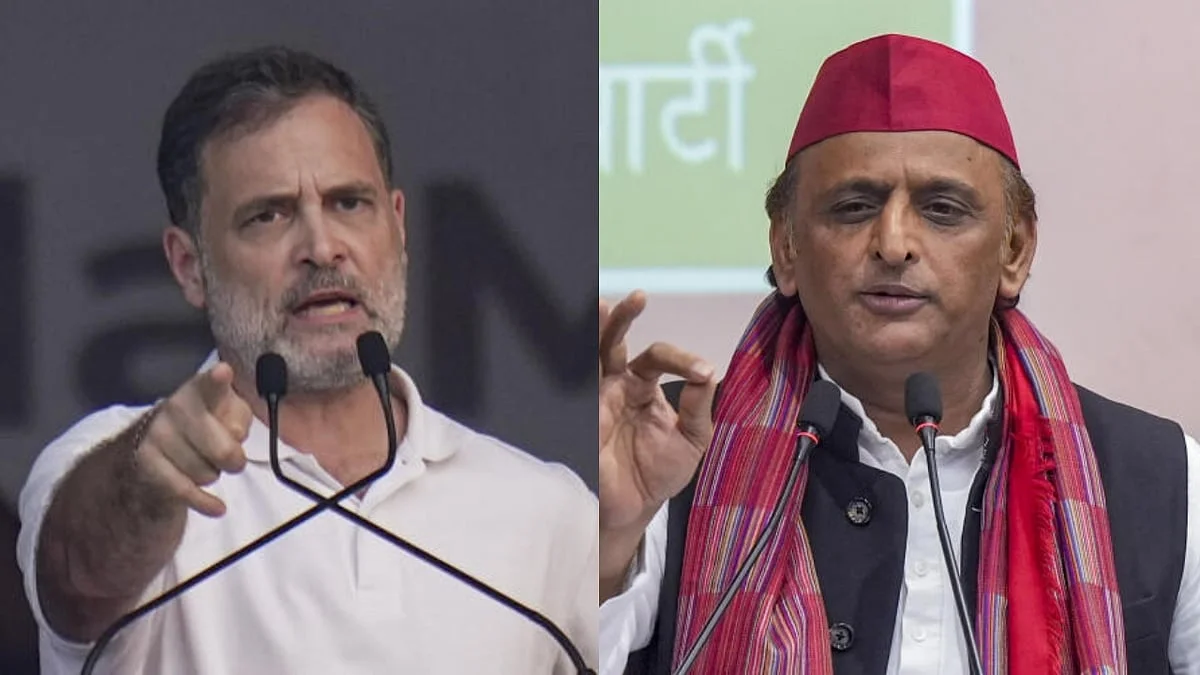
The Supreme Court on Tuesday said it would hear on 9 December a batch of pleas, including one filed by Congress leader Rahul Gandhi and other INDIA bloc leaders, alleging large-scale voter deletions and irregularities in the Special Intensive Revision (SIR) of electoral rolls.
A bench of Chief Justice Surya Kant and Justices Joymalya Bagchi and V Mohana, which was scheduled to hear the petitions during the day, adjourned the hearing as a part-heard matter would be taken up in the post-lunch session.
Senior advocate Kapil Sibal, appearing for Gandhi, referred to an application filed on Monday seeking permission to put 48 written questions, known as interrogatories, to the Election Commission on the decision-making process in the nationwide SIR.
The court said it would hear the application on the interrogatories on 9 December as well, and take a call after hearing the Election Commission's objections. "You may file your reply. You can raise your objections. We will examine the interrogatories issue and then take a call," the Chief Justice said.
What the 48 questions ask
The 48 questions, spread across 10 categories, relate to approvals, objections and database access, and alleged serious flaws in the SIR that the petitioners say paved the way for "vote theft".
The petitioners have sought sworn responses from Chief Election Commissioner Gyanesh Kumar, Election Commissioners Sukhbir Singh Sandhu and Vivek Joshi, Deputy Election Commissioner Bhanu Prakash Yeturu, who affirmed the poll panel's affidavits of 26 October and 14 November, and the poll body's Director General (IT).
The application asks whether decisions concerning the nationwide SIR were taken by the Election Commission as a collective body, or whether the Chief Election Commissioner exercised the Commission's powers without the knowledge, approval or concurrence of the other Commissioners.
The petitioners have asked for the file number clearing a nationwide SIR, the date of the decision, whether it was taken at a meeting, upon circulation of a file or through electronic means, and the date on which each member signified approval. They have also asked the two Election Commissioners to disclose every occasion between February 2025 and October 2026 on which they recorded written objections, dissents or reservations regarding the SIR.
The Election Commission's stand
Senior counsel Harish Salve, representing the poll panel, told the court that the Commission had serious reservations about Gandhi's application.
The Election Commission, in a 248-page counter-affidavit filed on 26 October, defended the SIR and maintained that its orders were issued unanimously by the three-member body. A supplementary affidavit was filed on 14 November.
The application challenges that claim, questioning whether the affidavit asserting a "unanimous decision" was ever placed before Sandhu and Joshi. The court has not ruled on the allegations or on the request for interrogatories.
How the case reached the court
The pleas were filed after The Indian Express reported on 25 September that Election Commissioners Sandhu and Joshi had objected on record at least 14 times over the previous 10 months to decisions and orders on the SIR that they said were issued without their knowledge or recommendation.
The Supreme Court issued notice to the Election Commission on 15 October on the petition filed by Gandhi and ten other opposition leaders challenging aspects of the Commission's functioning during the SIR.
The petitioners say the nationwide revision, carried out under three orders dated 24 June 2025, 27 October 2025 and 14 May 2026, led to the exclusion of around 13 crore voters. The December 9 hearing will decide whether they can formally question the poll body on the records behind its SIR decisions.