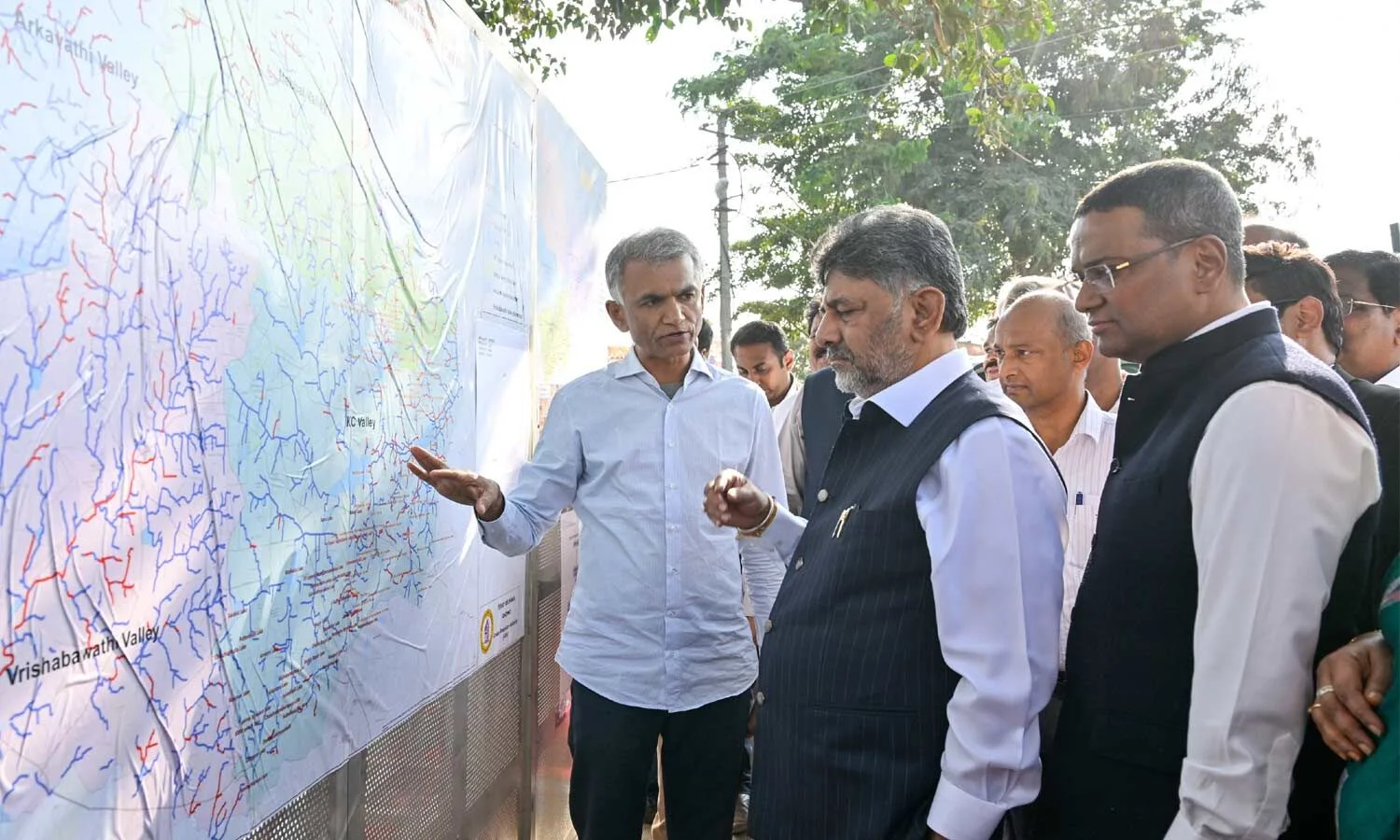
Chief Minister DK Shivakumar on Tuesday laid the foundation stone for drain and flood control works at Gunjur in the Mahadevapura Assembly constituency, and said the government's goal is to provide a permanent solution to Bengaluru's problems.
The works are being developed under the World Bank-assisted Karnataka Water Security and Disaster Resilience Programme. "The government has given special priority to the city's development, and significant infrastructure projects have been undertaken over the last three years. Never before in Bengaluru's history has such a massive amount of money been invested in development," Shivakumar said.
He said the government has taken note of the hardships faced by people due to waterlogging in several areas during the rains. Development works for rajakaluves, or stormwater drains, and rainwater drains have been taken up at a cost of around Rs 2,000 crore, including the construction of retaining walls and the clearance of encroachments in several areas.
"A foundation stone ceremony is not merely an event to lay a stone. It is a programme to respond to people's dreams, provide permanent solutions to their problems, and bring about a positive change in their lives," he said.
Rs 20,000 crore of works underway
"Our government has given priority to the city's road and infrastructure development. Various development works worth nearly Rs 20,000 crore, including the construction of new roads, are currently in progress in Bengaluru," Shivakumar said.
Alongside developing stormwater drains to prevent monsoon flooding, steps are also being taken to ease traffic congestion, he said.
A comprehensive map is being prepared and reviewed to identify remaining stormwater drain encroachments and locations requiring retaining walls across various parts of Bengaluru. The government has also prioritised projects such as flyovers, double-decker roads and Metro expansion.
Shivakumar recalled that several major works were carried out in Bengaluru under the JNNURM scheme implemented during former Prime Minister Manmohan Singh's tenure, including the Hoskote Road and KR Puram stretch, the Airport Flyover, the Electronic City Flyover and the Nelamangala Flyover. Those works, he said, were undertaken with the city's development in mind, not with political motives.
Target: a 500-km Metro network
Responding to a question on Metro development, Shivakumar said: "Keeping Bengaluru's future transit needs in mind, we aim to expand the Metro network. The objective is to build a total Metro network of 500 km in the city. Proposals for about 300 km of routes are already at various stages of approval. Plans for the remaining stretches will be formulated and implemented in phases."
Bengaluru is globally recognised today, he said, and lakhs of people from across the country and abroad are moving to the city in search of employment. In line with the city's growth, there is a need to expand basic infrastructure such as roads, drinking water and underground drainage.
Traffic congestion has increased for employees in areas with a high concentration of IT-BT industries, he said, and since those industries contribute significantly to tax revenues, thousands of crores of rupees in grants have been allocated for the development of these areas.
"It is not possible to fix all of Bengaluru at once, nor is widening roads by demolishing buildings the solution. Projects must be designed in a way that causes minimal inconvenience to the public," he said.
Tunnel road, road grid and land mafia warning
The government is striving to take up the tunnel road project to ease traffic congestion in Bengaluru, Shivakumar said. Opposition is coming from individuals who lack experience, he said, and cases have been filed in court. "The tendency to unnecessarily obstruct development projects is not right. Everyone must cooperate for the city's development," he urged.
A road grid system is being designed in Bengaluru to rectify the urban planning lapses that occurred during previous governments, he said, and strict measures will be taken in the coming days to prevent unregulated building construction within the limits of these road grids.
On the road connecting Hoskote to Nandagudi, Shivakumar said the previous BJP government, during the final leg of its tenure, had issued a notification for a 100-metre-wide road, which would have resulted in the demolition of around 5,000 to 6,000 buildings. The government identified an alternative route and decided to develop a 45-metre-wide road wherever necessary, he said, which has saved thousands of buildings while sparing the government a massive compensation burden.
He warned that cases of harassment against original landowners by the land mafia have come to his notice, and said police officers must maintain strict vigilance. Allegations regarding the involvement of politicians and police officers with the land mafia will have to be investigated, he said.
Responding to the media at Gunjur, when asked whether Bengaluru had received higher grants over the last three years, Shivakumar said he was answering with statistical records. "Have the BJP built any major flyovers? When asked to suggest an alternative to the tunnel project, they have no answer. If we propose a flyover, they complain that trees will be cut. Then where are people supposed to commute?"