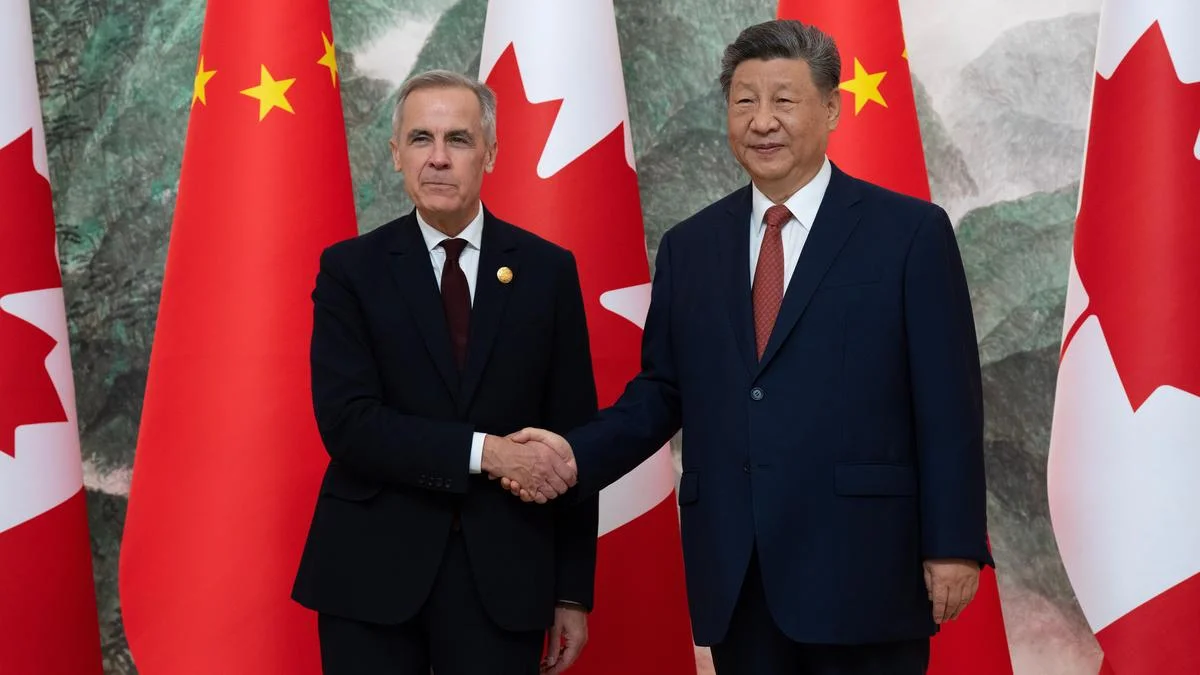
The leaders of China and Canada called for deeper ties on Tuesday as Ottawa navigates strained relations with the United States and seeks closer cooperation with Beijing.
Chinese President Xi Jinping and Canadian Prime Minister Mark Carney met in Shenzhen ahead of the Asia-Pacific Economic Cooperation leaders' summit. Both praised the strategic partnership they agreed to pursue this year and pointed to improving economic ties between the two countries.
The meeting came a day after Carney said Canada could turn to Chinese automakers if trade negotiations with US President Donald Trump fail to preserve an integrated North American auto industry.
Carney made the comments to reporters in Cambodia on Monday, ahead of his planned meeting with Xi in Shenzhen, where Chinese auto manufacturing was expected to be discussed.
Carney warns auto industry is on the line
Carney said on Monday that negotiations with the United States remain his priority, but their outcome could determine whether Canada pursues alternatives involving European, Chinese or Japanese automakers.
Asked whether possible Chinese investment was leverage in the US talks, Carney said it was not. "It's not leverage. But action, reaction," he said.
He said any Chinese investment would need substantial manufacturing in Canada rather than simple assembly of imported parts, and that foreign automakers should invest in Canadian manufacturing, create jobs and develop domestic supply chains.
Carney had said in Manila on Saturday that any trade agreement with Washington must leave Canada with a viable auto industry. He said he had spoken at length with Trump and senior US officials and that the two countries were making progress toward a possible trade agreement, although differences remained.
The Detroit Three, Ford, General Motors and Stellantis, operate factories across Canada, the United States and Mexico, with parts crossing borders repeatedly before a finished vehicle rolls off the line.
January deal opened the door to Chinese EVs
Xi and Carney reached an agreement in January allowing tens of thousands of Chinese electric vehicles into Canada at reduced tariffs. Under the deal, Canada reduced its 100 percent tariff on Chinese electric vehicles to 6.1 percent, initially allowing up to 49,000 vehicles annually, with the cap increasing over time.
Chinese-made electric vehicles do not qualify for Canada's federal EV rebate of up to $5,000, which applies only to vehicles built in Canada or in countries with which Canada has a free-trade agreement.
Trade talks with Washington have restarted in recent weeks, and US Ambassador to Canada Pete Hoekstra has said he is confident a deal can be reached before the end of the year.
Carney's meeting with Xi in Shenzhen comes as the Chinese city also prepares to host a trilateral meeting between Xi, Trump and Russian President Vladimir Putin on Thursday.