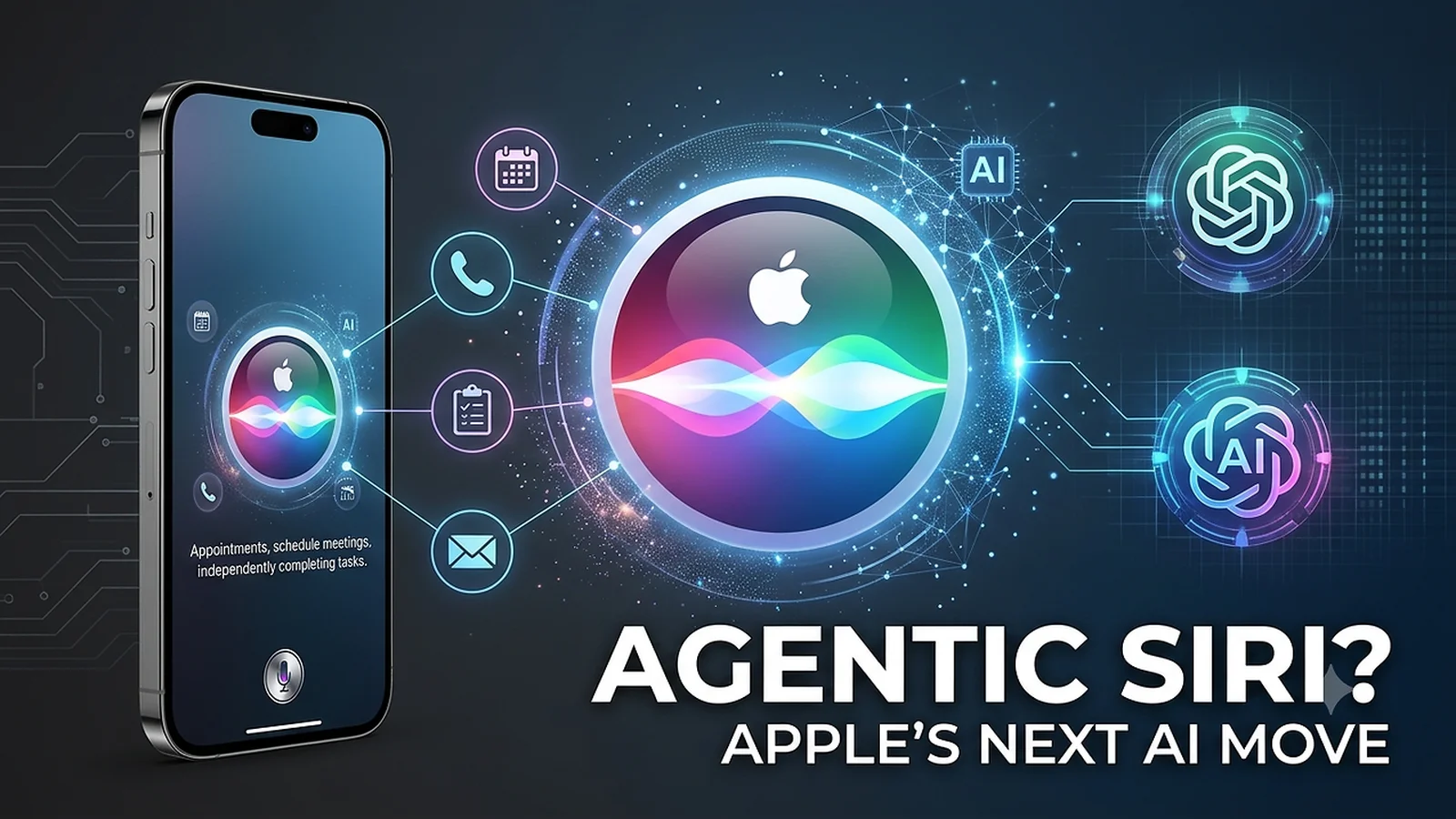
Apple is working on turning Siri into an AI agent that can keep track of goals and keep working on them without the user starting every step, according to a report by Bloomberg's Mark Gurman. The report, published in his Power On newsletter on 8 November and covered widely on 9 November, said Apple chief John Ternus has pushed software chief Craig Federighi to speed up the company's AI work. Apple has not announced anything, and it has not commented on the report.
What an agentic Siri would do
Gurman wrote that Apple wants Siri to move past answering one question at a time. An agentic Siri would track a goal, work out what needs to happen next, and keep going until the task is done. The user would not need to start each step. Gurman compared the idea to AI agents from other companies, including ChatGPT Dots, Meta Muse and Grok. Those agents can run in the background, take on tasks handed to them, and carry out multi-step work across apps. Apple, the report said, wants Siri to work in a similar way. The report added that Ternus held a closed-door meeting with Federighi in recent weeks, and that he was frustrated by what Gurman described as a reluctance to embrace AI with the same urgency as competitors. The push from the top is meant to close the gap between Siri and rival assistants.
The timing, and what is confirmed
Gurman said he believes Apple could make Siri more like an agent as early as next year, meaning 2027. He framed the timing as his own expectation, not as an Apple announcement. Apple has not set a date for an agentic Siri, and it has not said which tasks such an assistant would handle. The report also gave nearer timelines for Siri features already in progress. Siri AI actions in Apple's own apps are expected to reach the public release in December, while support for third-party apps is expected only in spring 2027, and then only as a preview. A developer preview linking Siri AI with third-party apps was released in the iOS 27.3 beta. Siri AI, the rebuilt assistant, shipped with iOS 27 in September. The iOS 27.2 release added the ability to carry context between interactions and to draw on a wider range of personal context, including messages, notes and emails.
Apple overhauls how it builds iOS
The report also said Apple has changed how it develops its operating systems. For the next generation, iOS 28, Apple has split development into three stages called M1, M2 and M3, each lasting eight weeks. The M1 stage is divided into two four-week sprints. For the M1 stage of iOS 28, engineers have been given six weeks to code and explore, and two weeks to converge. The change gives engineers more time to build and test new features before the code is locked down, and it is part of the same push to move faster on AI. Gurman also noted that Apple has built frameworks such as App Intents, which tie apps and system features to Siri. Those frameworks could let Apple build agent features without relying as heavily on the computing-heavy automation that other agents use, which could keep costs down.
Why Apple is under pressure
Apple shipped its long awaited personalised Siri with iOS 27, meeting goals it had set in 2024. But rivals have moved faster on agents that act on their own, and Apple is now seen as playing catch-up in the most visible part of AI. The report said Apple has little choice but to move in this direction, given what users now expect from assistants. Whether the agentic Siri arrives in 2027 will depend on how quickly Apple can build it, and on whether the features work well enough to ship. Until Apple says so itself, the 2027 timing remains a report, not a plan.