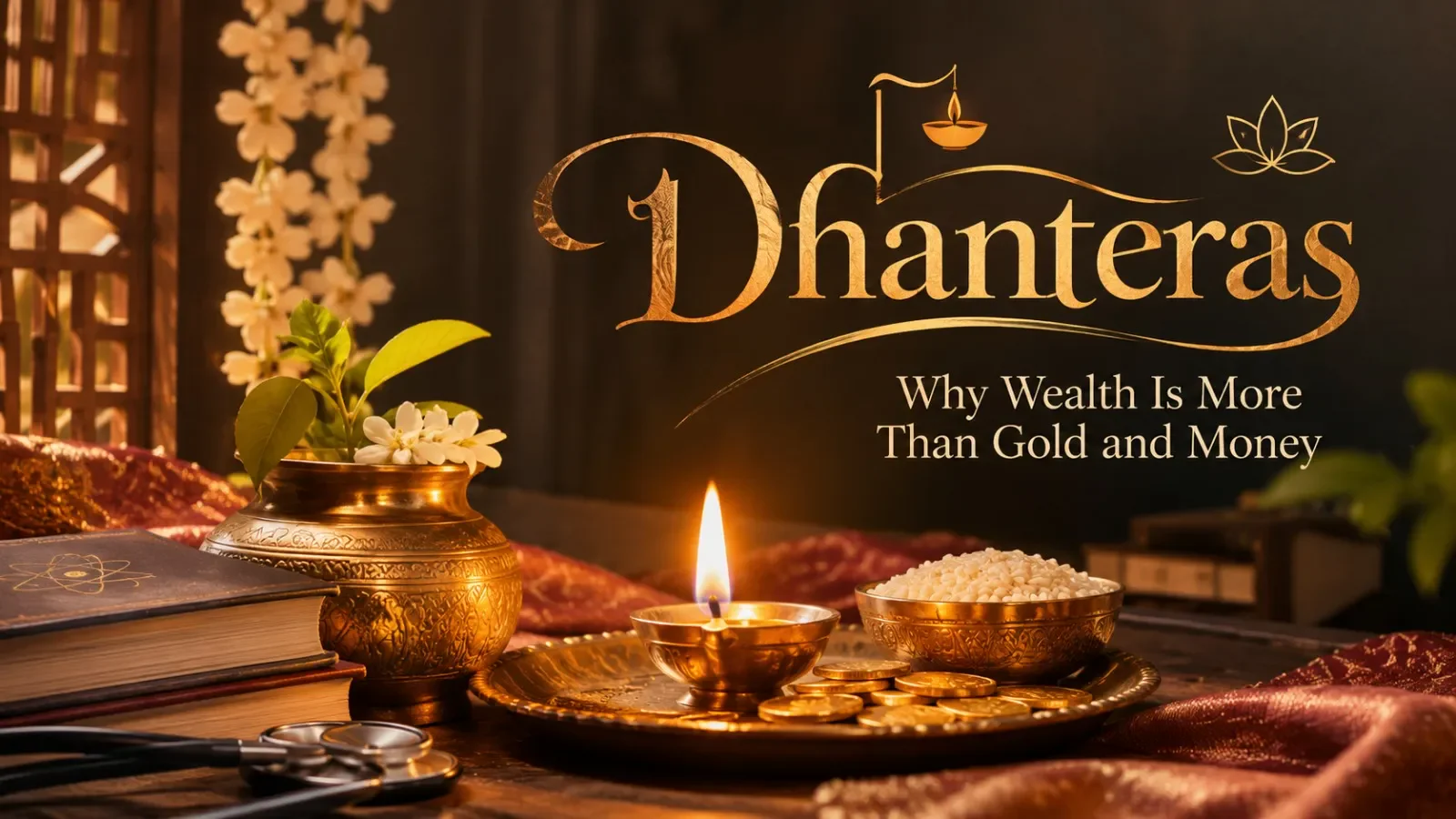
Across India, Dhanteras arrives with a familiar excitement. Jewellery shops prepare for crowds, families visit markets, new utensils find their way into kitchens, and homes glow with the light of diyas.
For some, it is an occasion to purchase gold or silver. For others, it means buying something small for the home, offering prayers or spending time with loved ones.
But consider three families celebrating Dhanteras.
One brings home an expensive gold necklace. Another buys a simple steel vessel. A third cannot afford to purchase anything at all but lights a diya and shares a meal together.
Which of these families has truly celebrated prosperity?
It may seem like a strange question during a festival so closely associated with wealth. Yet it brings us to something worth thinking about.
Money is important. Gold has value. Financial security matters. But are these the only things that make a person wealthy?
Perhaps, in our enthusiasm for celebrating wealth, we have gradually narrowed our understanding of what wealth actually means.
Why Do We Celebrate Dhanteras?
Dhanteras, also known as Dhantrayodashi, marks the beginning of the traditional five-day Diwali festivities. It falls on the thirteenth lunar day, or Trayodashi, of the dark fortnight in the Hindu calendar.
In 2026, Dhanteras is celebrated on Friday, November 6.
The word Dhan means wealth, while Teras refers to the thirteenth day.
The festival is associated with Goddess Lakshmi, who represents prosperity and good fortune; Lord Kubera, associated with riches; and Lord Dhanvantari, revered as the divine physician and associated with health and Ayurveda.
According to Hindu tradition, Dhanvantari emerged during the Samudra Manthan, or churning of the cosmic ocean, carrying a vessel of amrita, the nectar of immortality.
Many families worship Lakshmi and Kubera, purchase gold, silver or household utensils, and light a lamp for Yama, the deity associated with death, as part of prayers for protection and long life.
These customs vary across regions and families, but they share a concern for human well-being.
And there is something remarkable here.
A festival so strongly associated with acquiring wealth also honours a divine physician.
Health is not an unrelated addition to Dhanteras. It is part of the festival's religious and cultural meaning.
That alone should encourage us to look beyond money when we speak about prosperity.
When Did Wealth Become Almost Synonymous With Money?
Ask someone what makes a person wealthy, and the answers often begin with money, property, gold, investments and possessions.
There is nothing surprising about this. Material resources influence almost every aspect of modern life.
Money helps pay for education, healthcare, housing, food and the countless necessities of everyday living. For families living with financial uncertainty, building savings can mean greater independence and peace of mind.
In India, gold also carries meanings that go beyond luxury. For generations, families have treated it as a form of savings, a valuable asset and something to pass on to the next generation. A small gold ornament may represent years of careful saving rather than extravagance.
So the problem is not that people value money or gold.
The problem begins when we treat financial wealth as the entirety of wealth itself.
Over time, festive advertising, shopping campaigns and social expectations can make the purchase of something valuable appear almost inseparable from the celebration.
A festival of prosperity can begin to look like a festival of purchasing power.
But a person can have an impressive bank balance and still struggle with loneliness, illness or a lack of purpose.
Another person may possess little material wealth but have knowledge, meaningful relationships, good health and a strong sense of belonging.
Neither situation tells us everything about the quality of a human life.
Wealth is more complicated than a number in a bank account.
What Is Wealth Beyond Money and Gold?
If we move beyond the narrow financial definition, wealth can be understood as the valuable resources, capabilities, relationships and conditions that help people live meaningful, secure and fulfilling lives.
These forms of wealth are different. They are not always interchangeable, and many cannot be assigned a meaningful market price.
Financial wealth provides the means to meet our needs, support our families, prepare for emergencies and exercise greater independence.
Health wealth includes physical well-being, mental health and the ability to live without preventable suffering. Medical care, nutrition, rest and a healthy environment are essential to it.
Intellectual wealth includes knowledge, education, wisdom, creativity, scientific understanding and the ability to think critically. It allows individuals and societies to solve problems and develop new possibilities.
Social wealth exists in relationships, friendships, family support, community cooperation and trust. It matters when people face difficulties that money alone cannot resolve.
Time wealth means having meaningful control over one's time: the freedom to rest, learn, pursue interests and spend time with people who matter.
Cultural wealth lives in languages, literature, art, music, traditions, collective memory and the knowledge passed between generations.
Natural wealth includes clean air, fertile soil, water, forests, biodiversity and functioning ecosystems. Human prosperity cannot be sustained without them.
There is also the wealth of freedom, dignity, safety, opportunity, compassion and peace.
These are not merely poetic descriptions of wealth. They are real dimensions of human well-being, even if economists, philosophers and social scientists may classify them differently.
Money can help us access many of these things, but it does not automatically provide them.
A person cannot simply purchase genuine friendship. A society cannot replace a destroyed forest merely by counting its financial assets. And years of lost time cannot be deposited back into an account.
Money is a component of wealth. It is not wealth in its entirety.
Indian Traditions Have Long Recognised Different Forms of Prosperity
The idea that wealth extends beyond money is not necessarily a modern reinterpretation of Indian culture.
Within Hindu traditions, Lakshmi is associated with several dimensions of prosperity.
In traditions concerning Ashta Lakshmi, the eight manifestations of Goddess Lakshmi, different forms represent different aspects of abundance.
These include Dhana Lakshmi, associated with material wealth; Dhanya Lakshmi, associated with grain and agricultural abundance; and, in widely followed versions of the tradition, Vidya Lakshmi, associated with knowledge and learning.
The exact groupings and interpretations vary across traditions, but the broader idea is meaningful: prosperity is not represented solely through coins or jewellery.
Consider what these forms signify.
Grain sustains life. Knowledge enables understanding. Courage helps people face uncertainty. Material resources provide security.
Each serves a different human need.
An agricultural family praying for a good harvest, a student hoping to complete an education, a patient wishing to recover from illness and a worker hoping for stable employment are all seeking forms of prosperity.
Their wishes may be different, but none is inherently less important simply because it cannot be measured in gold.
Why Don't We Celebrate Knowledge With the Same Enthusiasm?
This leads to another question.
We celebrate wealth with festivals, special purchases and elaborate advertisements. But how often do we celebrate the acquisition of knowledge with comparable enthusiasm?
A student understanding a difficult mathematical concept, a teacher helping someone read for the first time, a scientist making a discovery or a researcher challenging an established assumption may not generate the spectacle of a festive gold purchase.
Yet their contributions can be extraordinarily valuable.
Knowledge has an unusual characteristic.
A piece of gold changes ownership when it is given away. Knowledge, however, can be shared without the original holder necessarily losing it.
A teacher can educate hundreds of students while retaining their own understanding. A scientific discovery can become the foundation for further discoveries. An idea developed in one generation can improve the lives of generations yet to come.
Of course, knowledge alone cannot solve every problem. Education requires resources, and intellectual opportunity is often shaped by economic inequality.
Still, knowledge is among the resources that allow humanity to expand what is possible.
The medicines that save lives, the engineering that makes buildings safer, the agricultural advances that help feed populations and the technologies connecting people across continents all depend on accumulated human understanding.
If these achievements are not forms of wealth, what are they?
Perhaps we need to celebrate the creation and sharing of knowledge more visibly, not only on ceremonial occasions but in everyday life.
That need not mean replacing traditional festivals. It can mean broadening the values we recognise within them.
Is It Fair to Celebrate Wealth When So Many People Struggle Financially?
Celebrating prosperity is not inherently wrong.
Wanting a secure home, adequate savings, a comfortable life or a better future for one's children is entirely reasonable.
For someone who has experienced poverty, financial stability is not an empty symbol. It can mean freedom from hunger, protection against emergencies and the ability to make choices without constant fear.
We should not romanticise poverty or suggest that people without money ought to be satisfied with knowledge and relationships alone.
A family struggling to afford medical treatment needs accessible healthcare and financial support, not merely the reassurance that health is the greatest wealth.
Material security is essential.
The concern is different.
When a celebration of prosperity becomes overwhelmingly associated with spending, it can create an uncomfortable distinction between those who can participate through purchases and those who cannot.
Festivals should not become tests of purchasing power.
A person who cannot afford gold has not failed at Dhanteras. A family that chooses not to buy anything is not necessarily less prosperous in every meaningful sense.
The value of a celebration should not depend on the price of what someone brings home.
This distinction matters in a country as economically diverse as India, where households experience prosperity and hardship in profoundly different ways.
It is possible to appreciate the traditions of Dhanteras while also questioning the pressures of consumerism.
In fact, such reflection may help preserve the festival's meaning rather than diminish it.
What If We Celebrated Every Form of Wealth This Dhanteras?
Imagine observing Dhanteras not only as an occasion to welcome financial prosperity but also as a moment to recognise the different forms of wealth already present in our lives.
Someone might buy gold because it represents financial security for their family.
Someone else might purchase a book and begin learning something new.
A family might prioritise a long-overdue health checkup, spend an evening together without distractions or help a child access educational resources.
A community might support a struggling neighbour, acknowledge the work of teachers and healthcare workers, or care for a shared public space.
None of these gestures needs to replace religious observances or established customs.
They simply offer additional ways to think about prosperity.
A diya can be lit with gratitude for good health. A prayer can include the hope that every child receives an education. A festival gathering can become an opportunity to reconnect with people who have grown distant.
And a family that has enjoyed financial success can celebrate it while remembering that prosperity also carries responsibilities toward others.
These choices may not produce the spectacle of a jewellery purchase, but they reflect values worth preserving.
The Real Meaning of Prosperity
There is something deeply human about wanting prosperity.
People want their families to be safe. They want freedom from uncertainty, opportunities for their children, comfortable homes, healthy lives and the ability to look toward the future with hope.
Money plays an important role in achieving many of these things.
But prosperity is ultimately larger than the financial tools used to pursue it.
A society filled with expensive possessions but lacking accessible education, affordable healthcare, clean air and mutual trust cannot reasonably be considered prosperous in every sense.
Likewise, individual wealth tells us little about the well-being of a community if opportunities remain inaccessible to large sections of its population.
A richer understanding of wealth should therefore include not just what individuals can accumulate, but what people can experience, contribute and share.
That is an important distinction.
Because the wealth of a nation is not measured only through the gold stored in its vaults or the money moving through its economy. It is also reflected in the health of its people, the education of its children, the strength of its institutions, the creativity of its citizens and the condition of its environment.
These things deserve protection, investment and celebration.
This Dhanteras, Perhaps We Can Ask a Different Question
Dhanteras does not need to stop being a festival of wealth.
But perhaps we can allow the meaning of that word to grow.
Celebrate the gold if you wish. Value your savings. Work toward financial independence. There is nothing wrong with wanting material prosperity.
At the same time, celebrate the knowledge you have gained, the people who stand beside you, the health that allows you to live fully and the opportunities that help you move forward.
Remember those who have less, and recognise that a meaningful celebration need not require a purchase.
A festival rooted in prosperity can also be an occasion to reflect on what prosperity should mean for everyone.
After all, when we wish someone wealth, what do we really want for them?
More gold? A larger bank balance? Or a life with security, health, knowledge, dignity, freedom and happiness?
Perhaps the answer is not to choose between them, but to remember that they are not the same thing.
Money is only one component of wealth, not wealth itself in its entirety.
And perhaps that is a thought worth carrying into Dhanteras, long after the shopping is over and the diyas have gone out.