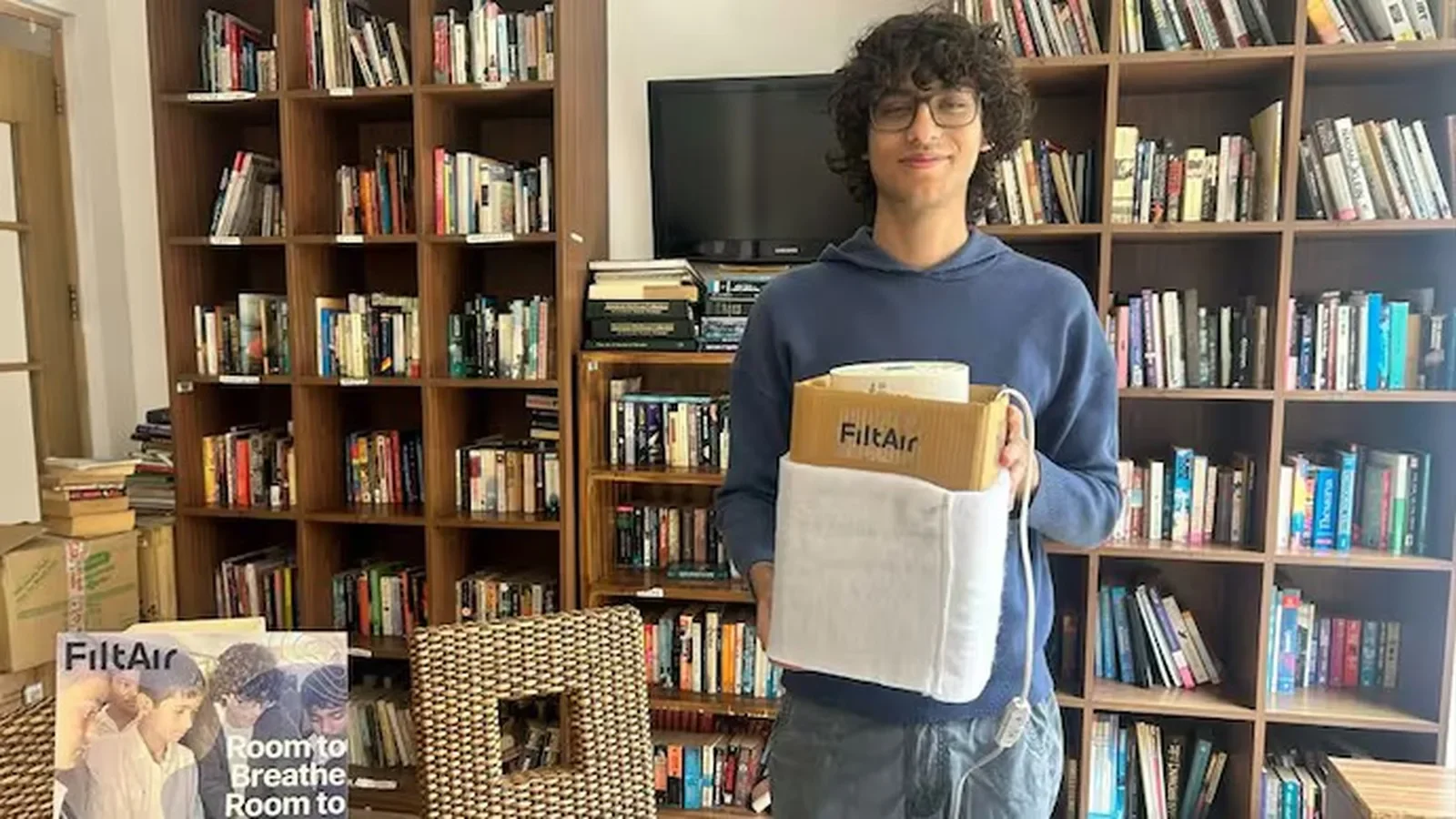
Two Delhi teenagers have found a way to turn an ordinary classroom fan into an air purifier for Rs 140. Their tests suggest it can sharply cut fine-particle pollution, and they say thousands of students are already using the filters.
Krish Aggarwal, a Class 12 student at Sanskriti School, and Samarth Meattle, a Class 11 student at Vasant Valley School, are the founders of Project Vayu. Krish has been named to the 2026 Diana Award Roll of Honour for the initiative.
The idea came from growing up in a city where toxic air has become a winter reality. The two said what bothered them was that some schools could buy air purifiers while thousands of students in under-resourced schools simply sat in the same air all day with nothing. They wanted to fix that.
A Fan, An Elastic Band And Rs 140
The teenagers decided they did not need to build an expensive purifier from scratch. Their solution uses something almost every classroom already has: a fan.
The filter fits over a table or wall fan and is secured with an elastic band. Switch on the fan and the material inflates like a balloon as air passes through it. The filter uses electrically charged fibres that trap tiny particles, including PM2.5, which can enter deep into the lungs.
No tools, no rewiring and less than a minute to install, according to the founders. Each filter costs Rs 140 to make but is provided free to schools. The duo credit filtration company Hollingsworth and Vose for supplying the material without charge, and the project says the company supplied 700 metres of filter media for the work.
The filters need replacing two or three times during the winter pollution season. They start out white and turn grey or even black after a few weeks of use, which makes the pollution they have trapped visible.
How Well Does It Work?
The teenagers say independent and external testing, along with research conducted with Hollingsworth and Vose, has shown encouraging results. In a closed room measuring roughly 200 square feet, PM2.5 levels fell from 158 to 11 micrograms per cubic metre within an hour, a reduction of more than 90 per cent.
But the results depend on classroom conditions. In a larger room, one filter brought PM2.5 levels down by around 60 per cent in an hour, they said. Keeping doors open can also reduce its effectiveness. These are the founders' reported test results and do not guarantee identical performance in every classroom.
Project Vayu began with a pilot covering 295 classrooms and around 8,000 students, with 602 filters installed. The founders say they have since expanded to 10 schools and several under-resourced medical clinics, reaching approximately 20,000 students. They now want to take the idea to Delhi's government schools and eventually to other parts of India.
The timing matters. Delhi's 24-hour average air quality index stood at 313 on Wednesday, in the very poor category, and Stage III pollution curbs remain in force. At just Rs 140 per filter, the founders say, it is a solution that could be scaled without major infrastructure investments.