
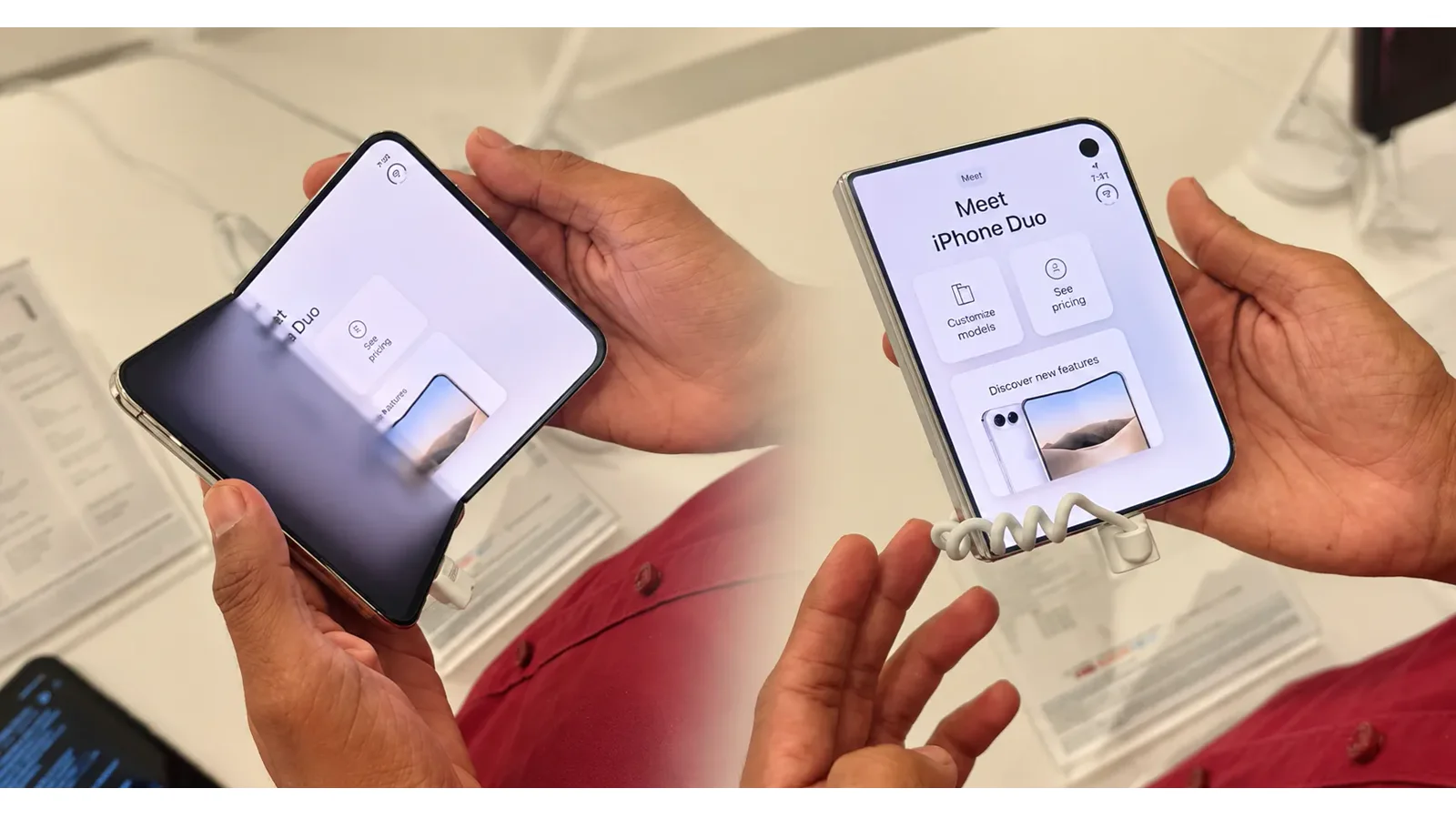
Apple's first foldable phone is here. It costs $1,999 in the United States for 256 GB of storage, which is $100 more than the Galaxy Z Fold 8 and roughly double the cost of an iPhone 18 Pro. For that, you get a phone shaped like a passport when closed, with a 5.4-inch outer display that opens sideways into a 7.6-inch inner display, a grade 5 titanium frame, the A20 Pro chip from the iPhone 18 Pro, and two 48MP rear cameras, but no dedicated telephoto lens.
The reviewer, who had pre-ordered the phone and used it for more than a week at home, around London and on a trip overseas, says this was the most excited he had been for a new smartphone in years. The Duo is one of the first iPhone models in years that fans camped out for, and in his view it lives up to expectations. The passport shape suits a foldable much better than the tall book style most other devices use, the nano-texture inner display handles the crease better than anything else on sale, and Apple's software immediately outclasses eight years of foldable Android phones.
Design, hinge and durability
Closed, the Duo measures 117.8mm tall and 84.1mm wide, making it 45.6mm shorter than an iPhone 18 Pro Max but 6.1mm wider. Folded it is 11.3mm thick, and open it is just 5.2mm thin, which undercuts the iPhone Air. At 254g it is the heaviest iPhone Apple has ever made, heavier than the 249g iPhone 18 Pro Max, the 239g Pixel 11 Pro Fold and the 201g Galaxy Z Fold 8, though coming from a Pro Max the weight was not particularly noticeable, and unfolded the larger screen spreads it out.
Apple put Touch ID in the power button instead of Face ID, with the button slightly raised so a thumb can find it, and several fingers can be enrolled for different grips. After initial setup it rarely caused problems, but Face ID remains the better system: notifications no longer expand on a glance, the display does not hold off dimming while reading, Apple Pay takes a beat longer, and gloves cause trouble. The volume buttons moved to the top edge, Camera Control sits well for landscape shooting but too low in portrait, and the programmable Action Button is missing.
The hinge uses more than a hundred components with a variable torque profile, holds its position at essentially any angle between 15 and 165 degrees, and opens completely flat at 180 degrees. Magnets make opening a two-handed job in most situations, while closing is easier as the magnet array pulls the halves together with a satisfying clap. The Duo also carries an IP68 water and dust rating, submersible in 6 meters of water for up to 30 minutes, which no first-generation foldable has managed before. Ceramic Shield 2 protects the outer display and is three times more scratch-resistant than the first version, while the inner display's matte nano-texture polymer layer is up to 40 percent stiffer than the industry standard for foldables. If the inner cover layer is damaged it can be replaced on its own for $49, or $19 with AppleCare+, and Apple is replacing a small number of units affected by cracks in the lower half of the display along the hinge.
Two displays and a crease you cannot feel
The 5.4-inch outer display delivers 90 percent of the screen area of an iPhone 18 Pro thanks to its 1.4:1 aspect ratio, with more horizontal room but less vertical space. It runs 120 Hz ProMotion, supports the Always On Display, and reaches 3,000 nits outdoors. It is big enough to run full apps properly, and it is where the reviewer spent most of his time, with messages, emails, reminders, reading and the camera all easy to use, and one-handed swipe typing more comfortable than on any recent iPhone because the wider keyboard shortens thumb travel. The keyboard does occupy close to half the display's height while typing, and cookie banners and newsletter overlays can swallow almost the whole visible page on some websites.
Opening the Duo presents a 7.6-inch display, which Apple says is 50 percent larger than an iPhone 18 Pro Max and 80 percent larger than an iPhone 18 Pro, sharing the same 1.4:1 ratio so content scales without awkward resizing, again with 120 Hz ProMotion and 3,000 nits peak brightness. The nano-texture finish is the star, cutting reflections so the display stays readable in bright sunlight where glossy foldable displays turn into mirrors, and feeling a little like paper under the finger. The trade-off is contrast, with blacks slightly less inky and colours a little less punchy than the outer display. The under-display FaceTime camera sits in the top corner, with pixels above it switching off in use, and is mostly forgettable.
If you look straight at the inner display, the crease is more or less invisible, catching light slightly only at an angle on dark backgrounds, and more importantly you cannot really feel it. Running a thumb across the centre, the surface feels pretty flat, which the reviewer says no other foldable he has used manages. The inner display stacks more than 10 layers with high-strength glass above and below the folding panel and a titanium plate at the base, and one measurement put the crease at 48 microns on a brand-new unit, rising to 167 microns after 3,000 folds.
Performance, battery and cameras
The Duo runs on the A20 Pro chip, built on a 2nm process with a 6-core CPU, a 7-core GPU and a dual 16-core neural engine, scoring 4,002 single-core and 11,123 multi-core in Geekbench 7, level with Apple's slab flagship. Apple pairs the chip with a vapour chamber and flexible graphite layer across both halves, claiming up to 35 percent higher sustained performance than an iPhone 17 Pro, though the phone can get quite warm around the camera bump during gaming, video recording and heavy setup. Apple's own C2 modem held a connection and loaded a website in an underground station where most flagships struggle, and Wi-Fi 7, Bluetooth 6 and satellite messaging are included.
The 4,883 mAh battery is spread across two cells, one in each half, rated for up to 44 hours of video playback on the outer display, 31 hours on the inner display and 24 hours of mixed use. In reality the reviewer got 6 to 7 hours of screen-on time across a typical day, usually finishing with around 20 percent remaining, and kept himself occupied through a 7-hour hospital waiting room visit almost entirely on the outer display. Wired charging reaches around 60 percent in half an hour with a 45W adapter, Apple claims up to 50 percent in around 20 minutes with a 60W adapter, and MagSafe wireless charging runs at up to 25W. No charger comes in the box.
On the rear, the 48MP Fusion main camera at 26mm with a built-in 2x digital telephoto crop sits alongside a 48MP Fusion Ultrawide with the same lens as the iPhone 18 Pro. Photos come out detailed with natural colour and good highlight and shadow retention in daylight, but overall the camera feels closer to the iPhone 17 or iPhone Air than the iPhone 18 Pro, with more lens flare around lights and a softer look in comparison, and no variable aperture or ProRAW. The lack of a telephoto lens is the reviewer's biggest gripe: the 2x crop produces usable images, but beyond that detail falls apart, and portrait shots show more artificial background blur as the phone compensates. He says he will switch to the Duo full-time but keep carrying an iPhone 18 Pro Max for serious photography. The 12-megapixel Center Stage selfie camera on the cover handles portrait and landscape framing without rotating the phone, while the under-display inner camera is HD only and soft for stills, though fine for video calls. Video still looks good with 4K Dolby Vision up to 120 fps.
Software, rivals and verdict
The Duo runs iOS 27 rather than iPadOS, with lock screen controls, the dock and in-app navigation moved to the right-hand side, two home screen pages with Today view on the left in landscape, and a circular status module in the top-right corner that opens Control Center. The opening animation makes content look as though it was already there waiting to unfold, and Safari puts its URL bar at the bottom when folded like an iPhone and at the top when open like an iPad. Split View brings side-by-side apps to the iPhone for the first time by dragging the gesture bar towards either edge, but the split is locked at 50:50 with no resize option and no third app. Most daily apps handle the display properly, with Google Maps and Google Docs the notable exceptions. Apple Pencil support arrived in iOS 27.2 but only works with the USB-C Apple Pencil, and StandBy works even when the phone is not charging when the Duo is partially folded.
Against rivals, the Galaxy Z Fold 8 at $1,900 is lighter at 201g and thinner at 9.7mm folded, but drops to an IP48 rating, uses a glossy inner panel with a more noticeable crease, and also lacks a telephoto lens. The Pixel 11 Pro Fold at $1,899 keeps a conventional tall shape and opens into an almost square 8-inch panel, with a 5x telephoto lens making it the better camera foldable, though weaker battery life and a crease you can feel. The Galaxy Z Fold 8 Ultra at $2,100 keeps the tall book design with a 200MP main camera, and if cameras matter most, the iPhone 18 Pro takes better photographs for considerably less money.
The verdict is that the Duo is exactly what the reviewer wanted Apple's foldable to be: a smaller phone that opens up rather than a regular phone that unfolds into a big tablet. The outer display handles everything needed day to day, the inner one replaces an iPad for reading, email, light work and video, and the hinge, nano-texture panel and software polish are a step ahead of any Android foldable. The missing telephoto camera, Touch ID instead of Face ID, and a weak under-display camera for stills are the real compromises, but at $100 above the Galaxy Z Fold 8, the Duo feels considerably more premium, nothing about it feels plasticky, and after carrying it caseless it still looks new.