
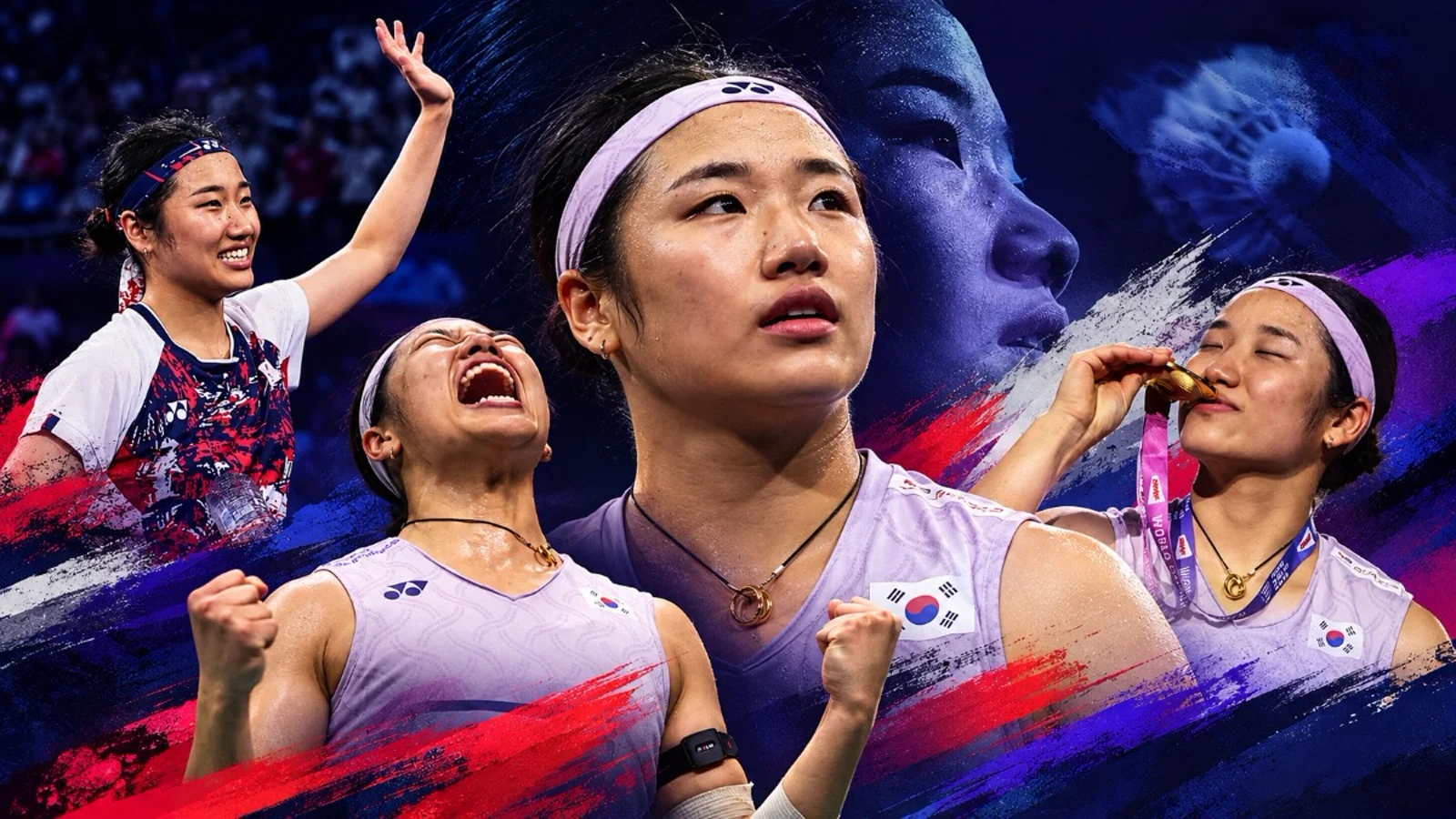
Peace is An Se Young's favourite English word, a choice with a certain irony for a player who gives her opponents so little peace on a badminton court. The 24-year-old South Korean retrieves the impossible, sends rivals scurrying from corner to corner, and almost never looks hurried. After losing to her in the World Championships semi-final in New Delhi in August, China's Wang Zhi Yi turned to her and asked the question everyone in the sport has been asking: how do I beat you?
The numbers behind that question are startling. After winning the Paris Open title in October, An stood at 66 wins from 67 matches in 2026, a win rate of 98.5 percent, with 50 victories in a row. Her only defeat came in the All England final in Birmingham in March, to Wang, ending a 37-match winning streak. Last season she won 73 of 77 matches, a success rate of 94.81 percent, with 11 titles. This year has brought 10 titles, one final defeat and one injury-hit Japan Open, interruptions that have barely disturbed the larger picture.
Her dominance is now measured differently by opponents. Reaching 11 points in a game against her counts as respectable, getting past 15 is an achievement, and taking a game off her means something special has happened. PV Sindhu offered a glimpse of what might be possible in the French Open final, taking the first game 21-16 with aggressive play, before An tightened, cut her errors and won the next two games 21-11 and 21-12, for an 11th win in 11 meetings with the Indian star.
A world title won without dropping a game
An arrived in Delhi for the World Championships without a month of competitive badminton behind her, after a foot injury ended her Japan Open in July, with the Asian Games a little over a month away. Her coaching team confirmed it was An herself who pushed to play, even though she did not feel at 100 percent. She left with the world title without dropping a game, beating Japan's Akane Yamaguchi 21-17, 21-14 in a final played before a full hall at the Indira Gandhi Indoor Stadium, despite no Indian reaching the finals. Five weeks later, in Ichinomiya, she became the first woman to defend the Asian Games singles title, beating Yamaguchi again, 21-17, 21-9, adding to the singles and team golds she won at Hangzhou.
Former chief national coach Vimal Kumar likens playing An to facing Rafael Nadal on clay, where opponents felt everything they hit would simply come back. He says she has the right mixture of strength and consistency, stays in long rallies and plays constructive rallies rather than merely returning the shuttle, and her length, deceptive clears from the back and flicks at the net, plus precise placement and anticipation, matter more than the absence of a big smash, which she places sharply and deceptively.
From defensive rally player to attacking force
An's rise was not a straight line. South Korean women's singles had long been associated with a defensive, rally-based style, and she initially looked cut from the same cloth. Senior badminton journalist Abhijeet Kulkarni, who first saw her play in 2019, recalls a completely defensive player, and says nobody before 2022 thought of her as the next big name. The change began around the Covid-19 pandemic, when An made herself attack even when it was costing her matches, understanding defence alone would not carry her at the highest level.
That transformation built the player she is today: one who can rally and attack, arriving early, settling her balance and playing without chasing the shuttle. Former India player Aparna Popat names footwork, stroke-making and temperament as the three pillars of her dominance, but says the real strength is how they fit together, with recovery between tournaments, physical and mental, described as absolutely incredible. Her coach Lee Hyun-il, a former South Korean men's singles star, has revealed she has worked with a mental consultant for more than a year and that the team is preparing her for a more attacking future, with power and weight training.
The greatest of all time question
Senior journalist Vinayakk Mohanarangan sees an almost machine-like player who has refined her approach over three or four years, choosing solidity over unnecessary variation and learning when to use her variety and when to resist something spectacular. He suggests troubling her would take a hypothetical combination of peak Tai Tzu Ying, for deception and variety, and Carolina Marin, for aggression and sustained pressure, each once in a generation. He has seen glimpses of it in India's Tanvi Sharma, 17, whose deceptive game made An think more than usual, even though Tanvi, then world number 24, lost to her at both the Denmark Open and the French Open this year, after leading 5-1 early in Paris.
Vimal is reluctant to place An among the greatest of all time just yet, arguing the current field lacks the depth of a decade ago, when China produced several world-class contenders and Tai, Marin, Ratchanok Intanon, Sindhu and Yamaguchi made a fiercely competitive tour. He is careful to separate that from criticism of An, calling her the outstanding player of her era. Her head-to-head records underline the point: she turned a 0-7 deficit against Chen Yufei into an 18-14 lead, leads Wang Zhi Yi 21-5, Sindhu 11-0 and Yamaguchi 24-15. After Olympic gold in Paris in August 2024, she also used the moment to publicly question the Badminton Korea Association over its handling of her knee injury, training practices and restrictions on athletes, reforms that followed gave players greater freedom over equipment deals, and she signed her own deal with Yonex in 2025. At 24, the most dominant player in badminton may still have her best years ahead of her.