
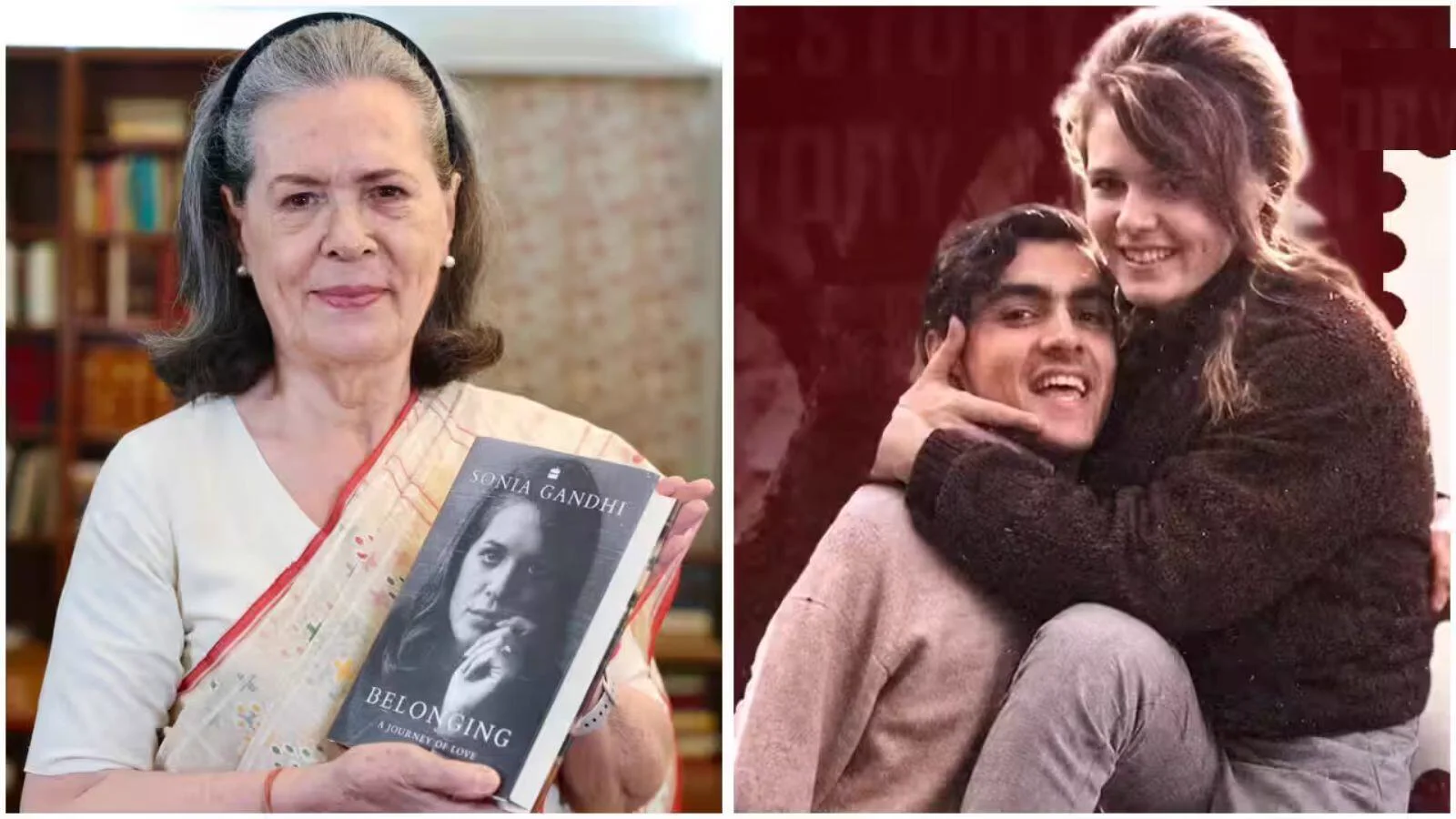
Congress Parliamentary Party chairperson Sonia Gandhi has opened a personal chapter of India's political history, revealing that she opposed her husband Rajiv Gandhi becoming Prime Minister. The disclosure comes in a short video she shared ahead of the publication of her memoir, Belonging: A Journey of Love.
In the video, shared on Instagram on Tuesday, Sonia Gandhi speaks about why she decided to tell her own story. She says that when Rajiv Gandhi was asked to become Prime Minister, she was completely against the idea. The short preview does not explain in detail what worried her most at that time.
That detail, she indicates, will become clear only when the book itself is read. The preview is deliberately brief, offering a glimpse of a private disagreement inside one of India's most prominent political families, without giving away the full account.
Sonia Gandhi's memoir covers her childhood in Italy, her move to India, her marriage to Rajiv Gandhi, and her life with the Gandhi family. Its title points to a journey shaped by love, family, relationships and belonging, and the Rajiv episode is presented as part of that personal story rather than as a political argument.
The moment Rajiv Gandhi took office
Rajiv Gandhi became Prime Minister after the assassination of his mother, Prime Minister Indira Gandhi, on 31 October 1984. The country was passing through a grave political crisis, and the responsibility came to him at a moment of national shock and grief.
Rajiv Gandhi had entered active politics before that, but the Prime Minister's office was a turning point in his life. He led the country through a period of major change, before he himself was assassinated during an election rally at Sriperumbudur in Tamil Nadu on 21 May 1991.
Sonia Gandhi's revelation adds a private dimension to that public history. It shows that a decision now recorded as a matter of national record was, inside the family, a source of disagreement and worry. Her opposition, as she describes it, was complete, not hesitant.
Why she decided to write her own story
In the video, Sonia Gandhi explains her decision to write the memoir in her own words. She says that for decades, other people have told her story, and that much of what was written was either incorrect or exaggerated. Now, she says, it is her turn to speak.
She has also acknowledged that the book may stir debate once it is published. In a post shared on X, she wrote that some commotion is bound to follow publication, adding that after decades of others telling her story, the turn is now hers.
That framing matters, because it presents the memoir as an act of reclaiming her own narrative. Sonia Gandhi has spent decades in public life, often as a subject of commentary, and the book is her attempt to set out her experiences as she remembers them.
When the memoir will be published
Sonia Gandhi began her Instagram account on 22 October, sharing the first glimpse of the book at that time. The memoir is set to be published on 10 November, when readers will be able to read the fuller account of her life and political journey.
The publication date gives the preview its timing. With less than two weeks to go, the short video has already drawn attention to the book and to the Rajiv episode in particular, which is likely to be among its most discussed passages.
For readers, the memoir promises a personal account rather than an official history. Its value will lie in what Sonia Gandhi herself chooses to reveal about private moments that shaped public events, and in how she explains decisions that have long been viewed only from the outside.