
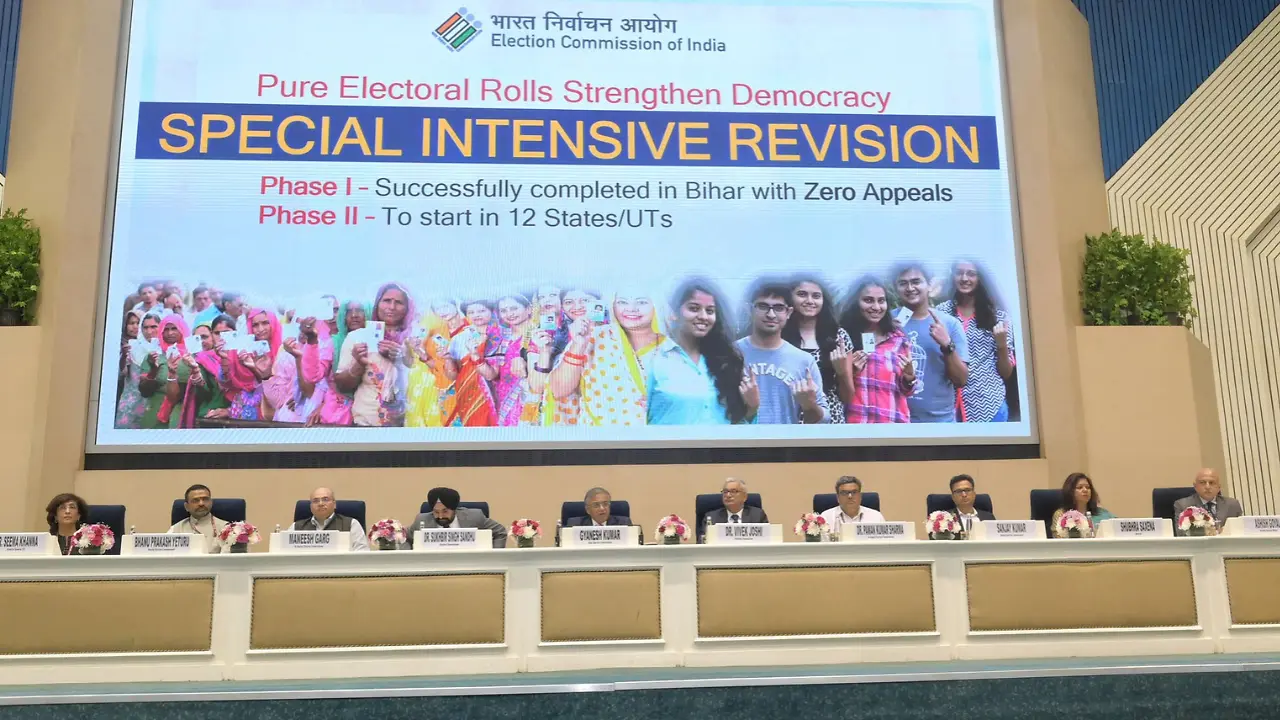
The Election Commission has revised the timetable for the Special Intensive Revision of electoral rolls in six states and union territories, giving voters and officials more time to complete the exercise. The revised schedule covers Maharashtra, Haryana, Andhra Pradesh, Delhi, Telangana and Nagaland, and it follows questions raised by the Supreme Court about the pace of the Delhi revision in particular.
Under the new timetable, the final electoral rolls for Maharashtra, Haryana, Andhra Pradesh, Telangana and Nagaland will be published on November 30. Delhi will follow later, with its final roll scheduled for publication on December 22. The split timetable is the most important change in the new order, because Delhi had previously been working to a much earlier cut-off.
The deadlines for deciding claims and objections have also moved. In Haryana and Andhra Pradesh, that work must be completed by November 20. Maharashtra and Nagaland have until November 25, Telangana until November 26, and Delhi until December 15. These are the dates by which disputed entries must be settled, so the extra weeks matter most to voters whose names were flagged during the revision.
The Commission has told officials to publicise the revised schedules widely, so that voters know the new dates and can take part in the process. That direction matters because a revision exercise only works if people who need to file claims, objections or enrolment applications know they still have time to do so.
Why the Supreme Court questioned the Delhi timetable
The extension follows a hearing on October 28, when the Supreme Court questioned the urgency behind the October 30 deadline for filing claims, objections and enrolment applications in Delhi. Chief Justice Surya Kant pointed out that no election is due in Delhi soon, and urged the poll panel not to insist on an early cut-off for voters seeking to be included again.
The Chief Justice said, in plain terms, that there was no immediate election in Delhi and that things should not be done in a hurry. He also asked the Commission to reach out to voters and encourage them to submit the relevant forms, adding that the simplest remedy should be chosen for people trying to get back on the rolls.
That exchange is the reason the Delhi dates moved the most. Where other states gained days or weeks, Delhi gained a final publication date in late December, giving the capital's revision exercise a materially longer runway than the one it had before the hearing.
What the Commission said it would consider
During the hearing, the Commission indicated that it was willing to extend the deadline if required, and said it would consider accepting late enumeration forms. That assurance, combined with the revised orders dated October 29, gives voters who missed the earlier cut-off a realistic second chance to be heard.
The practical effect is straightforward. A voter in Delhi who was left off the draft roll, or whose entry was flagged for a discrepancy, now has until the revised disposal deadline of December 15 for that claim to be decided, with the final roll following a week later. In the other five states and territories, the corresponding decisions will be completed by late November.
The orders also underline a wider point about the revision process. The exercise is meant to clean the rolls without removing genuine voters, and speed alone is not a measure of success. By slowing the Delhi timetable, the Commission has accepted, in effect, that accuracy and inclusion matter more than meeting an early date.
What voters should do now
For voters, the message is simple: check your entry, and if it is missing or wrong, file the claim or objection before the revised deadline for your state. In Haryana and Andhra Pradesh that means acting well before November 20, in Maharashtra and Nagaland before November 25, in Telangana before November 26, and in Delhi before December 15.
Officials, meanwhile, are expected to make the new dates public and to help voters complete the process, rather than leaving them to discover the change by chance. How well that publicity works will decide whether the extension actually protects voters, or simply moves the same confusion to a later date.
For now, the revised schedule stands as the latest word on the revision timetable. Any further change would need a fresh order, and voters should follow the dates in the October 29 orders until one appears.