
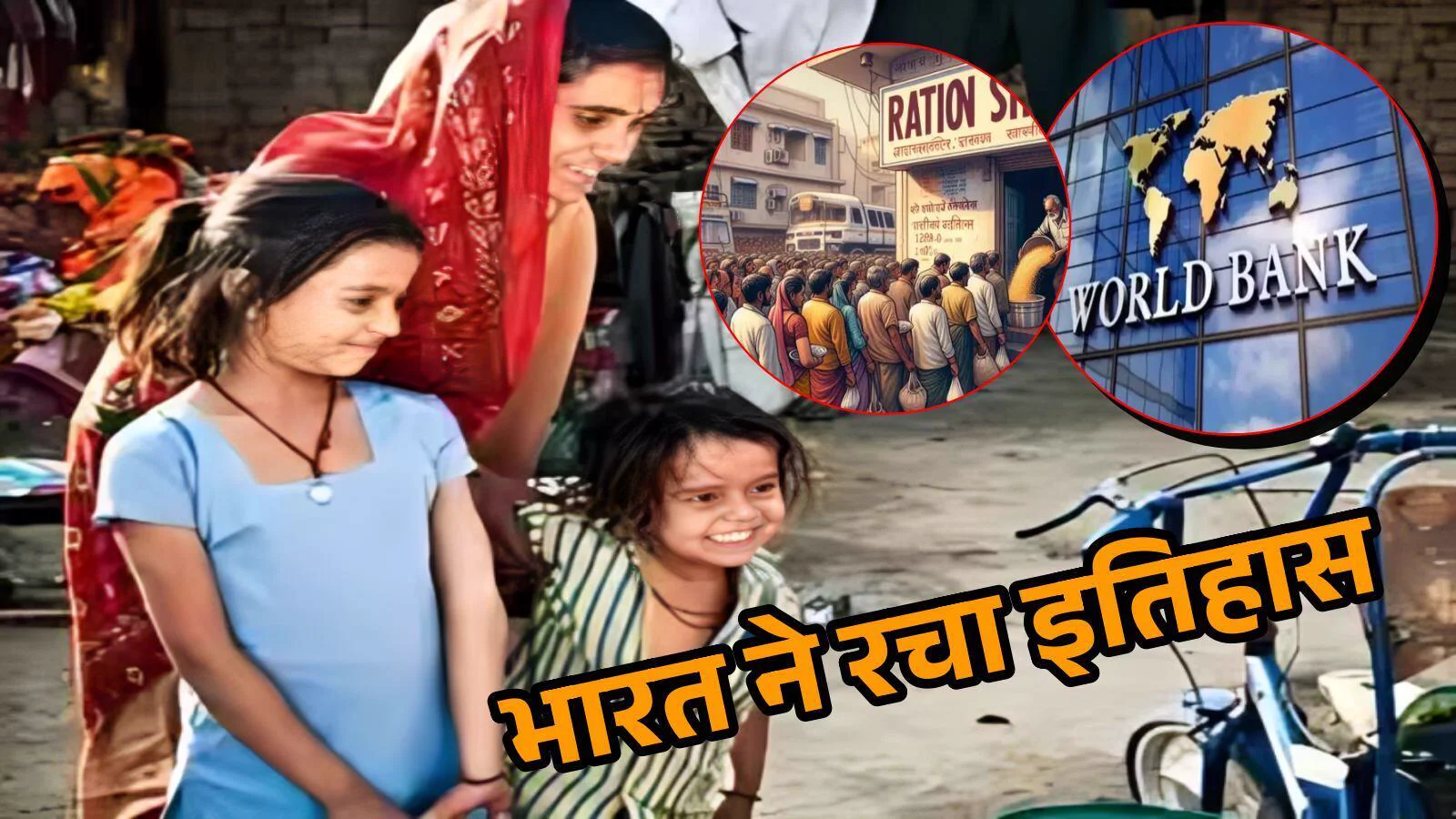
India has recorded a historic fall in poverty, according to the World Bank's October 2026 Poverty and Equity Brief.
The report says India moved faster than any other country in the world on poverty reduction, lifting nearly 49.6 crore people out of extreme poverty in 12 years, between 2011 and 2023.
During this period, the extreme poverty rate fell from 27.1 percent to just 2.6 percent.
Progress beyond extreme poverty
The improvement goes beyond the extreme poverty line. The share of people living below the lower-middle income threshold, set at 4.20 dollars per person per day, fell from 57.7 percent to 16.1 percent.
Multidimensional poverty, which looks at health, education and living standards together, also improved sharply, falling from 53.8 percent in 2005-06 to 15.5 percent in 2022-23.
These figures together show a broad improvement, not just a change on one measure.
What drove the fall
The report gives much of the credit to strong consumption growth, rising employment with growing participation of rural women, and effective implementation of schemes such as free ration subsidy.
Together, these forces raised household spending power and gave poorer families a more secure base.
The combination of growth and welfare delivery is presented as the key reason the fall in poverty was so large and so fast.
Challenges that remain
Despite this progress, the report points to serious employment and regional challenges that India still faces.
Nearly 57 percent of the country's poor population is concentrated in the belt stretching from Uttar Pradesh to West Bengal.
Between 2017 and 2023, nearly 13.4 crore jobs were created, but the unemployment rate still rose slightly, and most of the new jobs were in low-productivity sectors.
Real earnings have seen little growth, which means the UP to Bengal belt urgently needs more productive employment, not just more jobs.
The world's poorest countries
On the other side of the story, Global Finance's 2026 figures show that the world's poorest countries remain trapped in a cycle of hunger and poverty.
Despite having resources, 9 of the 10 poorest countries are in Africa, hit by war, corruption, climate crisis and cuts in foreign aid.
Burundi is the world's poorest country, with GDP per capita on a purchasing power basis of 994.23 dollars, followed by the Central African Republic at 1,437.72 dollars and South Sudan at 1,467.19 dollars.
Next in the list are Yemen, Mozambique, Malawi, Somalia, Liberia, Madagascar and the Democratic Republic of the Congo, with Niger, Afghanistan, Sudan, Solomon Islands, Haiti, Burkina Faso, Lesotho, Chad, Guinea-Bissau and Mali completing the 20 poorest.
International analysts say long-running wars, corrupt governance, weak rule of law, colonial exploitation and severe climate conditions have combined to stall the growth cycle in these countries.