
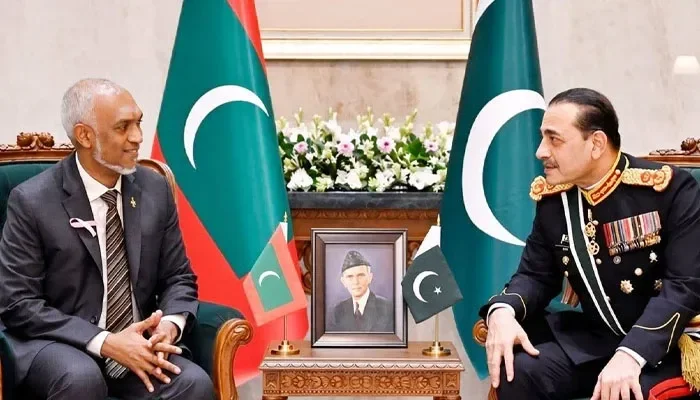
Three days, twenty agreements and one closely watched meeting with the army chief: Mohamed Muizzu's state visit to Pakistan from October 20 to 22 has set off a fresh round of debate about where the Maldives is heading and what it means for the Indian Ocean.
The Maldivian president met Prime Minister Shehbaz Sharif and Field Marshal Asim Munir in Islamabad. The paperwork exchanged between the two governments ranged across defence, maritime security, trade, education and more. For India, which watches this stretch of ocean closely, the visit was always going to draw attention.
Why the Munir Meeting Matters
Muizzu's sit-down with Asim Munir was the visit's most sensitive engagement. Pakistan's military said the two discussed bilateral ties, the regional security picture and ways to deepen defence cooperation, with both sides backing stronger institutional links and professional exchanges between their forces.
The Maldives sits astride some of the busiest shipping lanes in the Indian Ocean, carrying a huge share of world trade and energy. Any defence conversation involving Male therefore lands differently than it would for a landlocked state.
Twenty Pacts, One Ambitious Trade Number
The 20 memorandums of understanding covered defence cooperation, maritime security, healthcare, education, technical training, tourism, agriculture, fisheries and law enforcement. Alongside them came a striking target: take two-way trade from about $13.4 million today to $200 million within two years.
Paper, though, is only the first step. Whether the defence parts of this package matter strategically will depend on what actually follows: training, patrols, equipment, people on the ground.
India's Stake in the Maldives
New Delhi's interest is structural, not sentimental. The Maldives lies in India's southwestern maritime neighbourhood, close to key sea lanes. The two countries share deep links in development projects, trade, healthcare, disaster relief and security, and India has repeatedly been the first responder when the islands needed emergency help.
So a Maldivian opening to Pakistan naturally gets read in Delhi through a strategic lens. But reading the visit as Male joining an anti-India alignment goes beyond what the evidence currently shows.
Drift Towards Pakistan, or Hedging by a Small State?
The honest answer is that one visit cannot settle the question. Maldives-Pakistan ties go back to 1966, and both governments framed this trip as strengthening an existing relationship, not inventing a new one.
Muizzu's government talks about engaging widely and multiplying development partners. For a small island state, spreading partnerships across trade, tourism, education and security is a familiar survival strategy. The test of any real shift will be implementation: whether defence clauses turn into joint activity and sustained military contact.
A Call to Wake SAARC Up
Muizzu also used the visit to push for reviving SAARC, the South Asian bloc whose last summit was in Kathmandu in 2014. A working SAARC could reopen channels on trade and connectivity, but its paralysis has always run through India-Pakistan tensions, and thawing that will take more than a visiting president's appeal.
What to Watch From Here
The visit is best filed, for now, as a significant diplomatic development rather than a power shift. If the pacts produce real defence and maritime cooperation, the assessment changes. India's own engagement with Male, economic, humanitarian and maritime, remains its strongest counterweight, and the Maldives will keep balancing its growing list of partners against its own interests.